How to Fact-Check AI Content Before You Publish It
How to Fact-Check AI Content Before You Publish It Your AI tool hands you a finished draft in minutes, and every stat in it sounds like…
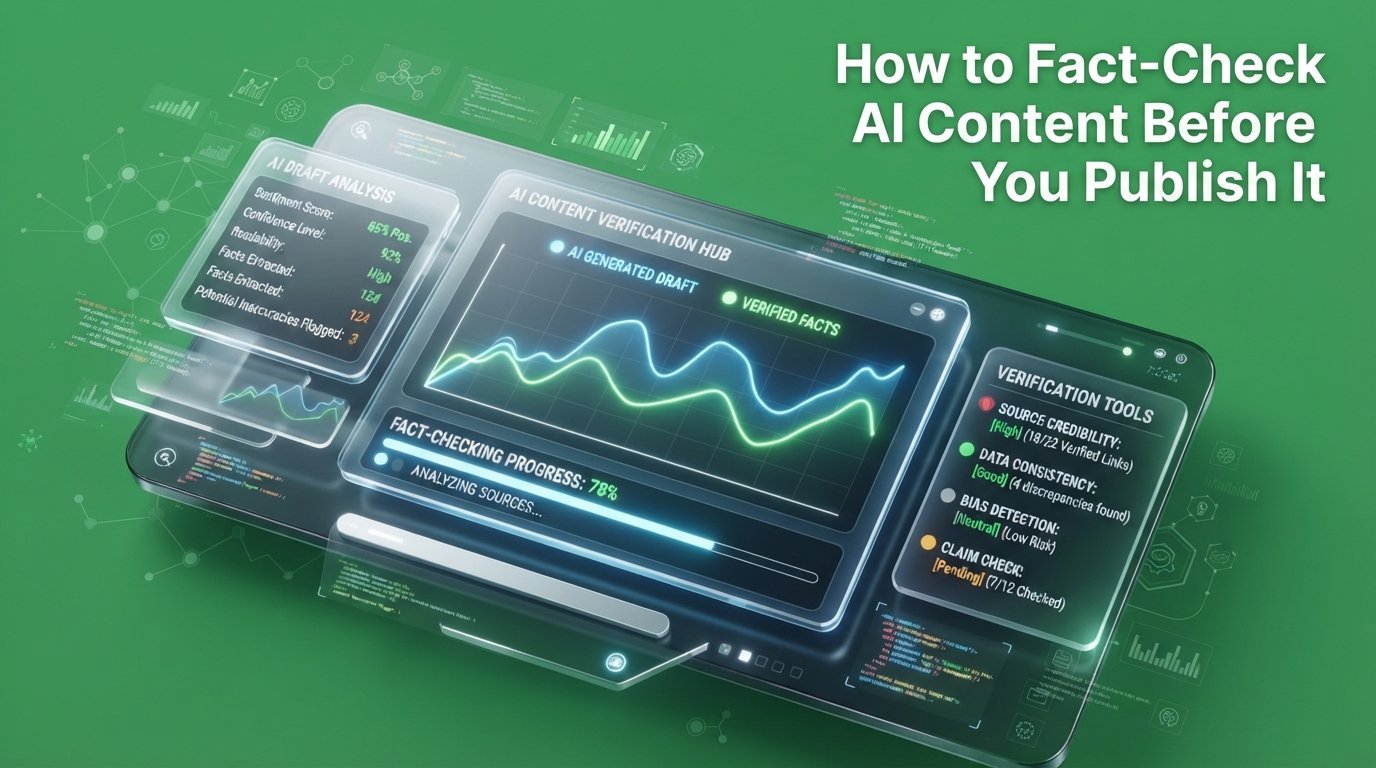
Your AI tool hands you a finished draft in minutes, and every stat in it sounds like it came from somewhere. Your team skims it, fixes a comma and hits publish. That isn’t editing, it’s hoping. To fact-check AI content, treat every number, name and date as guilty until a primary source clears it, and know that Google’s own guidance now says the same.
AI accelerates draft creation, but publishing without verification jeopardizes your brand’s reputation. At “TheMayk”, we pair high-speed AI copy with rigorous human editing to safeguard your authority. By implementing our six-pass fact-checking workflow verifying primary sources, auditing metadata, and infusing original expertise you satisfy Google’s strict quality guidelines. Protect your brand’s trust and scale your publishing safely with THEMAYK’s expert review process.
AI drafts don’t read like guesses. They read like a confident colleague who did the homework.
That confidence is built in. In their paper on why language models hallucinate, researchers at OpenAI and Georgia Tech argue that models are trained and graded in ways that reward guessing over admitting uncertainty. When they asked one open-source model for an author’s birthday, it gave three different wrong dates across three tries.
The paper also says the problem still shows up in the latest models, and that its analysis covers search-and-retrieval models too. So a tool with web search switched on still needs a human checking its work.
Picture the usual Tuesday. A writer feeds a brief to the tool, pastes the output into the CMS, adds a header image and schedules it. Nobody opened a single source.
The post goes live. A prospect reads it, spots a number that’s off in the first scroll, and doesn’t email you about it. They just close the tab.
Here’s where AI content hallucinations usually hide in a marketing draft:
Most advice says to run the draft through an AI detector, or ask the model to double-check itself. A detector tells you who wrote the text, not whether it’s true. And asking the same model to grade its own homework hands the job back to the thing that guessed.
Your reader doesn’t know which sentence a machine wrote. They know your brand printed a wrong number. We’ve covered why a content marketing strategy stalls even when you publish every week, and unchecked AI volume makes that worse, not better.
A wrong stat doesn’t look wrong. That’s the whole problem.
Google’s AI-generated content guidelines changed on October 1, 2026, and the accuracy section got blunt. Google now says it’s “critical to manually factcheck and review all AI-generated content” before you publish.
Its reasoning is simple. Generative models predict likely words rather than looking facts up, so inaccuracies slip in.
Here’s the insight most teams miss. A hallucination isn’t an occasional glitch. It’s the default output of a word predictor, and a false stat comes out sounding exactly like a true one.
That’s why you can’t proofread your way out. Proofreading checks whether a sentence reads well. Fact-checking checks whether it’s true. AI drafts pass the first test almost every time, which is how they sneak past the second.
So change your job title. When you review an AI draft, you’re not the editor. You’re the auditor.
Every claim is a lead until you’ve opened the source yourself. The draft’s job is to hand you leads fast. Yours is to turn each one into a fact or delete it.
The timing isn’t subtle either. Google’s September 2026 spam update finished rolling out on October 8, nearly 14 days after it started and far longer than the two-day rollouts of the previous few. Google hasn’t said that update targeted unchecked AI copy, so we won’t claim it did.
But when Google is actively policing spam and has just told publishers to check AI output, an unverified draft is a bad bet.
Google didn’t offer a suggestion. It handed you the job.
Now here’s the part most teams skip. Google’s guidance says the review isn’t just for body copy. It also covers the title element, the meta description, structured data and image alt text, because all of them can appear in search results.
Think about your workflow. The AI wrote the article, then wrote the snippet that sells it. The snippet is the first thing a searcher reads, and it usually gets the least human attention.
Picture a title promising “2026 data” on a page full of 2024 numbers. Or an alt text describing a chart the image doesn’t show. Or schema markup crediting an author who never touched the piece.
None of those throws an error. All of them are public.
The snippet is the first claim your reader sees. Check it first.
Here’s where it gets practical. Run these in order, because each pass catches a different kind of error and skipping one leaves a gap the others won’t cover.
Two rules before you start:
Read the draft once and change nothing. Highlight every checkable claim: numbers, percentages, names, job titles, dates, quotes, feature claims, and any “studies show” or “experts say.”
Paste them into a sheet, one per row. You do this to see the real workload. Most drafts hold more claims than anyone assumed, and you can’t verify what you haven’t listed.
No list, no review.
For each number, find the original: the study, the dataset, the filing, the official page. Not the blog that quoted it. Not the blog that quoted that blog.
Say the draft cites “a leading research firm.” Find the firm. Find the report. If the firm’s own site doesn’t carry that number, the sentence goes.
Then check four things:
If you can’t find a primary source, cut the stat. A missing number costs you nothing. A fake one costs you the reader.
No source, no stat.
These errors survive a stat check, because nobody thinks of them as statistics.
A feature the draft calls “new” may have changed twice since the model last saw it. You’d never know from the sentence.
Anything that can change gets checked on the day you publish.
Pull each one out and test it against the finished page. Does the title promise only what the body delivers? Is every fact in the description supported in the copy? Does the alt text describe what’s actually in the image?
If you use structured data, Google’s guidance says to validate the markup too. And run the page through a meta tag checker so you can read the tags the way a stranger would.
Four small fields. Each one can be wrong in public.
Accuracy isn’t the only bar. Google’s guidance warns that using generative tools to produce many pages without adding value for users may violate its spam policy on scaled content abuse.
So add one thing per piece the model couldn’t have produced. A result from your own dashboard. A line from a client call. A screenshot, a test you ran, a mistake you made, an opinion you’ll defend.
You do this to turn a generic draft into something only your brand could publish. Google also suggests telling readers how automation was used when content is generated automatically. And if AI search is on your radar, our guide to ranking in AI search (GEO) picks up from here.
If a competitor could publish the same paragraph, you’re not done.
Keep one record per post: the claim sheet, the source links, who checked what, and the date. Name one human who signs off.
That’s your AI content editing process on a single page. When a reader or a client asks where a number came from, you answer in a minute, not after a week of digging.
Then go back and run the same six passes on your highest-traffic AI-assisted posts. The old ones carry the same risk.
Process beats memory. Write it down.
At “TheMayk, AI-generated copy goes through expert human review before it goes live, edited for tone, accuracy and intent. It’s the unglamorous half of our AI copywriting and editing work, and it’s the half that protects your name.
AI writes the first draft fast. Your team shouldn’t publish it fast.
If your AI-assisted content is going live without a source log, let’s fix that. Book a free strategy call at www.themayk.com.
AI accelerates draft creation, but publishing without verification jeopardizes your brand’s reputation. At “TheMayk”, we pair high-speed AI output with rigorous human review to protect your authority. By implementing our six-pass fact-checking workflow verifying primary sources, auditing metadata, and infusing original expertise you satisfy Google’s strict quality guidelines and ensure every piece published reliably builds audience trust.
Because in 2026, the difference between a “No” and a “Yes” isn’t your tech stack—it’s the human strategy behind it. Let’s turn your digital ghost town into a conversion machine.
How to Fact-Check AI Content Before You Publish It Your AI tool hands you a finished draft in minutes, and every stat in it sounds like…
How to Capture Brand Searches Outside Performance Max Your brand conversions slipped, and the Performance Max dashboard still looks fine. Your agency says give it a…
How to Prepare Your Store for Google Universal Cart You’re already competing for product clicks on Google. Now Google is changing what happens after someone finds…
How we use your info: Used strictly to review your project, prepare tailored insights, and reach out for a 1-on-1 strategy call. Zero spam, zero shared data.