
Blogs > Why your $5k ad spend resulted in zero orders this week

Why your $5k ad spend resulted in zero orders this week

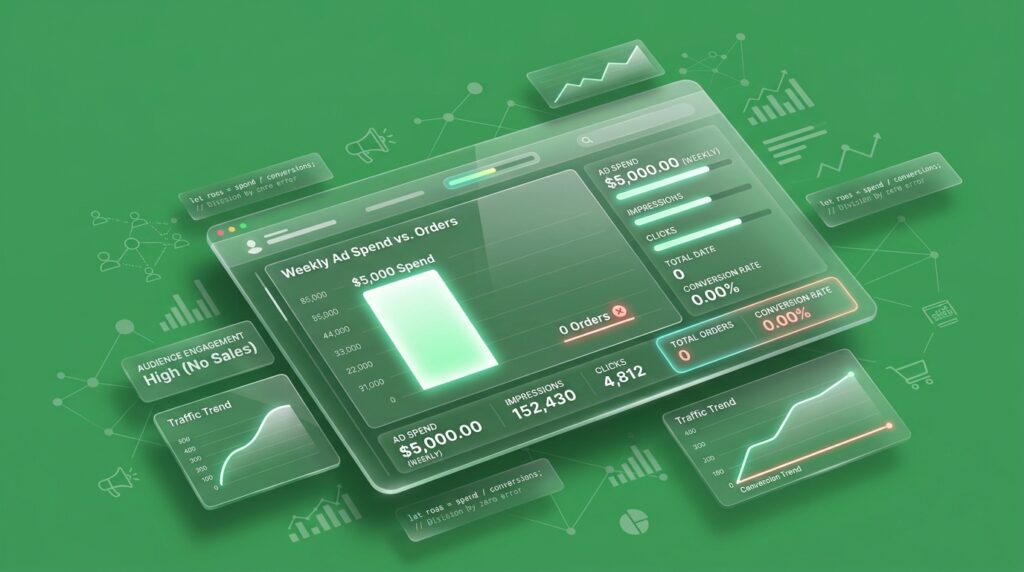
You opened Ads Manager on Monday morning. The spend is right there $5,000 out the door over the past week. Clicks came in. Traffic moved. And somehow, you’re staring at a sales report with a number on it that makes no sense.

Zero.

Your agency has a theory. Your developer has a theory. Everyone has a theory. But the money is already gone, and none of the theories are bringing it back.

Here’s something we’ve seen across dozens of accounts at “TheMayk” the ad is almost never the problem. And yet that’s always where businesses look first.

The real issue is what happens before the ad runs and after the click lands. Fix those two things and a $5k week starts looking very different.

The Click Was Never the Problem

Most brands obsess over the ad because it’s visible, but the invisible friction is what kills revenue. Every extra second of load time, every unclear promise, every repeated creative quietly drains intent. Build a system that respects attention from click to checkout, and your budget starts compounding instead of leaking. Growth isn’t louder ads it’s smoother journeys. Focus on what happens

The ad did its job your funnel didn't

Let’s be clear about what a Meta ad is actually responsible for: getting someone curious enough to click. That’s it. The ad is the doorbell. What’s behind the door your landing page, your offer, your trust signals that’s where the sale is won or lost.

Most businesses spend 90% of their energy on the ad and almost none on what comes after it. The result? They’re paying for clicks that were never going to convert, because the post-click experience wasn’t built to close.

The data confirms it. According to research from Triple Whale analysing Meta ad performance across ecommerce brands in 2025, the median conversion rate on Meta was just 1.57% and CPM rose 20% year-over-year. So, you’re paying more to reach people and converting fewer of them. That’s a compounding problem, not a targeting problem.

The traffic isn’t the issue. The destination is.

Your landing page is running a completely different conversation than your ad

This is the part most people don’t want to hear because it means the redesign they just paid for might be working against them.

When a user clicks a Meta ad, they arrive primed. They’re in a specific mental state based on what your ad promised them. The headline they saw, the image that stopped their scroll, the offer that made them curious all of that has set an expectation.

If your landing page doesn’t immediately match that expectation in tone, in visual style, in the specific language of the offer the visitor bounces. Not because they’re not interested. Because the conversation suddenly changed and they got confused.

This is called message mismatch, and it’s one of the most expensive silent killers in paid media. Shopify’s research on landing page performance highlights it directly: when ad copy and landing page content don’t align, bounce rates spike and conversion rates tank not because the product is wrong, but because the journey is broken.

Social traffic is already harder to convert than search. Data from product page conversion benchmarks puts the average conversion rate from social media traffic at just 0.91%, versus 1.55% from search. The intent gap is real which means the landing page needs to work much harder to bridge it.

People don’t bounce because they don’t want what you’re selling. They bounce because the page didn’t make them feel like they’d arrived in the right place.

You've been running the same creative so long your audience went blind to it

Here’s a scenario that plays out in almost every account we audit. The business finds a creative that works great hook, solid visual, good early ROAS. They keep running it. And running it. And after a few weeks, performance starts to quietly erode.

By the time they notice, the creative has been burned into their audience’s feed so many times that it triggers nothing. No click. No curiosity. Just the thumb moving past it automatically.

This is creative fatigue, and it’s measurable. Research published by Analytics at Meta found that a creative fatigue level of 0.2 is associated with an average 20% drop in CTR. And 19% of all ad impressions on Meta come from creatives the same person has already seen more than five times in 30 days. That’s not frequency management that’s budget evaporation.

Search Engine Land’s analysis of creative lifecycle data puts it plainly: fatigued ads lose 20 to 30% of engagement every week. The ad that was delivering solid returns in week one is actively costing you money by week four.

The fix isn’t more budget. It’s a creative rotation system and most businesses running $5k/week don’t have one.

Meta is optimising for what you told it to and you told it the wrong thing

This one stings. Meta’s algorithm is very good at finding people who will do what you’re optimising for. If you’re optimising for link clicks, it will find people who click links. If you’re optimising for purchases, it will find people who buy.

The problem is that many businesses are running Traffic objectives because they’re cheaper. Or they’re optimising for Add to Cart because Purchase optimisation requires more data. And the result is a flood of clicks from people who were never going to buy at a cost that looks efficient right up until you check the sales report.

Add to this the audience targeting gap. WordStream’s Facebook ads benchmark data shows that conversion rates for Traffic campaigns skew high on the click side but miss entirely on the purchase side. You can’t fix a conversion problem by chasing cheaper clicks. The metric you’re optimising for and the metric that actually matters are two different things.

The algorithm will deliver exactly what you ask for. The question is whether you’re asking for the right thing.

Here's the actual audit process we run before touching a single ad

When a client comes to us with a dead week $5k in, zero out we don’t open Creative Studio first. We run this five-step diagnostic.

Check message match between ad and landing page.

Pull the exact ad creative that ran most often. Load the landing page. Ask one question: does the headline on the page match the promise in the ad within the first three seconds? If you can’t find the connection immediately, your visitor couldn’t either. Rewrite the above-the-fold copy to mirror the ad’s specific language and offer.

Campaign-level frequency is a misleading number. Two ad sets sitting at 1.5 and one at 8 look like an average of 3.7. That third ad set is burned. Pull frequency at the ad level. If any creative is above 2.5 for cold audiences, pause it and rotate in a fresh variant. Meta’s own guidance on creative fatigue confirms that adding new creative to a fatigued ad set improves conversion rates in a measurable, dose-dependent way.

If you want purchases, you need to be running purchase-optimised campaigns full stop. If you don’t have enough conversion data for Meta’s algorithm to optimise toward purchase (typically 50 events in a 7-day window), work backward: optimise for Add to Cart first, build the data, then switch. Don’t run Traffic campaigns and wonder why traffic doesn’t buy.

Fix the page speed and mobile experience first.

Over 60% of global traffic is mobile. If your landing page takes more than three seconds to load on a phone, a significant portion of your ad clicks never even see the offer. Shopify’s landing page research shows that even a one-second improvement in load time can increase mobile conversion rates by 27%. Check your Core Web Vitals in Google Search Console before you adjust a single word of your ad copy.

Your landing page needs to answer three questions in the first scroll: What is this? Who is it for? Why should I act now? If a cold visitor has to hunt for those answers, they’re gone. Use specific benefit language not ‘premium quality’ but ’48-hour delivery, no minimum order, free returns.’ The specificity is what creates trust fast enough to convert a cold audience.

Before you put another dollar into ads, fix what the dollars are landing on

We’ve reviewed a lot of failing ad accounts. The problem is almost never the targeting. It’s almost never the creative hook. It’s the stuff that happens after the click the page that wasn’t built to sell, the offer that wasn’t clear, the creative that ran two weeks past its prime.

At “TheMayk”, our paid media work always starts with the full funnel not just the ad. Because we’ve seen it too many times: a great ad driving great traffic to a broken experience, producing nothing. You can’t outspend a broken post-click journey.

If your $5k week looked like this, we should talk before the next one does too. Start at www.themayk.com.

Key Takeaway

Conclusion

Five thousand dollars didn’t fail you your funnel did. Ads attract attention systems convert it. When message, experience, speed, and intent align, results follow fast. Fix the journey before scaling the spend. Otherwise, you’re just paying for proof that curiosity isn’t the same as commitment and clicks alone never built a business.

See How Our Agency Grow Your Traffic Into Conversions

SEO – unlock sustainable growth with proven search strategies.
Content Strategy – magnetic content that earns links, shares, and brand authority.
Paid Media – precision campaigns built for measurable ROI.

Blogs

Why your $5k ad spend resulted in zero orders this week

Why your $5k ad spend resulted in zero orders this week You opened Ads Manager on Monday morning. The spend is right there $5,000 out the door over the past week. Clicks came in. Traffic moved. And somehow, you’re staring at a sales report with a number on it that makes no sense. Zero. Your […]

The silent 22% tax you pay for having average brand authority

The silent 22% tax you pay for having average brand authority You’re running ads. You’re posting content. You’re doing everything the playbooks say. And yet you’re still losing deals to competitors whose product is, honestly, not as good as yours. The agency says it’s a targeting issue. Your developer says it’s the landing page. Your […]

Why 90% of your 2026 ad spend is actually fueling your competitors

Why 90% of your 2026 ad spend is actually fueling your competitors You raised your media budget this year. The results looked roughly the same. Your agency sent a report with impressions and reach numbers. Your dashboard showed spend going out. Your ROAS stayed flat. And somewhere in another browser tab, a competitor running tighter […]

Contact Us