
Blogs > The silent 22% tax you pay for having average brand authority

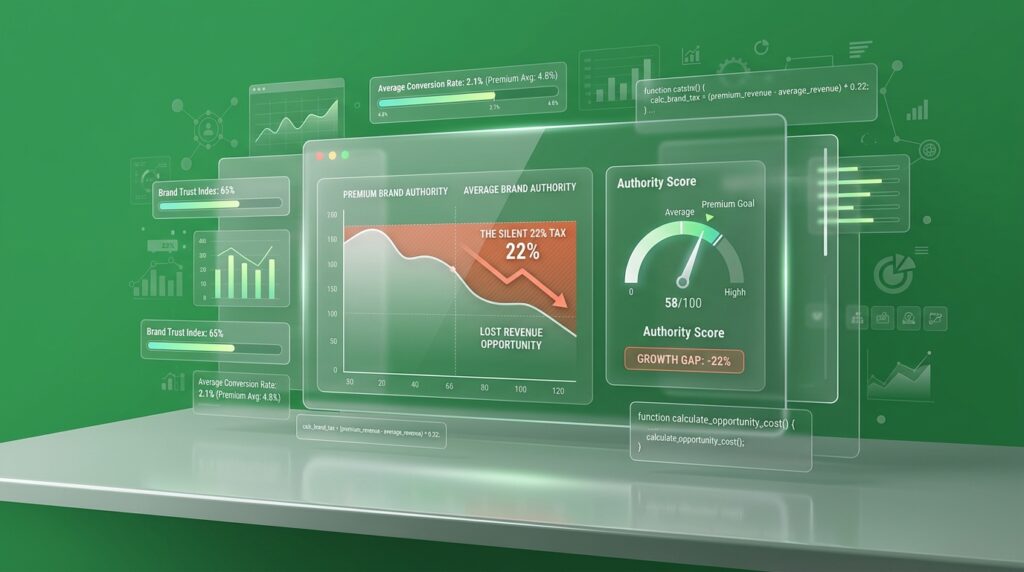
The silent 22% tax you pay for having average brand authority

You’re running ads. You’re posting content. You’re doing everything the playbooks say. And yet you’re still losing deals to competitors whose product is, honestly, not as good as yours.

The agency says it’s a targeting issue. Your developer says it’s the landing page. Your designer says you need a rebrand. Everyone has a theory.

Here’s the one nobody’s telling you: weak brand authority is an invisible tax on every dollar you spend. And most businesses are paying it every single day without realising it.

The Hidden Shortcut to Trust

The fastest signal of authority isn’t what you say it’s what you refuse to say. Clear boundaries, sharp positioning, and unapologetic opinions filter out bad-fit buyers and magnetise the right ones. When your brand feels decisive, prospects borrow that certainty. Confusion repels; conviction converts. If everyone agrees with you, you’re still too generic to be trusted to win meaningful, long-term customers.

Your customer decided before your sales team even picked up the phone

Before a prospect books a call with you, they’ve already made a decision. Not a final one but a prior one.

They’ve looked at your website. Glanced at your social. Searched your brand name and in roughly 7 seconds, their brain has sorted you into one of two buckets: credible or not sure.

If you land in the ‘not sure’ bucket, everything costs more. Your ads need more impressions to convert. Your sales team needs more touchpoints to close. Your offers need bigger discounts to win. The whole machine runs harder just to achieve what a trusted brand gets almost automatically.

This is the brand authority tax. It’s not a line item on your P&L. But it’s real and it compounds.

The numbers back this up. Lucidpress research tracking over 200 organisations found that companies with consistent, authoritative brand presentation see revenue increases of up to 23%. That 23% isn’t coming from a better product or smarter ads. It’s coming from the compounding effect of being trusted on sight.

Flip that number and you get the tax. Every year you run an inconsistent or weak brand, you’re leaving roughly a fifth of your potential revenue on the table.

Brand authority isn't about looking premium it's about reducing risk in the buyer's mind

This is the part most people misunderstand. They think brand authority is about aesthetics a better logo, a sleeker website, a more polished Instagram grid.

It’s not. Those things contribute, but they’re not the mechanism.

Brand authority works because it eliminates perceived risk. When a buyer doesn’t know you well, they’re not just evaluating your product they’re calculating the risk of being wrong. The risk of paying money and getting burned. The risk of looking bad to their boss for choosing you. The risk of wasted time.

A brand with strong authority reduces that anxiety before the conversation starts. Which is why Salsify’s consumer research found that 87% of shoppers will pay more for products from brands they trust. Not better products. The same products from brands they trust. That’s pricing power that comes entirely from authority, not from engineering.

And it shows up on the other side too. When brand trust is absent, the 2025 Edelman Trust Barometer found that trust now ranks equal to price and quality as a primary purchase consideration. Think about that for a second. Trust isn’t a bonus feature anymore. It’s a baseline requirement.

The businesses bleeding money right now aren’t failing because of bad products. They’re failing because their brand doesn’t command trust fast enough to compete.

Here's exactly where the tax shows up in your numbers

It’s not theoretical. Brand authority failure has a direct address in your business usually three of them.

Higher customer acquisition cost.

Weak brand recognition forces you to rent attention constantly. Your ads need to run longer and more frequently because they’re doing the work that brand equity should already be doing. Research from Marq/Lucidpress shows that companies with high brand consistency scores achieve 2.4x the average growth rate largely because their cost to acquire each customer drops significantly as the brand gains recognition.

When a buyer doesn’t immediately trust you, they don’t say no they say ‘let me think about it.’ They go back and do more research. They ask more questions. They bring in more stakeholders. A brand that creates instant authority collapses that cycle. One that doesn’t stretch it out indefinitely.

When you can’t win on trust, you win on price and that’s the most expensive game in the market. You train your customers to expect discounts. You thin your margins. And you end up in a race to the bottom against competitors who are probably also running on margin fumes.

All three of these leaks have the same root cause. And none of them get fixed by running better ads.

How to actually close the gap “TheMayk” authority build framework

We’ve audited dozens of brands across e-commerce, SaaS, and service businesses. The authority gap almost always comes from the same five places. Here’s how to address each one.

  1. Get your positioning off the shelf.

If your homepage could belong to any of your competitors, your positioning is broken. Authority comes from a specific point of view not ‘we make great products’ but ‘we build for the specific business owner who’s done trusting generic agencies.’ The more specific and opinionated your position, the faster trust forms. Specificity is credibility.

  1. Make your visual identity do work, not just exist.

Most visual identities are decorative. They exist. They don’t communicate. Every visual decision colour, type, imagery style, spacing should signal something specific about who you are and who you’re for. When it’s designed with intent, a prospect who’s never heard of you can look at your brand and already feel like they understand you. That’s brand strategy and storytelling done right.

  1. Use content to demonstrate, not just educate.

Most brands use content to explain what they do. Authority brands use content to show how they think. There’s a real difference. The moment a prospect reads something you wrote and thinks ‘these people understand my problem better than I do’ that’s when authority locks in. That’s when they stop comparing you on price.

  1. Build social proof that speaks to your specific buyer.

Generic testimonials don’t build authority. ‘Great service!’ means nothing. Case studies that speak to the exact pain your buyer is experiencing right now that’s what closes the trust gap. If you work with e-commerce founders, your proof should come from e-commerce founders. Specificity creates resonance.

  1. Show up consistently across every touchpoint.

Brand authority is cumulative. Every time a prospect encounters your brand an ad, a blog, an email, a LinkedIn post, a product page it either adds to or subtracts from their trust. Inconsistency is the fastest way to undo the authority you’ve built. According to PwC research, 32% of customers will leave a brand they love after just one bad experience. Consistency isn’t optional it’s the whole game.

What this means for you right now

If your ads aren’t converting the way they should, if your sales cycles feel longer than they need to be, if you’re winning business but only after offering a discount the problem probably isn’t the channel. It’s not the copy. It’s not the audience targeting.

It’s the brand. And it’s quietly taxing every marketing dollar you spend.

At “TheMayk”, brand authority is the first thing we look at before we touch a single campaign or creative. Because we’ve seen it too many times: great ad spend, broken brand foundation, predictable results. You can’t outspend a trust problem. But you can outbrand it.

Stop paying the tax. Let’s build the brand that earns your market. Talk to us at www.themayk.com.

Key Takeaway

Conclusion

Brand authority isn’t a luxury, it’s leverage you either compound or quietly lose. Every touchpoint is a vote for or against trust. Fix the foundation, and everything accelerates cheaper acquisition, faster decisions, stronger margins. Ignore it, and the tax keeps rising, invisible but relentless, until better branding not better products wins your market.

See How Our Agency Grow Your Traffic Into Conversions

SEO – unlock sustainable growth with proven search strategies.
Content Strategy – magnetic content that earns links, shares, and brand authority.
Paid Media – precision campaigns built for measurable ROI.

Blogs

Why your $5k ad spend resulted in zero orders this week

Why your $5k ad spend resulted in zero orders this week You opened Ads Manager on Monday morning. The spend is right there $5,000 out the door over the past week. Clicks came in. Traffic moved. And somehow, you’re staring at a sales report with a number on it that makes no sense. Zero. Your […]

The silent 22% tax you pay for having average brand authority

The silent 22% tax you pay for having average brand authority You’re running ads. You’re posting content. You’re doing everything the playbooks say. And yet you’re still losing deals to competitors whose product is, honestly, not as good as yours. The agency says it’s a targeting issue. Your developer says it’s the landing page. Your […]

Why 90% of your 2026 ad spend is actually fueling your competitors

Why 90% of your 2026 ad spend is actually fueling your competitors You raised your media budget this year. The results looked roughly the same. Your agency sent a report with impressions and reach numbers. Your dashboard showed spend going out. Your ROAS stayed flat. And somewhere in another browser tab, a competitor running tighter […]

Contact Us