
Blogs > Why the 2026 algorithm hates your “automated” social media strategy

Why the 2026 algorithm hates your "automated" social media strategy

Your posting schedule is perfect. Your captions are polished. Content goes out every single day automated, consistent, on-brand. And your reach is quietly collapsing. You’ve been told to post more. Try different formats. Optimize your hashtags. We’ve looked at enough accounts to know those aren’t the problem.

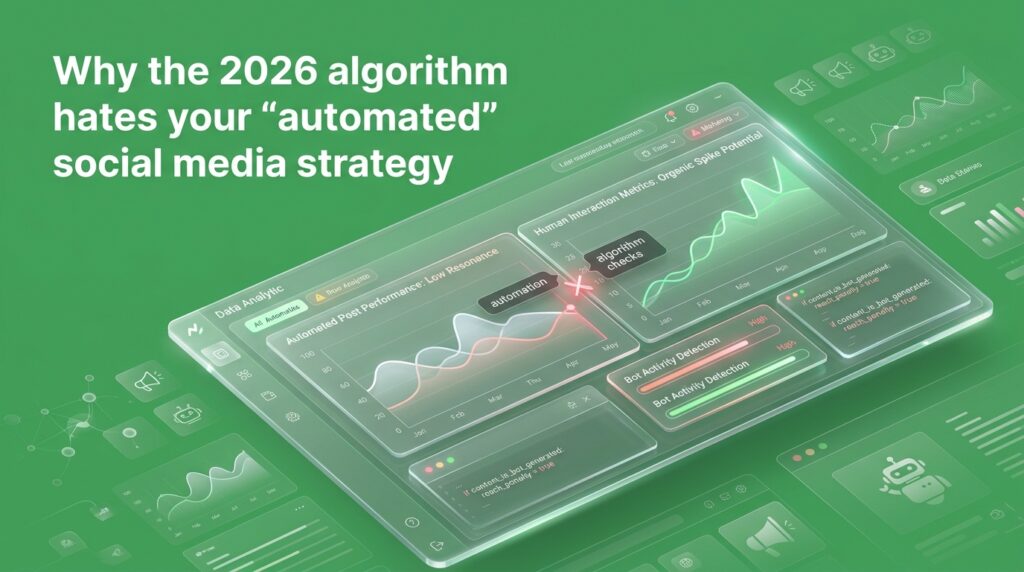
The problem is that the 2026 algorithm has gotten very good at detecting automation. And it’s burying accounts that rely on it.

This isn’t speculation. The social media automation penalty is measurable, documented, and accelerating right now.

Escaping the Algorithm’s Automated Filter

The 2026 social media algorithm is aggressively auditing your behavioral fingerprint, penalizing brands that prioritize volume over meaningful interactions. To bypass the social media automation penalty, you must integrate intentional imperfection and authority-led positioning into your narrative architecture. Real growth requires optimizing for algorithmic trust signals and dwell time replacing invisible, scheduled echoes with undeniable, human-driven presence at “TheMayk”.

Your reach didn't just drop you got algorithmically filtered out

There’s a pattern we keep seeing in brand accounts that reach out to us after a performance cliff. Follower count is healthy. Posting frequency is consistent. The content looks competent. But organic reach has collapsed. Engagement is flat. And none of the standard fixes Reels, trending audio, posting at ‘9am on Tuesdays’ have done anything.

Here’s the actual diagnosis: the platform isn’t reducing your reach because your content is bad. It’s reducing it because your account behavior pattern looks like a machine, not a person.

In 2026, that distinction is enough to get you shadow-pushed to the bottom of every feed you’re trying to appear in. Instagram, LinkedIn, TikTok, and X have all updated their trust signal architecture in the last 18 months. The direction is consistent across all of them: they are actively prioritizing human-led accounts and deprioritizing what their systems classify as machine-led activity. This is the automation penalty most marketing teams missed because it arrived gradually, looks like a routine algorithm update, and gets blamed on everything else.

It's not about your content quality it's about your behavioral fingerprint

To understand why this is happening, you need to understand how platforms are now reading your account. It’s not just the content they’re evaluating. It’s the behavioral fingerprint your account leaves behind the pattern of activity that tells the algorithm whether there’s a real person running this.

Platforms are now tracking:

  • The time gap between posting and your first response to comments.
  • Whether your engagement spikes are proportional or unnaturally uniform
  • The linguistic consistency of your captions across months (templated writing is detectable)
  • Your ratio of outbound interaction to inbound posting
  • Whether your posting times cluster in patterns no human account would naturally produce

A fully automated account fails most of these signals. Not because the content is bad. Because the pattern doesn’t look like a person.

Instagram’s Creator Academy updates have referenced ‘comment-response rates’ as a direct distribution factor accounts that reply quickly and genuinely receive significantly better reach regardless of follower count. Their creator research documentation has been explicit: platforms reward accounts where a real person is visibly present.

TikTok’s For You algorithm has always prioritized real-time engagement. Their creator economy research shows that the first 30 minutes after posting and the quality of interaction in that window determines the majority of a post’s total reach. Automation removes you from that window completely.

Schedule the post and walk away. Lose the distribution. That’s the penalty.

Stop Leaking Revenue to "Optimized" Mediocrity

Scheduled posts aren't just less effective in 2026 they're generating active penalties

Most brands treated scheduling as neutral. It doesn’t help, but it doesn’t hurt.

That stopped being true somewhere in 2024. In 2026, automated posting is generating three specific and measurable penalties:

1.Aesthetic fatigue detection

Platforms now use image and text similarity scoring to identify repetitive creative output. When your templates stay consistent for months same layout, same color scheme, same caption structure it registers as low creative effort and actively reduces distribution priority.

This is the algorithmic version of what designers call aesthetic fatigue in digital marketing: the platform filtering out content that’s visually indistinguishable from a hundred other accounts in your category.

2.Engagement velocity mismatch

Real posts from real people generate engagement that clusters in the first hour and tapers naturally. Scheduled content produces flatter, more spread-out engagement patterns.

Algorithms have been trained on enough human behavior to know the difference. A flat engagement curve in the first 60 minutes sends one signal: this account didn’t post this. Something did it for them.

3.Algorithmic trust score erosion

Every interaction your account takes or doesn’t take contributes to what platforms now treat as an algorithmic trust score. Accounts that post without responding, that engage via pre-set comment templates, or that follow/unfollow in unnatural patterns accumulate a degraded trust profile that lowers their organic reach ceiling over time. It’s not a single penalty event. It’s a slow, compounding ratchet downward.

A 2024 Social Media Examiner industry report found that 63% of marketers reported declining organic reach despite maintaining or increasing posting frequency. The common denominator: heavy scheduling tool dependency and templated content strategies.

Posting more didn’t fix it. In most cases, it accelerated the decline.

The platforms have picked a side and it's not the one you're currently on

The major platforms aren’t doing this arbitrarily. They’re following where their users’ attention actually flows and real engagement still happens around human-led content. Content that has a distinct perspective. That responds to comments like a person who cares. That exists in the moment rather than in a scheduling queue from three weeks ago.

The split this is creating is already visible:

  • Brands that automated everything to save time are posting to shrinking, disengaged audiences
  • Brands that stayed human-led even at lower volume are getting actively amplified

Meta’s transparency documentation on ranking and content explicitly lists ‘meaningful interactions’ and ‘personal connection signals’ as primary distribution drivers. These are, by definition, things automation cannot produce.

LinkedIn’s algorithm has shifted toward dwell time in the comment section as a ranking signal how long people spend reading the conversation under a post, not just whether they liked it. Three genuine replies outperform two hundred automatic reactions.

TikTok has stated publicly that re-shares sent to personal messages are among their highest-weighted signals. That is a person-to-person behavior. It cannot be scheduled.

The 2026 algorithm rewards presence. And presence, by definition, can’t be automated.

Key Takeaway

How to fix the automation penalty without burning your team out

This isn’t an argument for abandoning scheduling tools entirely. That’s not practical and it’s not what we recommend. The fix is a hybrid architecture: use automation only for the parts that don’t trigger algorithmic penalties, and protect human effort for the parts that do.

Audit your account's behavioral fingerprint first

Pull your last 90 days of data. Ask honestly: What is your average comment response time? What does your engagement curve look like in the first 60 minutes after posting? How much genuine outbound interaction is your account doing? If those numbers are uncomfortable, the algorithm has already registered them.

Batching your content creation is fine. Scheduling the distribution is where the risk lives. The new model: create in batches, but have a person manually publish and stay present for 30–45 minutes after posting. That window is where algorithmic trust is built or lost.

Auto-replies, pre-set comment responses, bot follows these are trust score killers. One genuinely curious comment on a relevant post in your niche does more for your distribution than 50 automated interactions.

Dedicate 20–30 minutes immediately after each post to real responses not generic ‘thank you!’ replies, but actual conversation that continues the thread. This single habit produces measurable distribution improvements within two to three weeks.

Create content that demands a human response

A strong take on something happening in your industry. A piece of data your audience hasn’t seen. A counter-intuitive truth they’ve been half-thinking themselves. If your content could have been published by any brand in your category, the algorithm won’t priorities it.

Stories repost, evergreen content reshares, cross-platform distribution after manual primary posting these are safe. Primary feed posts, comment interactions, and DMs are not.

Your automation isn't the enemy your strategy around it is

Every brand we’ve audited that’s running into the social media automation penalty got there the same way: they adopted automation because they ran out of bandwidth, and no one updated the strategy when the algorithm updated its rules.

The tools aren’t the problem. The playbook is.

At “THEMAYK”, we build human-led social strategies for brands that are serious about being visible in 2026 not just active. That means auditing what your account’s behavioral signals actually look like to the algorithm, rebuilding the content system around what earns distribution today, and designing a posting architecture that doesn’t flag your account as a machine.

Not more content. Not better hashtags. A system that the algorithm actually wants to promote.

Stop guessing. Let’s build an authority-led system that the 2026 algorithm actually rewards. Book your strategy audit at “TheMayk”.

Conclusion

The 2026 algorithm isn’t just filtering your content; it’s auditing your brand’s digital pulse. To escape the social media automation penalty, you must pivot from scheduled noise to authority-led positioning. Real growth requires narrative architecture that triggers algorithmic trust signals. Stop being a machine. Be undeniable. Ready to fix your reach? Resolve the mystery at “TheMayk”.

See How Our Agency Grow Your Traffic Into Conversions

SEO – unlock sustainable growth with proven search strategies.
Content Strategy – magnetic content that earns links, shares, and brand authority.
Paid Media – precision campaigns built for measurable ROI.

Blogs

Why the 2026 algorithm hates your “automated” social media strategy

Why the 2026 algorithm hates your “automated” social media strategy Your posting schedule is perfect. Your captions are polished. Content goes out every single day automated, consistent, on-brand. And your reach is quietly collapsing. You’ve been told to post more. Try different formats. Optimize your hashtags. We’ve looked at enough accounts to know those aren’t […]

Why most AI-generated brands look like cheap templates to the 2026 consumer

AI is making your marketing impossible to notice and most brands don’t see it yet You’re putting out more content than ever. Posts, emails, ads, blogs the machine is running and yet something feels off. The engagement is flat. The leads are thin. The brand feels… forgettable. The common advice? Post more consistently. Try a […]

Why 80% of startups fail by replacing creative strategy with automation

Why 80% of Startups Fail by Replacing Creative Strategy With Automation You bought the tools. You set up the workflows. Your team is running AI across content, emails, ads, and social. Output is up. Costs are down. Velocity is through the roof and your brand is disappearing in plain sight. This isn’t a story about […]

Contact Us