
Blogs > Why most AI-generated brands look like cheap templates to the 2026 consumer

AI is making your marketing impossible to notice and most brands don't see it yet

You’re putting out more content than ever. Posts, emails, ads, blogs the machine is running and yet something feels off. The engagement is flat. The leads are thin. The brand feels… forgettable. The common advice? Post more consistently. Try a new format. Optimize the copy.

Here’s what nobody’s saying out loud: the real problem isn’t your output volume. It’s that AI is pulling every brand including yours toward the exact same middle.

And in the middle, nobody gets noticed.

The Al-Driven Erosion of Premium Authority

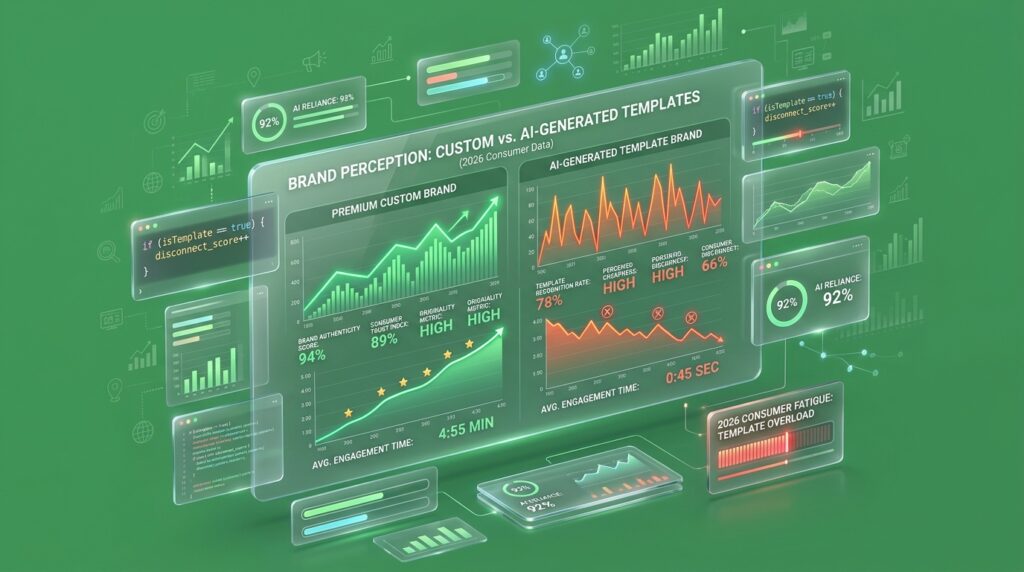
The market is currently suffering from aesthetic fatigue, a byproduct of brands prioritizing volume over narrative architecture. When you rely on algorithmic averages, you sacrifice the cultural weight and creative tension required to command premium prices. To remain undeniable in 2026, you must pivot from generic “content” to authority-led strategy replacing invisible, polished echoes with a distinctive, human-driven point of view.

Your marketing isn't underperforming. It's disappearing.

There’s a specific kind of frustration that comes with AI-assisted marketing. The work looks polished. The copy is clean. The visuals are sharp. The content goes out on schedule. But the results don’t match the effort. And the reason is uncomfortable: polished isn’t the same as distinctive.

Most AI marketing tools were trained on enormous datasets of what already worked top-performing ads, high-ranking blogs, successful brand visuals. That sounds useful. In practice, it means every output they generate is a remix of patterns that already exist. They don’t create from scratch. They average. And when every brand using the same tools gets averaged output, you end up with a market full of brands that are all… fine. Clean. Competent. Ignored. This is the quiet crisis in AI marketing that most businesses won’t notice until the pipeline is already drying up.

How a Fintech Disruptor Grew Conversions by 112%

This isn’t a criticism of the tools. It’s how they work by design. Generative AI systems learn by finding patterns in high-volume data. They get very good at identifying what statistically performed well. Then they reproduce it. The result is a built-in pull toward the mean toward safe formats, familiar layouts, tone that doesn’t offend and doesn’t excite, visuals that look professional and feel like nothing.

A 2024 study on AI-generated marketing content published in Harvard Business Review found that while generative AI dramatically accelerates production, it tends to compress creative diversity especially when brands rely on it without strong creative direction driving the brief.

In plain terms: more content, less difference. And here’s the compounding problem. When 74% of websites already contain AI-generated content a figure tracked by Originality.AI’s web content research and those pages are all optimised against the same performance benchmarks, the internet doesn’t get richer. It gets flatter. Consumers feel it before they can name it. The sense that they’ve ‘seen this before’ that low-level recognition that triggers instant scepticism about perceived value.

When your brand looks like the category average, buyers can’t justify choosing you over anyone else.

Why it always ends up looking like a cheap template

There are six specific reasons this keeps happening. Most businesses only figure out two or three of them.

Humans detect repetition faster than brands realise

By 2025, the average buyer had seen thousands of pastel gradients, soft sans-serif wordmarks, Notion-style layouts, and ‘modern minimal’ landing pages.

Neuroscience research from the Nielsen Norman Group confirms that perceived aesthetic similarity triggers a measurable drop in trust signals the brain interprets repetition as low effort, and low effort as low value.

Your audience doesn’t think ‘this is AI-generated.’ They just feel less interested.

Most AI tools skip the hard part: brand thinking.

No positioning. No cultural tension. No reason behind the aesthetic choice. What they produce is:

  • Clean layout + professional fonts + generic copy
  • presented as a brand

That’s decoration. And decoration doesn’t drive decisions

AI is genuinely good at making things look finished. Perfect spacing. Balanced typography. Structured layouts. What it lacks is intentional imperfection the kind of creative risk that makes something feel like it came from a real point of view.

The result lands in an uncanny zone: looks professional, feels like nothing. This is what the design community is now calling ‘aesthetic fatigue’ and it’s accelerating.

When the brief says ‘modern, premium, minimal’ and the tool has seen a million iterations of that brief, the output is predetermined.

Same prompt architecture + same training data + same aesthetic benchmarks = same output. Just wearing different logos.

AI doesn't have taste it has data

Even leading voices in brand design acknowledge this distinction: AI can replicate style but can’t feel timing, cultural weight, or creative tension. It imitates what taste looks like. It doesn’t understand why something tastes right for a specific brand at a specific moment.

‘Give me a brand identity for a premium DTC skincare brand targeting millennials.’

That prompt has been run by thousands of brands. The output will reflect all of them. AI needs constraints, point of view, and genuine creative tension in the brief. Without those, it defaults to:

safest possible output which is invisible output.

The market is already splitting and the window is closing

There’s a quiet divide opening up right now between two types of brands.

On one side: brands churning out AI-generated content at volume. Fast, cheap, forgettable. Competing with each other in a race to the bottom of the attention economy.

On the other side: brands that use AI as infrastructure for speed, for research, for execution while investing in real creative strategy, real brand thinking, and real differentiation.

The second group is getting rarer. Which means they’re getting more valuable.

This tracks with what consumer research is showing. McKinsey’s 2024 State of AI in Marketing report found that brands which combine AI-powered execution with strong human creative leadership outperform pure AI-automation approaches by a significant margin particularly in brand recall and customer loyalty metrics.

Handcrafted thinking is becoming the new premium signal.

The more AI brands flood the market, the more distinctive brands stand out but only if they’re actually building something different.

Stop Leaking Revenue to "Optimized" Mediocrity

How to use AI without becoming invisible

This isn’t an argument against AI tools. We use them at “TheMayk”. They’re genuinely useful when they’re pointed at the right problems. The issue is treating AI as the strategy rather than the execution layer. Here’s how to reframe the workflow:

Start with positioning, not prompts

Before you open any AI tool, define what makes your brand the specific answer to a specific problem for a specific person. That sentence is the creative brief. Without it, every AI output defaults to the average.

Vague prompts get generic outputs. Your briefs need: a defined POV, a tension to resolve, a specific audience emotional state, and a non-negotiable tone boundary. Specificity is the only antidote to sameness.

AI is exceptional at drafting, formatting, iterating, and testing. It’s not a replacement for brand strategy or creative direction. Use it to execute the vision not to generate one.

Audit what you've put out in the last 90 days

Print it out. Line it up. Ask honestly: could any competitor in your category have posted this? If yes, you don’t have a brand voice. You have content.

Brand strategy. Narrative architecture. Creative risk. Cultural context. These are the inputs that make AI outputs distinctive. The brands winning right now are investing heavily in the thinking and using AI to scale the execution.

Key Takeaway

You already know something is off

If you’ve read this far, some part of this is hitting close to home.Maybe your content feels flat. Maybe your brand looks like your competitors. Maybe you’ve got more AI tools than results and can’t quite explain why.

At THEMAYK, this is exactly what we fix. Not by adding more tools by building the strategy and creative direction that makes every output you put out actually mean something.

We work with business owners and marketing teams who are serious about differentiation people who’ve tried the generic route and want something that actually builds a brand.

Stop guessing. Let’s build something that doesn’t look like everyone else. www.themayk.com

When you educate a customer better than your competitor does, you don’t just win the click,you win the category.

Conclusion

The “sea of sameness” is real, and it’s drowning high-ticket brands. If your marketing feels like a polished echo, you’re not scaling you’re disappearing. Real growth requires authority-led positioning and radical differentiation that AI can’t spoof. Stop settling for “clean” and start being undeniable. Ready to break the cycle? Let’s solve the mystery of your missing ROI at “TheMayk”.

See How Our Agency Grow Your Traffic Into Conversions

SEO – unlock sustainable growth with proven search strategies.
Content Strategy – magnetic content that earns links, shares, and brand authority.
Paid Media – precision campaigns built for measurable ROI.

Blogs

Why the 2026 algorithm hates your “automated” social media strategy

Why the 2026 algorithm hates your “automated” social media strategy Your posting schedule is perfect. Your captions are polished. Content goes out every single day automated, consistent, on-brand. And your reach is quietly collapsing. You’ve been told to post more. Try different formats. Optimize your hashtags. We’ve looked at enough accounts to know those aren’t […]

Why most AI-generated brands look like cheap templates to the 2026 consumer

AI is making your marketing impossible to notice and most brands don’t see it yet You’re putting out more content than ever. Posts, emails, ads, blogs the machine is running and yet something feels off. The engagement is flat. The leads are thin. The brand feels… forgettable. The common advice? Post more consistently. Try a […]

Why 80% of startups fail by replacing creative strategy with automation

Why 80% of Startups Fail by Replacing Creative Strategy With Automation You bought the tools. You set up the workflows. Your team is running AI across content, emails, ads, and social. Output is up. Costs are down. Velocity is through the roof and your brand is disappearing in plain sight. This isn’t a story about […]

Contact Us