
Blogs > Why spending more on Meta won’t fix your startup’s broken positioning

Why spending more on Meta won't fix your startup's broken positioning

Why spending more on Meta won’t fix your startup’s broken positioning

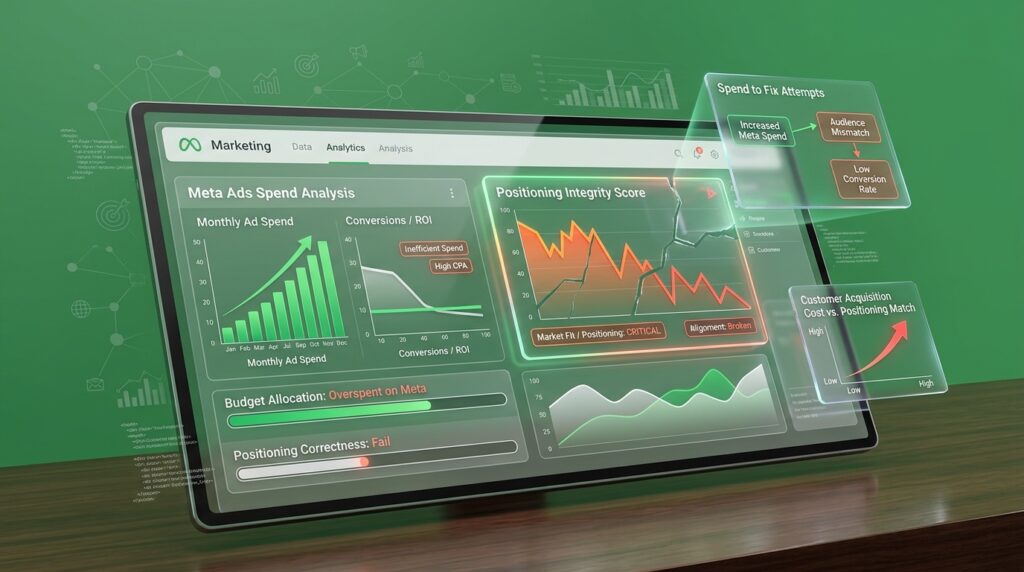
You’ve been told the same thing twice this month. Increase the budget. Give the algorithm more to work with. Your agency says it. Your co-founder says it. And somehow, you keep hitting the button. But your cost-per-acquisition keeps climbing. Your ROAS is flatlining. And the only thing growing is the number in your ad spend report.

Here’s what nobody wants to say to your face: Meta isn’t your problem. Your positioning is.

Clarity Drives Growth Not Budget

Throwing money at ads without fixing positioning is like pouring water into a leaking bucket. You might see movement, but you won’t see progress. When your message clicks, everything else becomes cheaper and easier. Fix what you’re saying first then let your budget amplify something actually worth hearing and responding to.

Your ad rings loud but nobody’s excited to answer the door.

Founders scaling fast often make one mistake: they treat ads like the product. They chase hooks, thumbnails, and flashy openings—but that’s just surface work.

Nielsen analysis of nearly 500 advertising campaigns found that creative quality accounts for 47% of a campaign’s contribution to sales the single biggest factor. But the same research shows that brand itself contributes 15% of sales lift, and that figure has grown significantly as shoppers place more weight on how they perceive a company before they buy.

Think about what that means. You can have exceptional creative and still lose if the brand behind the ad doesn’t mean anything to the people seeing it.      Positioning is what makes your brand mean something. It’s the answer to the question every potential customer is unconsciously asking: Why you, and not the five other options I’ll see in my feed today?

If you don’t have a sharp, singular answer to that question, more budget doesn’t help. It just shows the vague answer to more people, faster.

“Most businesses don’t fail at paid media because they picked the wrong platform. They fail because they’re advertising an offer the market hasn’t been given a reason to care about.”

Weak positioning doesn't look like weak positioning that's what makes it dangerous

Here’s the thing about broken positioning: it’s not always obvious from the inside. Your team wrote the copy. You’ve read it a hundred times. It sounds clear. But clarity to an insider and clarity to a cold prospect are completely different things.

Weak positioning usually hides behind language that sounds strong:

  • “We help businesses grow.”
  • “The all-in-one platform for modern teams.”
  • “Smarter marketing, better results.”

None of that is wrong. None of it lands. Because it says nothing a prospect couldn’t find on the homepage of your three nearest competitors. When your positioning is generic, your ads are generic no matter how good the creative looks.

And generic ads in a crowded feed are expensive. You’re paying CPMs that have been climbing steadily, fighting for attention against brands that have done the positioning work you haven’t. When your message isn’t sharp, the algorithm can’t find the people most likely to convert because you haven’t told it who those people are in a way it can model.

Your funnel is leaking from the top. More spend makes the leak bigger.

What to fix before you touch the budget again

This isn’t a process you need six months and a consultant to run. But it does need honest attention before you spend another dollar on distribution. Here’s how we approach it:

Write A One-Sentence Position Test

Fill in this blank: “We are the only [category] that [does X] for [specific audience].”

If you can’t complete that sentence without using words like “comprehensive,” “innovative,” or “end-to-end” your positioning isn’t ready. If the completed sentence could describe a competitor, it’s not differentiated enough. You need to keep narrowing until the answer is specific enough to make some people say “that’s not for me” because that’s the same specificity that makes the right people say “that’s exactly what I need.”

Pull up your top-performing Meta ad. Read the copy and note the specific promise it makes. Then click through to your landing page and ask one question: does the first thing a visitor reads directly address that exact promise?

If there’s any gap even a slight shift in language you’re losing people in that gap. Our CRO work consistently shows that message mismatch between ad and landing page is one of the top three reasons startups see strong CTRs and weak conversion rates. The click happened. The close didn’t. That’s a positioning continuity failure.

Pull your last 20 customer reviews, DMs, or sales call notes. Look for the specific words customers use to describe the problem you solve. Not your words theirs. That language is your positioning. When you write ads using the exact words your best customers use to describe their pain, you’re not marketing. You’re mirroring. And mirroring converts.

Before any creative adjustment, look at where people drop off. If they’re clicking and bouncing within 10 seconds, the issue isn’t the creative it’s what they find on the other side. If they’re spending time on the page but not converting, it’s usually a clarity or trust problem. Both of those are positioning problems, not media problems. Data tells you where the leak is. It’s your job to trace it back to the source.

Rebuild Your Primary Message Around One Outcome, Not A List Of Features

Features are what you sell. Outcomes are what people buy. A startup that says “AI-powered scheduling assistant with calendar sync and team collaboration tools” is selling features. A startup that says “Stop losing client bookings to scheduling chaos” is selling an outcome. The second one earns a click. The first one earns a scroll-past.

Pick the single most compelling outcome your product delivers for your most valuable customer segment. Lead with that. Build your ad around that. Build your landing page around that. Then spend on Meta.

More spend rewards clarity. It punishes confusion.

The founders who see strong Meta ROAS aren’t just better at ads. They’ve done the harder work first they’ve built something the market can understand, remember, and repeat back.

At “TheMayk”, every paid media engagement starts with a positioning audit before we touch the campaigns. Not because it’s a nice process to follow because we’ve learned the hard way that running ads on broken positioning just burns money faster. We fix the foundation first. Every dollar you spend after those compounds. Every dollar you spend before it disappears.

You don’t have a budget problem. You have a clarity problem. And clarity is fixable but it has to come before the spend, not after.


Key Takeaway

Conclusion

Throwing money at ads without fixing positioning is like pouring water into a leaking bucket. You might see movement, but you won’t see progress. When your message clicks, everything else becomes cheaper and easier. Fix what you’re saying first then let your budget amplify something actually worth hearing and responding to.

See How Our Agency Grow Your Traffic Into Conversions

SEO – unlock sustainable growth with proven search strategies.
Content Strategy – magnetic content that earns links, shares, and brand authority.
Paid Media – precision campaigns built for measurable ROI.

Blogs

Why your agency is happy with clicks while your warehouse stays full

Why Your Agency Is Happy With Clicks While Your Warehouse Stays Full You’re spending $10,000 a month on Meta and Google ads. Your agency sends over a “robust” monthly report full of green arrows and high click-through rates. But when you walk through your warehouse, the shelves are still hitting the ceiling with unsold inventory. […]

Why spending more on Meta won’t fix your startup’s broken positioning

Why spending more on Meta won’t fix your startup’s broken positioning Why spending more on Meta won’t fix your startup’s broken positioning You’ve been told the same thing twice this month. Increase the budget. Give the algorithm more to work with. Your agency says it. Your co-founder says it. And somehow, you keep hitting the […]

Why your $5k ad spend resulted in zero orders this week

Why your $5k ad spend resulted in zero orders this week You opened Ads Manager on Monday morning. The spend is right there $5,000 out the door over the past week. Clicks came in. Traffic moved. And somehow, you’re staring at a sales report with a number on it that makes no sense. Zero. Your […]

Contact Us