
Blogs > Why 90% of AI-generated brands look cheap in 2026.

Why 90% of AI-generated brands look cheap in 2026

You launched a brand last quarter. You used AI to generate the logo, the color palette, the brand voice doc, the Instagram bio, and the hero copy on your website. It came together in three days. Your competitor did the exact same thing. So did the brand next to them. And the one next to that.

Here’s what none of the AI branding tool marketing tells you: when everyone uses the same machine with the same training data and the same aesthetic defaults, the market doesn’t see ten different brands. It sees one brand, repeated ten times. And in 2026, consumers have gotten very good at spotting it.

Why Most AI-Generated Brands Look Cheap & Generic in 2026

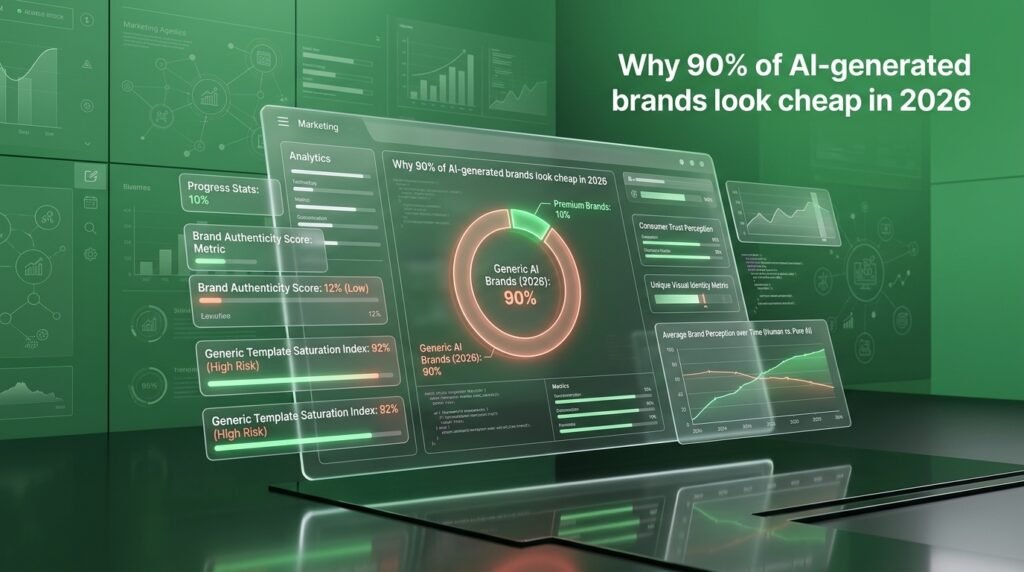
In 2026, AI-generated brand identity is everywhere but 90% of it screams “template.” When every founder uses the same AI branding tools with identical prompts and training data, the result is massive visual brand homogenization. Consumers instantly spot the generic logos, soulless palettes, and cookie-cutter vibes. What looks “professional” to AI actually signals lazy and forgettable. Real brands win by leading with strategy, not software.

Your brand looks like theirs because it came from the same place

This isn’t an opinion. It’s a structural problem built into how AI image and branding tools work.

Midjourney, DALL·E, Looka, Brandmar these tools were trained on the same massive dataset of images and brand assets. When you prompt them, they don’t invent. They interpolate. They give you the statistically most likely output for your input. Which means if you type “modern minimalist logo for a premium skincare brand,” you’re going to get something that looks nearly identical to what 10,000 other people got when they typed the same thing.

The result is a visual homogenization problem at an industry scale. As Zappi’s 2025 branding analysis noted, when marketers over-rely on AI to generate content, brand communications begin converging toward sameness weakening competitive positioning and blurring identities across entire categories.

This is what’s making your brand look cheap. Not the colors you chose. Not the font. The fact that the colors and the font were chosen by an algorithm optimizing for “what looks professional” rather than “what makes you unmistakable.”

Consumers aren't just noticing they're actively judging you for it

There’s a number you need to sit with.

According to a Bynder study of 2,000 UK and US consumers, half of consumers can now correctly identify AI-generated content. And when they identify it, the response isn’t neutral. Twenty percent call the brand lazy. Twenty-five percent call it impersonal. Twenty percent say it makes them distrust the brand.

That’s not a minor UX friction. That’s brand equity erosion happening quietly every time someone looks at your website and something feels slightly off. And it’s getting worse. Research from SmythOS found that 52% of consumers who identify AI-generated content report reduced engagement with that brand. More than half. The detection rate will only climb as consumers spend more time using these tools themselves.

What’s the profile of your buyer? A business owner who’s already spent serious money on marketing, a DTC founder evaluating whether your brand is worth their trust. These are not people who skim. They’re pattern-matchers with high standards. They’ve seen a hundred AI-generated brands this week. They know exactly what “template-core” looks like

The real problem isn't using AI it's using AI as the strategy

This is where most brands get it wrong, and where the conversation usually gets uncomfortable. AI tools are not a brand strategy. They are a production tool. The mistake is treating the output of a Midjourney session as equivalent to a considered brand identity and then being confused when the market responds with indifference. Think about what a real brand strategy actually requires: a clear articulation of who you’re for, what position you own in the market, what emotional territory you’re claiming, and how every visual and verbal choice reinforces that. None of that lives inside a prompt.

AI can generate a logo. It cannot tell you what that logo should stand for. It can write you a tagline. It cannot build the strategic narrative that makes the tagline mean something. These are fundamentally different jobs, and confusing them is exactly why so many AI-generated brands look like decoration rather than identity.

A Duke University study found that when participants were shown AI-generated branding materials, 67% described them as “generic” or “soulless” even when they couldn’t distinguish them from human-made designs at the surface level. The feeling was there before the identification. That’s the problem. You feel the absence of a point of view before you can name it.

Stop Leaking Revenue to "Optimized" Mediocrity

What a cheap brand actually signals to your buyer

Let’s be direct about what’s happening in the buyer’s brain.

When your brand looks cheap, it doesn’t just mean they think you skimped on design. It triggers a cascade of inferences that are much more damaging. Research from the Wharton School found that 58% of consumers associate AI-heavy design with startups or financially constrained companies.

A buyer looking at a $30,000 B2B contract, or even a $200 DTC purchase, is running a subconscious risk assessment. A brand that looks like it was assembled in an afternoon signals this company might not be here next year. That is the question your visual identity is either answering or leaving dangerously open. And this problem compounds into the content layer. If your brand identity is AI-generated and generic, your content tends to match it because an AI generating social posts for a generic brand will produce generic social posts. You end up with an entire ecosystem of sameness.

The brands winning in 2026 look like they have a position. Not just a palette.

Key Takeaway

The five things that actually separate a real brand from an AI assembly job

This is the part that actually matters. Here’s what the brands commanding premium pricing and real loyalty are doing differently

They start with strategy, not software.

Before a single visual is produced, the best brands know exactly what they own in the market and what emotional response they’re engineering. Brand strategy isn’t a document you fill out after the logo is done. It’s the brief that every design decision answers to.

AI tools are excellent for rapid concept generation producing thirty directions in the time it used to take to sketch five. The mistake is stopping there. The human job is to look at those thirty outputs and ask: which of these is actually us? That judgment call requires something AI cannot fake: a genuine point of view.

The brands that stand out look slightly wrong by the standards of their category. Oatly doesn’t look like a food brand. Liquid Death doesn’t look like a water brand. That friction is intentional it’s the visual equivalent of saying “we are not like those people.” You can’t arrive at that by asking an AI to make you look professional.

A logo is not a brand. A brand identity system is a set of rules visual, verbal, behavioral that scales consistently across every touchpoint. When you let AI generate individual assets without a governing system, the result is incoherence. Different posts, pages, and collateral that technically use the same colors but feel like they came from different companies.

They treat 3D and motion as brand-building tools, not nice-to-haves.

3D product visualization and motion branding are among the clearest signals of brand premium in 2026. AI-generated flat imagery is everywhere. A well-executed 3D render or brand animation communicates craft, budget confidence, and attention to detail three things a business buyer or DTC consumer is actively looking for.

The AI content that's actually working looks nothing like what most brands are producing

Here’s the counterintuitive part: AI isn’t the enemy of great branding. Misusing it is.

Research from SmythOS found that AI-generated content with human strategic oversight performs 4.1x better than fully automated output. Four times. That’s not a marginal improvement  that’s the difference between a brand that builds trust and one that leaks it. The brands getting this right are using AI to handle the production work: resizing, variation testing, copy drafts, initial concept exploration. Then they’re applying human judgment to every output that touches the audience. A strategist decides which direction. A designer refines the craft. A writer adds the voice.

That’s the workflow. AI for speed. Human for decisions.

At “TheMayk”, this is exactly how we approach AI-powered content creation not as a replacement for creative judgment, but as an accelerant for it. The strategy drives the tool. Not the other way around.

Your competitor just shipped another AI-generated rebrand. You have a window.

Right now, most of your market is getting lazier about brand, not sharper. The brands doubling down on strategy, human creativity, and genuinely differentiated visual identity are going to own more of the premium positioning in their categories by the end of this year because the gap between real brands and AI assembly jobs is widening, and consumers are noticing faster than most business owners realize.

This isn’t an argument against using AI. It’s an argument against outsourcing your identity to it.

You’re not in the business of looking professional. You’re in the business of being unforgettable. Those are very different briefs.

Stop guessing. Let’s build a brand that actually wins. Explore our brand and design services at www.themayk.com or book a free 20-minute strategy session and we’ll tell you exactly where your current brand is leaving money on the table.

Conclusion

In 2026, AI-generated brand identity has flooded markets with sameness, but the winners treat AI as a powerful accelerator not a replacement for strategy. By leading with clear positioning, using AI branding tools for exploration and iteration, then layering human judgment for intentional differentiation, brands avoid visual brand homogenization and build systems that feel alive and ownable. The gap is widening fast, AI for speed, humans for soul and decisions. Don’t just look professional be unforgettable. Start building a brand that actually wins today.

See How Our Agency Grow Your Traffic Into Conversions

SEO – unlock sustainable growth with proven search strategies.
Content Strategy – magnetic content that earns links, shares, and brand authority.
Paid Media – precision campaigns built for measurable ROI.

Blogs

Why Your Ads Get Clicks But No Sales (Full Funnel Breakdown).

Why Your Ads Are Getting Clicks But No Sales You’re spending $5,000 a month on Meta Ads and your ROAS is barely breaking even. Your agency says to give it more time, “test more creative,” or keep spending to “fuel the algorithm”.  We’ve looked at hundreds of accounts at “TheMayk” the problem is almost never […]

Why 90% of AI-generated brands look cheap in 2026.

Why 90% of AI-generated brands look cheap in 2026 You launched a brand last quarter. You used AI to generate the logo, the color palette, the brand voice doc, the Instagram bio, and the hero copy on your website. It came together in three days. Your competitor did the exact same thing. So did the […]

Why the 2026 algorithm hates your “automated” social media strategy

Why the 2026 algorithm hates your “automated” social media strategy Your posting schedule is perfect. Your captions are polished. Content goes out every single day automated, consistent, on-brand. And your reach is quietly collapsing. You’ve been told to post more. Try different formats. Optimize your hashtags. We’ve looked at enough accounts to know those aren’t […]

Contact Us