
How to Avoid Wasting Money on Digital Ads
How to Avoid Wasting Money on Digital Ads You’re putting real money into ads and the dashboard says things look fine. Clicks are up. Your agency…
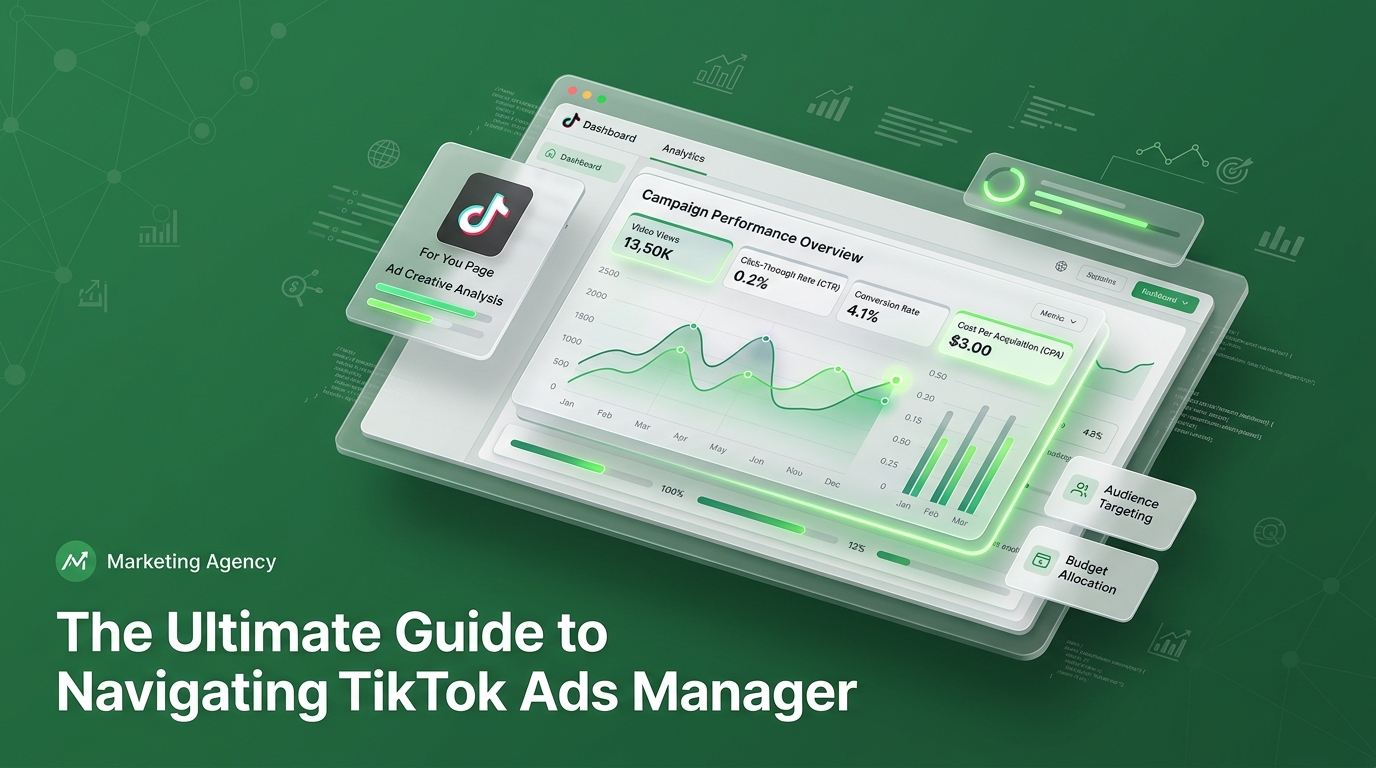
Launching a campaign shouldn’t feel like a gamble. When your budget vanishes with little to show for it, it’s easy to blame your video. However, after auditing dozens of accounts, we’ve found that poor performance rarely stems from your creative it’s almost always a tiktok ads manager mistakes issue. Missing hidden configurations or choosing the wrong settings can quietly tank your budget from day one. If you want to stop burning cash, understanding your backend settings is critical to unlocking a profitable tiktok marketing strategy 2026 approach. In this guide, we will break down the exact setup blunders costing you sales, how to correctly structure your pixel tracking, and the bidding strategies that actually protect your margins. Let’s fix your dashboard so your ads can finally convert.
When you drop a new campaign into the auction without a baseline, jumping straight to restrictive bidding strategies like Cost Cap or Bid Cap forces the system to guess blind. TikTok’s delivery engine requires initial volume to map out your ideal customer profile. Restricting it early only ensures your delivery stalls before the pixel can ever learn what a real conversion looks like.
Here’s what nobody tells you when you sign up: TikTok Ads Manager rewards accounts that give its algorithm a clean, narrow job to do. Most new advertisers do the opposite.
They create one campaign with five ad groups, each targeting a slightly different audience, each running the same three videos, all competing for the same daily budget. TikTok’s system sees five small, under-fed experiments instead of one well-fed one.
The result is predictable. Every ad group gets a trickle of impressions. None of them collects enough data to know who’s actually converting. You end up funding TikTok’s guesswork instead of your growth.
The account isn’t broken. The structure inside it is fighting itself.
TikTok’s delivery system needs a minimum number of conversions per ad group, in a short window, before it can optimize with any confidence. Most advertisers have never heard this rule, so they never build toward it.
Spread a $50 daily budget across five ad groups and each one might get one or two conversions a week. That’s not a signal. That’s noise. TikTok can’t learn from noise, so it keeps testing broadly, and your cost per result stays high indefinitely.
This is the layer most guides skip. They’ll tell you to “test different audiences” without explaining that testing only works once each test has enough spend behind it to actually finish. Split-testing five ideas with one idea’s worth of budget isn’t strategy. It’s five ways of not finding out anything.
Fewer, better-funded ad groups beat a wide, thin spread every time.
Before you touch targeting or creative, fix the shape of the campaign itself.
conversions, if you’re selling something, not traffic or engagement. Mixed objectives inside one campaign confuse what the algorithm is optimizing toward.
per campaign while you’re still gathering data, not five or six. Fewer groups means each one gets enough budget to actually learn.
not one. TikTok rotates spend toward whichever version performs, so you want real options inside the test, not outside it.
If your target cost per result is $20, that’s roughly $400 a day per ad group not per campaign.
Once your dashboard actually reflects how the auction is thinking, our paid social advertising team usually finds the second problem waiting right behind the first: who you told it to reach.
Get the shape right first. Everything else is easier to fix once the foundation isn’t fighting you.
Broad targeting scares people. It shouldn’t.
Most new advertisers build a narrow custom audience age range, three interests, one location because it feels safer than letting TikTok pick. It isn’t. A narrow audience gives the algorithm a small pool to search inside, which slows delivery and pushes your CPM up.
TikTok’s system was built to find your buyer inside a broad pool, not a pre-filtered one. Interest and behavior targeting worked in 2021. In 2026, the algorithm’s own signal-matching usually outperforms your manual guess about who wants your product.
Here’s the shift that actually moves the needle:
Once you’re watching how real visitors behave after the click instead of guessing at who they are beforehand, patterns show up fast, which is the whole argument for running proper behavioral tracking alongside your ad account instead of flying on ad-platform data alone.
Trust the algorithm with reach. Trust your data with everything after the click.
This is the part of TikTok Ads Manager that gets ignored until it’s expensive.
If your TikTok Pixel isn’t firing on every meaningful event view content, add to cart, purchase the algorithm is optimizing off partial information. It’ll happily keep spending toward people who click but never buy, because “purchase” was never defined clearly enough for it to chase.
Check these before you scale spend, not after:
This is exactly the gap our website and campaign analytics team finds first when a new client’s “creative isn’t working.” Usually the creative is fine. The account just never knew a sale happened.
An algorithm can only optimize toward what it can actually see. Give it the full picture.
TikTok gives you three bid strategies, and the difference between them decides how fast you can safely scale.
Most accounts we take over jump straight to Cost Cap or Bid Cap in week one, before the algorithm has any baseline to work from. That’s like setting a speed limit before you’ve driven the road once.
Let Lowest Cost run first. Cap the cost only once you actually know what “good” looks like for your account.
Getting this sequencing right is the difference between an account that scales calmly and one that stalls every time you raise the budget which is usually a funnel problem wearing an ad-platform disguise.
At “TheMayk”, we don’t start by writing ad copy. We audit your Ads Manager first, looking at campaign structure, targeting, pixel quality, and bidding strategy. In 48 hours, we usually find two or three critical errors.
With TikTok projected to hit nearly $44 billion in ad revenue in 2026 according to Statista’s TikTok data, it has quickly become the third most popular platform for paid social budgets based on HubSpot’s 2026 Social Media Marketing Report. TikTok’s own metrics show most weekly users research products after seeing an ad, but many accounts simply aren’t structured to capture that demand.
If your CPM is climbing while sales stall, a new video won’t fix a broken setup. Let’s find the settings costing you money book a free audit call today.
Because in 2026, the difference between a “No” and a “Yes” isn’t your tech stack it’s the human strategy behind it. Let’s turn your digital ghost town into a conversion machine.
How to Avoid Wasting Money on Digital Ads You’re putting real money into ads and the dashboard says things look fine. Clicks are up. Your agency…
How to Fix a Weak Brand Identity You’ve paid for the logo, the website, even a brand guide nobody opens. Prospects still start calls with “so,…
How to Avoid Common SEO Mistakes That Hurt Rankings You’ve published consistently. You’ve built links. You’ve done the keyword research, the meta tags, the alt text…
How we use your info: Used strictly to review your project, prepare tailored insights, and reach out for a 1-on-1 strategy call. Zero spam, zero shared data.