How to Remove a WordPress Backdoor Before It Returns
How to Remove a WordPress Backdoor Before It Returns You paid someone to clean your hacked WordPress site, watched the malware alert clear, and went back…
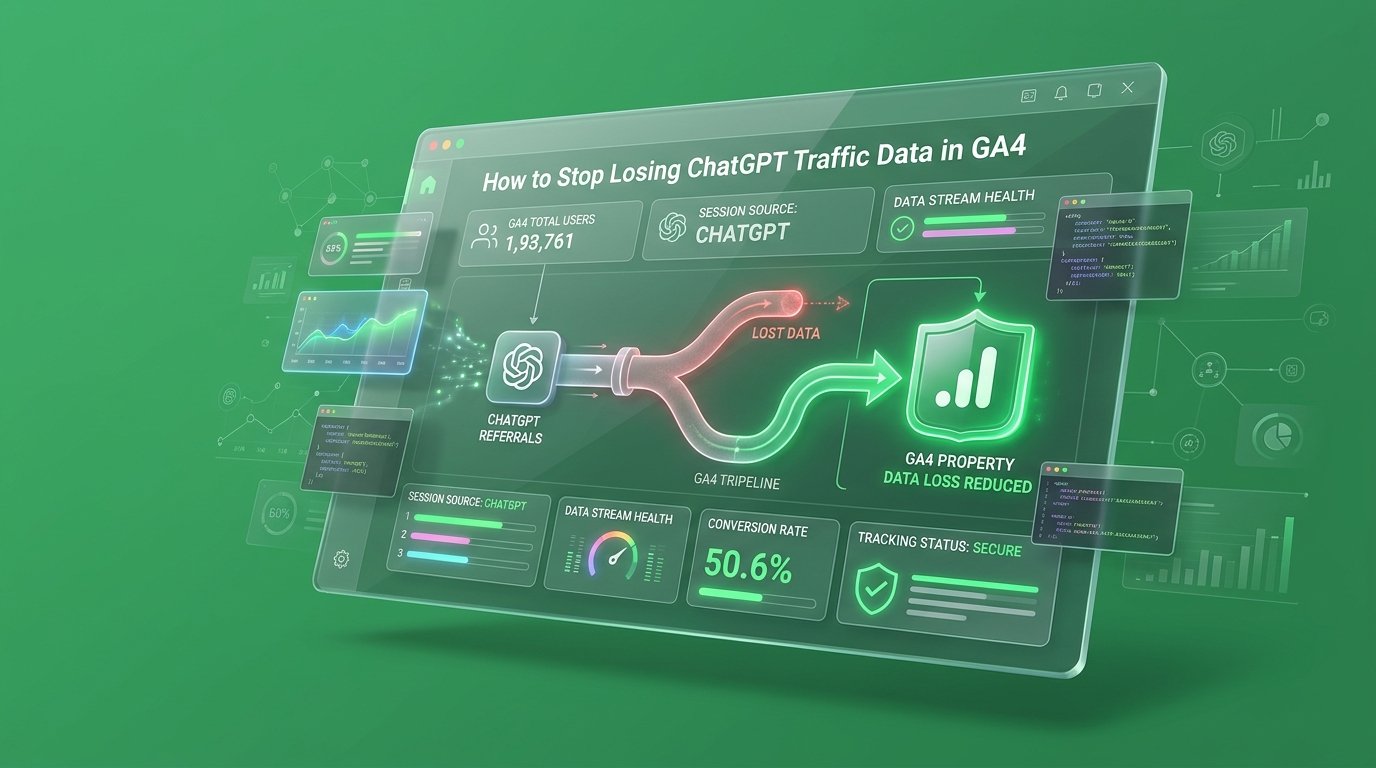
Your ChatGPT traffic dropped off a cliff in October, and your team is already questioning your AI search strategy.
Someone on your marketing team probably blamed an algorithm shift or told you to rewrite your content. We’ve audited enough analytics setups to tell you that’s dead wrong.
Your visitors didn’t stop clicking GA4 quietly misfiled them into Direct traffic.
Relying on fragile default analytics settings turns every platform update into a fire drill for your marketing team. When third-party referral tags fail, unconfigured accounts silently dump valuable buyer intent into Direct traffic instead of flagging the leak. You need custom channel rules and clean attribution pipelines that protect your data automatically, so you can make confident budget decisions without second-guessing your dashboard.
Open your GA4 Traffic Acquisition report right now and look at the second week of October.
If your numbers look like most of the accounts we inspect, your ChatGPT referrals fell off a ledge around October 8 while your Direct traffic spiked on the exact same pages.
Most marketing managers panic when they see a sudden 40% to 50% drop in a growing acquisition channel. They pause content updates, reallocate budget, or tell leadership that AI visibility is drying up.
Making budget decisions off broken attribution is expensive guessing.
Here is what actually happened behind the scenes:
Visitors still clicked your links inside ChatGPT answers at the exact same pace.
GA4 stripped the source label because the incoming clicks arrived completely blank.
Your Direct bucket absorbed the credit, making it look like thousands of people suddenly memorized your deepest blog URLs.
You didn’t lose your audience; you lost the receipt.
To understand how to stop losing ChatGPT traffic data in GA4, you have to understand how fragile AI attribution actually is.
Unlike traditional Google Search, ChatGPT rarely passes a standard browser referrer header when someone clicks a link especially on mobile apps, where links open inside in-app browsers using noreferrer rules.
GA4 only knows a visitor came from ChatGPT because OpenAI appends utm_source=chatgpt.com to outbound URLs. When that single parameter breaks, GA4 has zero fallback signals and dumps the session straight into Direct.
According to Search Engine Land’s reporting on the October UTM bug, Adobe’s Cedric Huesler analyzed roughly 500 pages and found that ChatGPT-attributed visits dropped by about 31,000 per day between October 9 and October 13, while Direct visits jumped by roughly 26,000 per day on those exact same pages.
Further tracking data from Search Engine Journal confirmed that as OpenAI rolled out GPT-6 and its new Intelligent UI cards, the share of cited answers carrying a tagged source link plummeted from 98% to 66% before OpenAI pushed a fix on October 15.
If your entire AI reporting relies on a third-party platform remembering to tag its links, your data will break again.

You cannot retroactively force GA4 to reclassify historical Direct sessions from October 8 to October 15—once GA4 processes a session without a source parameter, that label is permanent.
What you can do is isolate the historical gap and build a clean tracking setup so future tagging glitches never blindside your team. If your reporting stack already feels duct-taped together, our business and website analytics team builds custom attribution systems that catch these leaks automatically.
Follow these five steps today to lock down your GA4 data:
so nobody on your team mistakes a platform tagging bug for a real drop in AI search performance.
by filtering for URLs that historically pulled ChatGPT clicks and comparing their Direct traffic spike against the prior two weeks.
under Admin > Data Display > Channel Groups using a regex rule (.*(chatgpt|openai|perplexity|gemini|copilot|claude).*) and drag it above the default Referral channel.
in your custom channel rules so sessions showing chatgpt.com / (not set) don’t slip into Unassigned.
to your lead forms and checkout flows asking buyers how they found you, because self-reported data catches dark AI traffic that browser headers miss.
A clean channel rule turns messy parameter variations into one reliable line item.
Once your custom channel group is live, pair it with disciplined crawler management so you aren’t accidentally blocking the bots that generate those citations in the first place. Our 2026 guide on blocking AI crawlers in robots.txt breaks down how to block training scrapers while keeping search fetchers wide open.
At “TheMayk”, this exact attribution cleanup is the first thing we run during a full sales funnel breakdown because you can’t optimize conversion rates when half your top-of-funnel traffic is hiding in the wrong bucket.
Stop guessing where your best buyers are coming from. Let’s fix your tracking and build a growth system that actually holds up visit THEMAYK to book your analytics audit.
At “TheMayk”, we build bulletproof attribution systems that keep your analytics accurate even when platforms break their own tracking. You didn’t lose your AI search audience you just lost the paper trail. Stop guessing where your best buyers are coming from, and let’s fix your reporting foundation. Explore our analytics services and book your audit at www.themayk.com today.
Because in 2026, the difference between a “No” and a “Yes” isn’t your tech stack—it’s the human strategy behind it. Let’s turn your digital ghost town into a conversion machine.
How to Remove a WordPress Backdoor Before It Returns You paid someone to clean your hacked WordPress site, watched the malware alert clear, and went back…
How to Stop Losing ChatGPT Traffic Data in GA4 Your ChatGPT traffic dropped off a cliff in October, and your team is already questioning your AI…
How to Rank in AI Search Engine Overviews in 2026 You’re ranking on Google, publishing content every week, and investing in SEO. But when a potential…
How we use your info: Used strictly to review your project, prepare tailored insights, and reach out for a 1-on-1 strategy call. Zero spam, zero shared data.