How to Rank in AI Search Engine Overviews in 2026
How to Rank in AI Search Engine Overviews in 2026 You’re ranking on Google, publishing content every week, and investing in SEO. But when a potential…
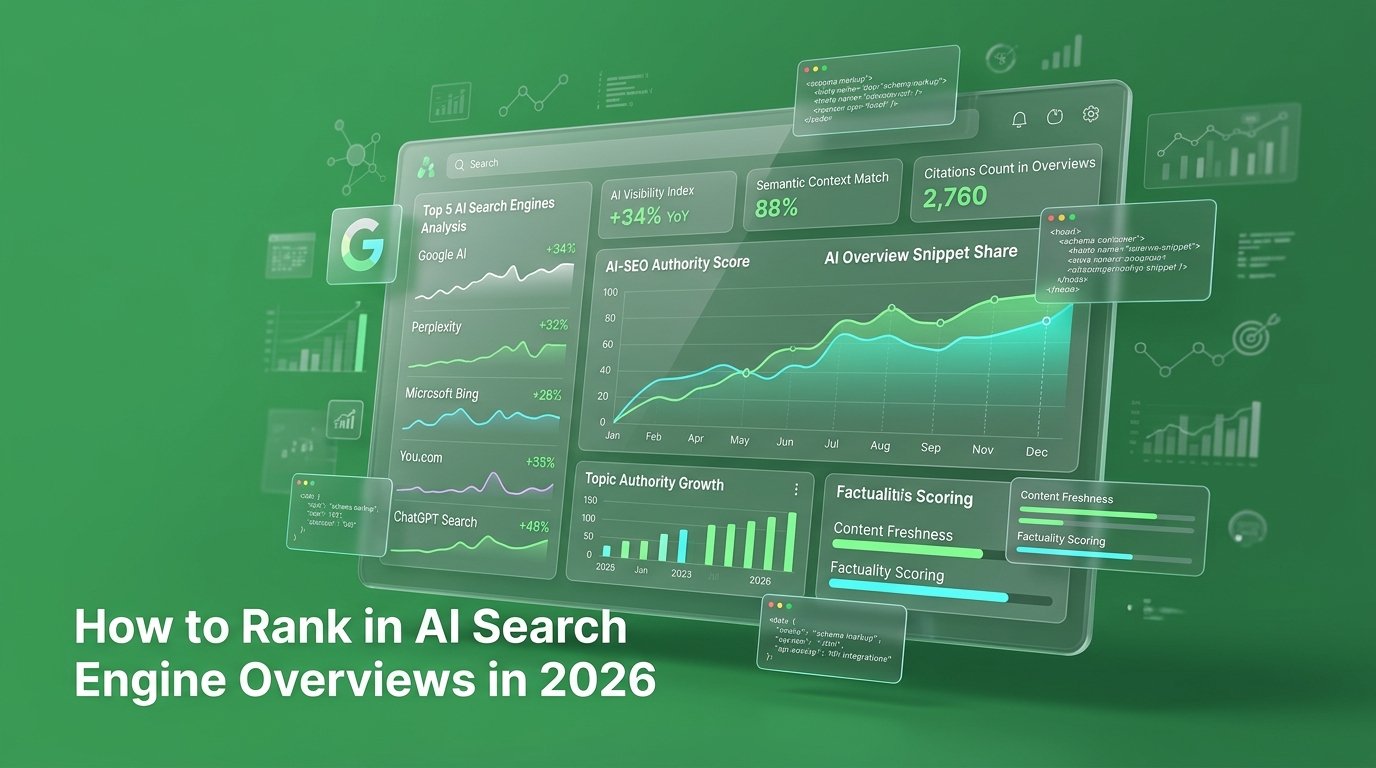
You’re ranking on Google, publishing content every week, and investing in SEO. But when a potential customer asks ChatGPT, Gemini, or Google AI Overviews to recommend a company in your industry, your brand is nowhere to be found. Your SEO agency says to publish more articles. That’s probably not the answer. AI search doesn’t just need another page. It needs a source it can retrieve, understand, and trust.
AI search is changing how customers discover businesses, compare services, and make purchasing decisions. If your website only focuses on traditional keyword rankings, you could miss valuable opportunities. Review your content, improve technical accessibility, and build a consistent brand presence across trusted platforms. The goal isn’t simply to appear in search results; it’s to become a source worth recommending.
Traditional SEO and AI search share a foundation, but they don’t deliver visibility in exactly the same way.
A traditional Google result gives users a list of pages to explore. AI search experiences such as Google AI Overviews, Gemini, and ChatGPT Search can collect information from multiple sources and present a synthesized response with supporting links.
That changes the opportunity for businesses.
Your website might rank well for a competitive keyword but still miss the specific questions an AI system uses to build its answer. A competitor with a smaller website could earn a citation because its content directly addresses the question and provides clearer supporting information.
Google’s own documentation on AI features confirms that existing SEO fundamentals remain relevant. There is no separate technical requirement or special AI markup that guarantees inclusion in AI Overviews.
So why are businesses spending money on so-called AI ranking shortcuts?
Because they’re confusing technical eligibility with actual visibility.
Getting indexed is the starting point. Becoming a useful source is the real competition.
Here’s where most SEO strategies need a rethink.
When someone searches for a service, they rarely use just one short keyword. They ask questions, compare alternatives, describe problems, and add specific requirements.
For example, a business owner might ask:
Which branding agency understands e-commerce businesses?
How much does professional product visualization cost?
Which SEO strategy helps a small company appear in AI search?
What should I check before hiring a digital marketing agency?
These questions create different opportunities for your website.
Google AI Overviews and AI Mode can use a process called query fan-out, where the system issues multiple related searches across subtopics and information sources to develop an answer.
This means a single search can create several opportunities for relevant pages to be discovered.
The same principle matters in Retrieval-Augmented Generation (RAG). A RAG system retrieves relevant information from external sources and uses that information to support a generated response.
Your content needs to be useful at the retrieval stage, not just attractive in a traditional search result.
A page that answers the wrong question won’t become a valuable source simply because it contains the right keyword.
Before changing your content strategy, understand what you’re actually optimizing.
These three terms are connected, but they aren’t interchangeable.
Search Engine Optimization (SEO)
SEO helps search engines discover, crawl, index, and rank your website. It includes technical performance, keyword targeting, internal links, content quality, and website structure.
Generative Engine Optimization (GEO)
GEO focuses on increasing your brand’s visibility in AI-generated responses. The goal is to make your content easier for generative search systems to identify, retrieve, understand, and cite.
Retrieval-Augmented Generation (RAG) Optimization
RAG optimization focuses on how information is retrieved and supplied to an AI system before it generates an answer. Clear information, relevant passages, and reliable source material can make your content more useful during retrieval.
Think of the relationship this way:
SEO helps your website become discoverable.
GEO focuses on visibility and citations in generated answers.
RAG optimization focuses on the information retrieval process that can support those answers.
Not every AI search platform uses an identical retrieval process. Treating them as one algorithm is a mistake.
You need one connected strategy, not three disconnected marketing campaigns.

Now let’s get practical. You don’t need to delete your existing SEO strategy and start again. You need to strengthen the parts that make your website useful to both search engines and potential customers.
Read your last five posts out loud. If they sound like a dry textbook, rewrite them with a specific, spicy opinion.
Publishing 20 unrelated articles doesn’t automatically make your website an authority.
If you run an e-commerce marketing agency, your content should demonstrate expertise in the subjects your customers actually need help with.
Start by building topic clusters around your main services.
For example:
SEO and AI Search
How to rank in Google AI Overviews
How to optimize content for ChatGPT Search
How to improve website crawlability
How to measure AI search visibility
Branding and E-Commerce
How branding influences purchasing decisions
How product visuals affect conversion rates
How to create a consistent brand identity
Marketing Performance
How to identify conversion funnel problems
How to measure paid advertising performance
How to improve landing page conversions
Connect related articles through contextual internal links. This helps readers discover supporting information and gives search engines clearer paths through your website.
Our guide on getting products recommended by ChatGPT is another example of a topic that supports this wider AI visibility strategy.
Your website should demonstrate what your business knows, not just how often it publishes.
This is where generic AI-generated content becomes a serious problem.
If your article repeats the same advice found across dozens of competing websites, there’s little reason for another source to stand out.
You need information that adds something useful.
Start including:
Original research and industry observations.
Real examples from your projects.
Expert commentary and practical explanations.
Relevant statistics linked to their original sources.
Clear comparisons between products, services, and approaches.
Specific processes that demonstrate how your team works.
A 2026 research paper by Mahe Chen and Nick Koudas, What Drives AI Citations? Content, Retrieval and Model Knowledge in Generative Engine Optimization, examined 158,099 AI-generated answers and 468,037 citations.
Its findings suggest that pages whose titles and paragraphs closely match the questions being asked receive more citations. The research also found that retrieval decisions explain considerably more citation variation than individual page properties.
The takeaway is straightforward: matching the actual information need matters more than decorating a page with GEO elements.
Don’t publish another article that says what everybody else already says. Give readers a reason to remember your source.
You can have excellent content and still create a technical problem that prevents an AI search platform from accessing it.
Check your robots.txt file, server settings, CDN rules, and crawl restrictions.
For ChatGPT Search, pay particular attention to OAI-SearchBot.
According to OpenAI’s official crawler documentation, OAI-SearchBot is used to discover websites for ChatGPT search features.
OpenAI also separates search crawling from GPTBot, which is associated with potential model training.
This distinction matters. Blocking one bot doesn’t automatically mean you’ve blocked the other.
Your technical checklist should include:
Allow OAI-SearchBot if you want your pages to be eligible for ChatGPT Search.
Ensure Googlebot can access your important content.
Check that important pages aren’t accidentally marked noindex.
Review canonical tags and redirect errors.
Submit an accurate XML sitemap.
Make important website information available in readable text.
We’ve covered the technical side in our guide on how to block AI crawlers in robots.txt. The important point is to make deliberate access decisions rather than blocking crawlers without understanding their purpose.
If a search system can’t access your content, your content strategy has a problem before ranking even begins.
AI systems need to understand which business they’re discussing.
If your website describes your company as a branding studio, LinkedIn calls it a software consultancy, and your business profiles describe something entirely different, you’re creating unnecessary confusion.
Build a consistent identity across your digital presence.
Check that:
Your business name is consistent across platforms.
Your website clearly explains what you do.
Your services have dedicated, detailed pages.
Your team and expertise are presented accurately.
Your business profiles contain current information.
Your important claims have supporting evidence.
Use structured data where it accurately represents visible page information. Organization, Product, Article, and other relevant schema types can help search engines interpret your content.
However, don’t add schema simply because someone claims it guarantees AI citations.
Google explicitly states that no special schema markup is required for inclusion in AI Overviews.
Your website, business profiles, and published content should tell the same story.
Your website shouldn’t be the only place where your business exists.
AI search visibility also involves how your brand is represented across the wider web.
Look for opportunities to build credible third-party references through:
Industry publications.
Relevant interviews and expert contributions.
Genuine customer reviews.
Industry directories.
Professional partnerships.
Relevant case studies and brand collaborations.
The goal isn’t to collect hundreds of low-quality backlinks.
It’s to establish a consistent, credible presence in the places where your potential customers and industry experts already exchange information.
A 2025 GEO research paper by Chen and colleagues also found differences in how generative search systems use brand-owned and third-party sources.
That makes external brand credibility worth measuring alongside your website’s own content.
A brand that only talks about itself has a weaker evidence trail.
Traditional SEO reporting often focuses on impressions, clicks, rankings, and organic conversions.
Those metrics still matter, but they don’t tell you everything about AI search visibility.
Start monitoring your website across several AI search experiences.
Here’s what to measure:
| Metric | What to monitor |
|---|---|
| AI citations | How often your pages appear as sources |
| Brand mentions | Whether AI answers mention your business |
| Cited URLs | Which specific pages receive visibility |
| Referral traffic | Visits arriving from AI platforms |
| Conversions | Leads and sales from AI referrals |
| Search performance | Organic impressions, clicks, and queries |
Microsoft has introduced an AI Performance report in Bing Webmaster Tools that provides information about pages cited in AI-generated answers, citation activity, and grounding queries across supported experiences.
You can explore it through Bing Webmaster Tools’ AI Performance documentation.
For Google, monitor your overall web performance through Search Console. Google reports AI feature traffic within the Web search type rather than providing a separate AI Overviews ranking report.
Also, don’t treat one AI-generated answer as proof of success or failure. Results can change across prompts, dates, and platforms.
Track a consistent set of relevant questions and repeat your checks over time.
If you aren’t measuring citations and conversions, you’re only guessing about AI visibility.
At “TheMayk”, we wouldn’t start by ordering 30 AI-written articles or purchasing another expensive optimization tool.
We’d start with an audit.
Our approach would follow five steps:
Audit existing visibility: Identify which pages already rank, which topics generate traffic, and where competitors are receiving AI citations.
Check technical access: Review indexing, robots.txt, crawler permissions, page rendering, internal links, and structured data.
Map search intent: Identify the questions customers ask across Google, ChatGPT, Gemini, and other relevant AI search platforms.
Rebuild content around evidence: Improve existing pages, add original insights, strengthen topic clusters, and remove unnecessary repetition.
Track commercial performance: Monitor citations, brand mentions, referral traffic, and actual leads to identify which improvements produce business value.
This approach connects SEO, GEO, content strategy, website development, and analytics instead of treating each as a separate service.
That’s how we approach search visibility at THEMAYK.
Ranking in AI search isn’t about finding a secret prompt or adding an AI badge to your website.
It’s about building a business presence that search systems can access, understand, retrieve, and verify. Strong technical SEO, useful content, consistent brand information, and credible external references all contribute to that foundation.
At THEMAYK, we connect Generative Engine Optimization, content strategy, technical SEO, and analytics to help brands compete for visibility across traditional and AI-powered search.
If your business is getting overlooked in AI search, let’s find out what’s missing. Contact our agency at THEMAYK and let’s build a search strategy that gets your brand found and remembered.
Stop Guessing. Start Growing.
AI search visibility isn’t built through shortcuts or keyword stuffing. It comes from creating useful content, maintaining strong technical SEO, and giving search systems reliable information about your brand. Businesses that invest in these foundations can improve their chances of earning AI citations and reaching potential customers. Start building your AI search strategy before your competitors get ahead.
Because in 2026, the difference between a “No” and a “Yes” isn’t your tech stack—it’s the human strategy behind it. Let’s turn your digital ghost town into a conversion machine.
How to Rank in AI Search Engine Overviews in 2026 You’re ranking on Google, publishing content every week, and investing in SEO. But when a potential…
How to Survive the Google November 2026 Core Update The Google November 2026 core update started rolling out on November 10, your rankings are already jumping…
How to Stop Overpaying for Black Friday Meta Ads You’re about to raise your Black Friday Meta ads budget, and your CPM already looks ugly. Your…
How we use your info: Used strictly to review your project, prepare tailored insights, and reach out for a 1-on-1 strategy call. Zero spam, zero shared data.