
How to Avoid Regret Buying the Xbox Nano Controller
How to Avoid Regret Buying the Xbox Nano Controller The Xbox Nano Controller is $49.99, pocket-sized, and open for pre-order. The headlines make it sound like…
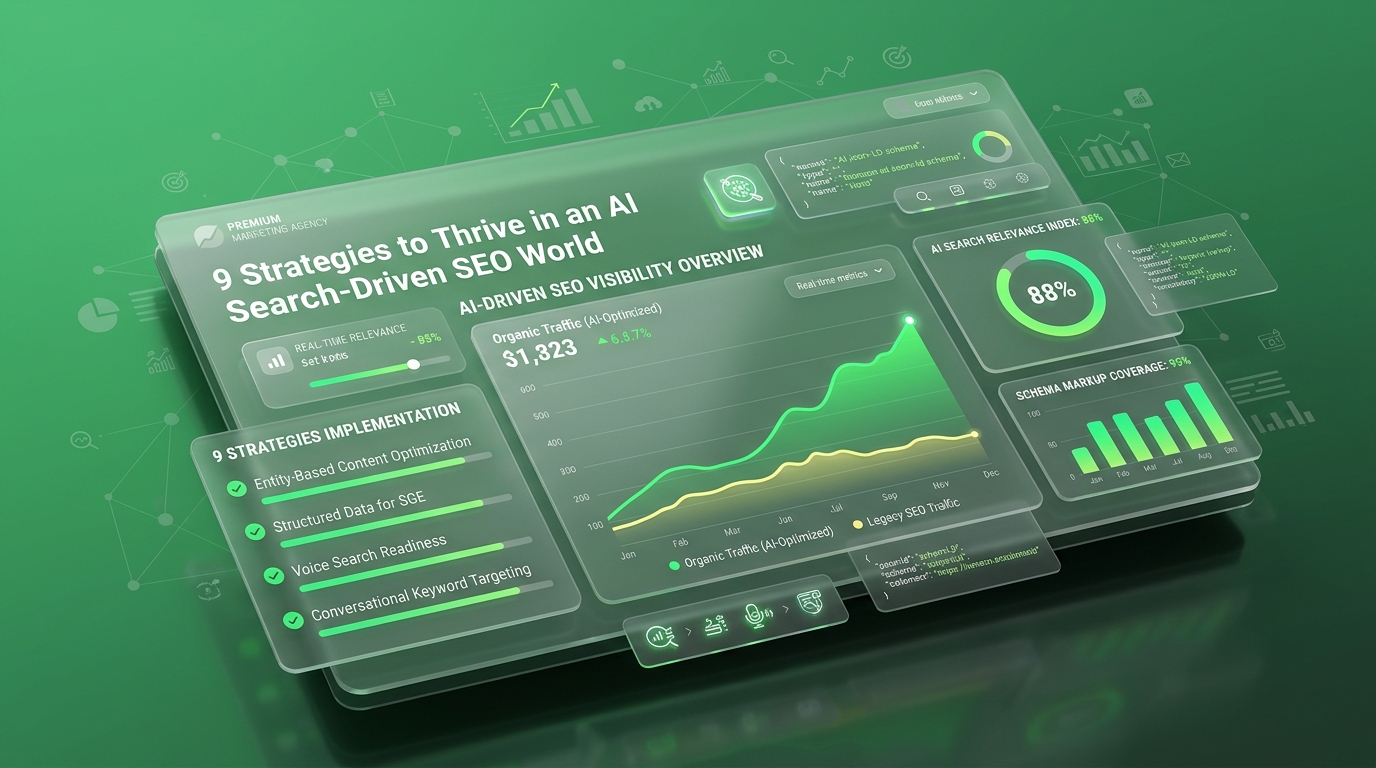
You’ve been doing SEO. You’ve ranked. You’ve followed the playbook. And your traffic is still dropping. Here’s what’s actually happening: AI search Google’s AI Overviews, Perplexity, ChatGPT Search, Microsoft Copilot is now answering questions directly on the results page. No click required. No visit needed. Your content gets read, synthesized, and summarized without your site ever seeing the user.
According to SparkToro’s zero-click search research, over 58.5% of all US Google searches now end without a single click to any external website. And when AI Overviews are present, that number climbs to 83%. You’re not losing to a competitor. You’re losing to the search engine itself.
The businesses that understand this are adapting. The ones that don’t are watching their organic traffic erode and blaming their agency for it. This isn’t about abandoning SEO. It’s about understanding that the game has two layers now and most businesses are only playing one of them.
Here are nine strategies that address both.
The shift to AI search is not coming it is already here. In 2026, visibility depends less on ranking first and more on being cited first. Brands that treat Generative Engine Optimization (GEO) as seriously as traditional SEO are seeing stronger AI citations, higher brand authority, and more resilient traffic. Those still relying on outdated tactics are quietly disappearing from AI answers. The good news? The strategies above give you a clear roadmap to adapt. Start implementing them now to protect and grow your organic presence before the gap widens further.
Before the strategies, you need to internalize the shift.
Traditional SEO was built around a simple exchange: rank high on a list of ten links, attract the click. That exchange is being disrupted at a rate most SEO teams haven’t fully accounted for yet.
Ahrefs’ February 2026 data shows that the presence of an AI Overview cuts click-through rates for position one by 58%. Not by a little. By more than half. You could have the top organic ranking and still lose most of the traffic you’d have received eighteen months ago.
And there’s a second problem that’s even more quietly damaging. Research from GEO firm Brandlight, cited by LLMRefs, found that the overlap between top Google organic results and AI-cited sources has dropped from 70% to below 20%. Ranking high no longer means AI is reading your content. They’re increasingly separate audiences, with separate content preferences.
That’s the context. The strategies below are built for it.
This is the most important structural change you can make, and it’s the one most businesses are slowest to make.
Traditional SEO content is built from the keyword outward. You start with a phrase, optimize a page around it, and structure your article to support that ranking objective. AI search doesn’t work that way. It works from the question inward.
AI engines are respondents. They read your content looking for a direct, clear, specific answer to a query. If your article buries the answer in three paragraphs of context before getting to the point, AI skips it and pulls from someone who answered faster. The fix is structural. Every piece of content you produce should open with a direct, specific answer to the question it’s targeting within the first 100 words. Not a teaser. Not a promise. The actual answer. Then build the context, the nuance, the evidence. But lead with the answer. AI reads like a very impatient expert, and it rewards content that respects that.
At “TheMayk”, when we audit a content library, this is the first thing we check: does the page answer the question clearly, or does it make the reader and the AI hunt for it? Most pages make them hunt. That’s fixable.
Most business websites have either no schema markup or the bare minimum that a WordPress plugin installed automatically. That’s not enough anymore.
Schema markup is how AI search engines understand the structure of your content what type of page this is, what question it answers, who authored it, when it was published, and how it connects to other content on your domain.
Without it, AI has to infer all of that from context. AI infers imperfectly and at scale. It will skip your well-written article because the structure doesn’t signal clearly what it contains.
The specific schema types that matter most for AI search visibility in 2026:
Research from Seer Interactive on 25 million impressions found that organic CTR dropped from 1.62% to 0.61% when AI Overviews were present. Schema markup is one of the most direct ways to influence whether your content gets included in that overview rather than replaced by it.
Run a full schema audit on your top 20 pages. If they’re empty, that’s where you start.
Here’s the insight that trips up even experienced SEO practitioners.
AI language models are trained on text, not hyperlinks. This means the signals that drive AI citation behavior are fundamentally different from the signals that drove traditional Google rankings. Backlinks built PageRank. Brand mentions build AI authority.
An Ahrefs study of 75,000 brands, published in August 2025, found that brand mentions correlate 3x more strongly with AI visibility than backlinks do a correlation of 0.664 versus 0.218. If your brand is regularly referenced across authoritative third-party publications, industry forums, analyst reports, and credible media sources, AI engines learn to treat you as a trustworthy source. If you only appear on your own website and a handful of paid placements, you don’t exist to the AI. This means your off-site strategy needs to look more like digital PR and less like traditional link building. Getting quoted in trade publications matters. Publishing original research that others cite matters. Building a real presence on the authoritative platforms AI models pull from Reddit, LinkedIn, niche industry sites matters.
Our content marketing strategy work at “TheMayk” is increasingly built around this off-site authority layer, not just on-page optimization. The two need to work together.
One well-ranking page does not make you a category authority in the eyes of AI search.
AI engines evaluate brands at the domain level, not just the page level. If your site has one strong article on a subject surrounded by thin, unrelated content, AI treats you as a one-hit source not an authority. Category authorities get cited repeatedly. One-hit sources get ignored after the initial extraction.
Building topical authority means publishing a cluster of content around every core subject you want to own. A pillar page. Supporting articles that go deep on related subtopics. Internal links that connect them logically. Regular updates that signal the topic is actively maintained.
Goodfirms’ 2026 marketer survey found that 43% of marketers are now actively implementing Generative Engine Optimization (GEO) strategies up from near zero in 2025. The businesses building topical clusters now are accumulating citation authority ahead of the majority who haven’t started yet. That gap compounds.
Map your core service areas. Build a content cluster for each one. This isn’t optional for AI search it’s the structural minimum.
E-E-A-T Experience, Expertise, Authoritativeness, Trustworthiness is not new. But how AI evaluates it is different from how traditional Google evaluated it. Traditional Google looked at on-page signals: author bios, credentials pages, internal links. AI engines evaluate E-E-A-T through off-site validation which authoritative publications reference you, which trusted platforms mention your brand, what the broader external web says about your credibility.
An author bio on your blog does not establish you as an expert in AI search. Being cited by industry publications, quoted in credible media, and referenced in original research does. This has practical implications. Your experts need visible external profiles. They need bylines in publications beyond your own site. They need to be the named source for data and insights that others pick up and republish. First-person expertise signals phrases like “in our experience” or “across the campaigns we manage” help establish credibility to AI models trained to prefer authoritative, specific sources over generic assertions.
TheMayks’s AI-powered content creation work always begins with this audit: who is the author, what makes them credible, and does that credibility exist where AI can find it?
Generic content doesn’t get cited. This sounds obvious. It’s not being treated that way.
If your content contains claims like “studies show that content marketing drives results” or “businesses that invest in SEO see improved visibility” — those claims are invisible to AI. They’re too vague to cite. They don’t contain verifiable information. AI engines prefer content with data, named examples, specific outcomes, and original research.
Research using the GEO-BENCH benchmark, published by IMD, found that GEO methods specifically the inclusion of citations, statistics, and quotations from credible sources boost content visibility in AI responses by over 40%.
AirOps’ April 2026 structured content study reinforces this: comparison pages with tables earn 25.7% more citations in AI responses, while content using shorter average sentence lengths earns up to 18.8% more citations.
Go through your top-performing content. For every major claim, ask one question: can this be independently verified? Does it have a number attached? Is there a named source? If not, it’s opinion — and AI treats it accordingly. The fix isn’t complicated. It’s disciplined. Add original data where you can. Cite credible external sources where you can’t. Name your examples. Attach real outcomes to your case studies. Make your content the kind of thing a skeptical editor would cite because that’s exactly what AI is.
Most SEO dashboards show the same things they showed in 2019: keyword rankings, organic traffic, backlink counts. None of those metrics tell you whether AI search is discovering or recommending your brand. And in 2026, that’s the visibility that’s starting to determine category leadership.
Semrush’s AI Visibility Index data for 2025-2026 found that 40–60% of sources cited in AI-generated responses rotate month over month. This is a fluid, dynamic environment and you cannot manage what you’re not measuring.
Tools that now make AI search visibility measurable:
These aren’t optional additions to your reporting stack anymore. If you’re spending money on SEO and organic growth without measuring AI search visibility, you’re making decisions with incomplete information. Set up AI visibility tracking before Q3 2026. The businesses doing this now will have six to twelve months of trend data when most of their competitors start paying attention.
AI engines develop trust in sources over time not just through individual pieces of content but through publishing consistency and topical focus.
A brand that publishes regularly on a specific set of subjects signals to AI models that it is an active, maintained source of information on those subjects. A brand that publishes sporadically, across unrelated topics, with large gaps between updates, signals the opposite.
Ahrefs’ research on ChatGPT citation behavior found that ChatGPT is more likely to cite newer pages recency is a factor. Content freshness signals active authority. A page last updated in 2023 on a subject that has changed significantly since then is a weak citation candidate.
The practical implication: if you’re publishing twelve blogs a year, across ten different topic areas, you’re not building authority anywhere. You’re spreading thin across everything. Build a focused content calendar around three to five core topic clusters. Publish with regularity. Update your best-performing existing content when the subject matter evolves. Freshness and focus work together. AI citation patterns reward both.
Our content strategy framework at “TheMayk” starts with this: how many topics can you realistically own? Then we build toward owning those not spreading across everything.
This is the strategy most businesses skip because it feels like effort without an obvious return. It has the highest return of anything on this list.
Publish original research.
Not a summary of other people’s data. Not a round-up of industry statistics. Original data that only your brand has from your client work, your proprietary tools, your internal analysis, your customer surveys.
Research using the Princeton University GEO visibility framework found that content with statistics, citations, and original data gets 30 to 40% higher visibility in AI-generated responses. Original research is the highest-value form of that. It’s the content AI has no other source for. It can’t be replaced by a competitor article. It’s verifiable. It’s specific. It builds the kind of off-site citation trail that compounds into lasting AI authority.
This doesn’t require a research team. It requires a commitment to turning what you already know into data. If you’ve audited 200 campaigns, publish the pattern. If you’ve tracked client performance across twelve months, publish the findings. If you’ve surveyed your customers about their biggest challenges, publish the results. Original data is the only content that no competitor can replicate. And it’s exactly what AI search rewards most.
The businesses losing ground right now aren’t losing because they’re doing bad SEO. They’re losing because they’re doing 2023 SEO in 2026. The rules didn’t change overnight. They changed gradually, then all at once. The shift from ten blue links to AI-synthesized answers has been building for years. What’s different now is that the impact is measurable and it’s accelerating. Seer Interactive data on 25 million impressions shows organic CTR falling by 61% year over year for queries where AI Overviews appear. That’s not a trend you can out-optimize with better metadata and more backlinks. The nine strategies above aren’t a complete replacement for SEO fundamentals. Technical performance, site architecture, and link authority still matter they’re just not sufficient on their own. What they need to be combined with is a content strategy that earns AI citation, not just page rankings.
That means clearer answers. Better structure. Real specificity. Topical depth. Off-site authority. Original data. Consistent publishing.
It’s a higher bar. But it’s the bar.
At “TheMatk”, our organic growth and SEO work in 2026 is built around both dimensions: traditional search performance and AI search visibility. We run conversion rate optimization audits that account for the traffic that never arrives the searches that were answered before the click and we build content strategies that put our clients inside the AI answer, not below it.
If your SEO isn’t adapting to AI search yet, let’s look at it together. Book a strategy call at www.themayk.com. Stop guessing. Start growing.
The AI search era has permanently changed how visibility works online. Traditional SEO alone is no longer enough you must now optimize for both clicks and citations. By implementing these 9 strategies, you can protect your traffic, earn AI recommendations, and build lasting authority in 2026.
The brands that adapt fastest will dominate. Don’t wait to be replaced by an AI answer. Start optimizing for the new reality today.
Ready to future-proof your organic growth? Book a strategy call at www.themayk.com.
Because in 2026, the difference between a “No” and a “Yes” isn’t your tech stack it’s the human strategy behind it. Let’s turn your digital ghost town into a conversion machine.
How to Avoid Regret Buying the Xbox Nano Controller The Xbox Nano Controller is $49.99, pocket-sized, and open for pre-order. The headlines make it sound like…
Is the Xbox Nano Controller Actually Comfortable? You’ve read the headlines: five inches, 3.5 ounces, $49.99, all 18 inputs. Everyone’s calling it cute. Nobody’s answered the…
How to Master Social Media Marketing Fast You are posting three times a week on Instagram and LinkedIn. Your designer makes pristine templates, and your team…
How we use your info: Used strictly to review your project, prepare tailored insights, and reach out for a 1-on-1 strategy call. Zero spam, zero shared data.