How to Avoid Regret Buying the Xbox Nano Controller
How to Avoid Regret Buying the Xbox Nano Controller The Xbox Nano Controller is $49.99, pocket-sized, and open for pre-order. The headlines make it sound like…
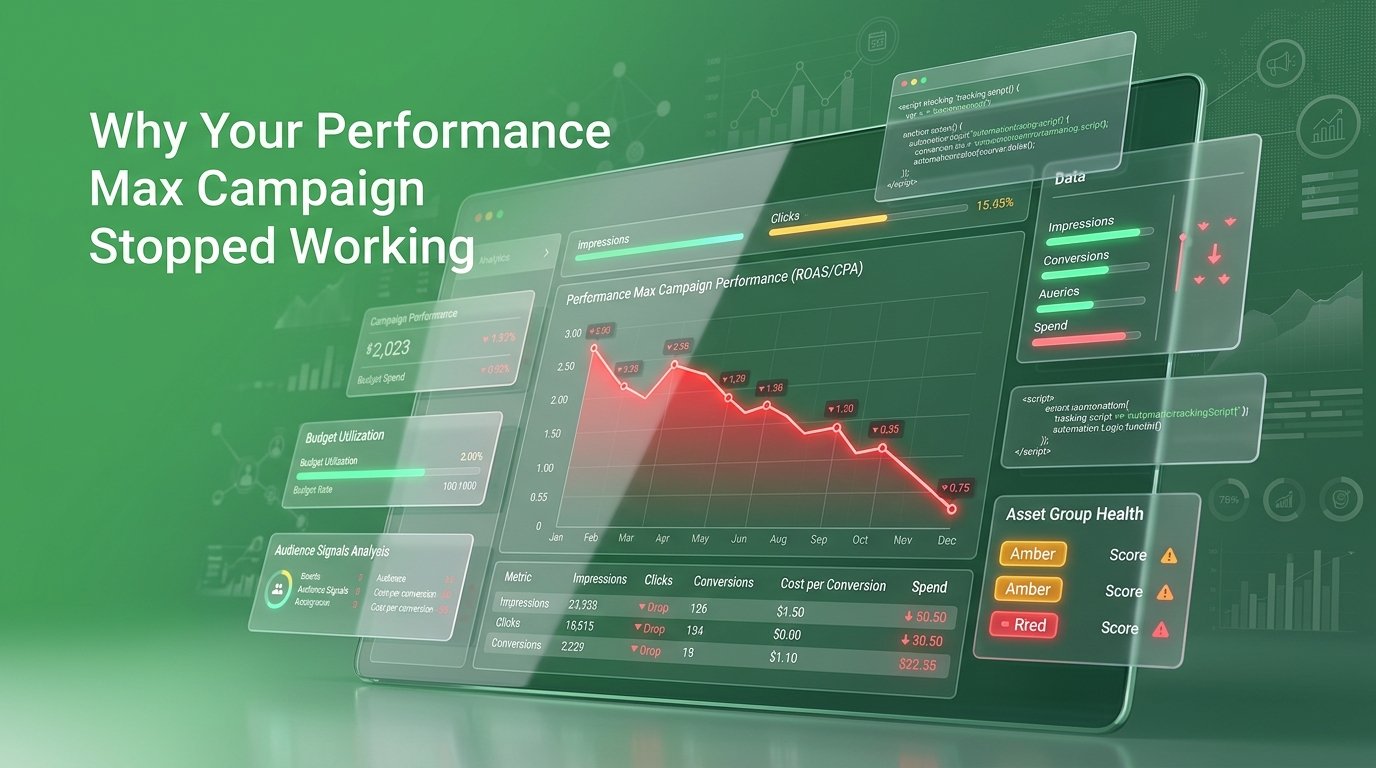
Your Performance Max campaign was hitting target ROAS for weeks. Then, without a single change on your end, the numbers started sliding.
Your account rep says give it more time to relearn. Your agency says the algorithm is “recalibrating.”
We’ve pulled apart hundreds of PMax accounts at THEMAYK. The dip almost never starts with the algorithm. It starts with something you fed it two or three weeks ago that you’ve already forgotten about and by the time it shows up in your ROAS, nobody connects the two.
When campaign performance drops, account managers often blame Google’s learning algorithm to buy time. But machine learning models don’t just lose efficiency overnight without a reason. Performance Max simply acts on the data it receives. When ROAS collapses, it is almost always caused by silent errors in your product feed, tracking drift, or outdated audience signals. Waiting for a broken input to fix itself only burns through your ad budget.
Performance Max doesn’t fail the way a normal Google Ads search campaign fails. There’s no single broken keyword or bad bid you can point to. It’s one system pulling Search, Shopping, Display, YouTube, Gmail, and Discover into a single black box.
That’s exactly what makes the failure so confusing. Something changes upstream your feed, your signals, your conversion data and the drop doesn’t show up for days. By the time you notice it in your dashboard, the cause is long gone from your memory.
Most people get handed one of three explanations when they ask what happened:
None of those are wrong on their own. None of them are the actual reason your account is bleeding money right now, either.
Here’s the part most advertisers never get told: Performance Max optimizes exactly toward the inputs you give it. Not what you meant. Not what worked six months ago. What you’re feeding it right now, today.
When your product feed gets messy, your audience signals go untouched, or your conversion tracking drifts, the system doesn’t announce it. It just quietly starts spending your budget on the wrong signal and reports a normal-looking ROAS while it does it.
This is also why the fix never shows up right away. Google’s own documentation on audience signals confirms it can take up to two weeks for its machine learning models to fully integrate a change you make so the campaign that’s underperforming today is often still running on a signal you updated, or broke, a while back.
That lag is the whole reason “just wait it out” feels like reasonable advice. It isn’t. Waiting only works if the thing you’re waiting on is still moving in the right direction.
Here’s where it gets interesting: the same delay works against a stale account and for a repaired one. Fix the actual input, and the recovery is just as invisible for about two weeks. Then it shows up in your ROAS all at once.

Forget “optimize your campaign.” That’s not a plan, it’s a shrug. Here’s the actual sequence, in order.
A campaign built on top of broken titles, missing GTINs, or outdated pricing fails quietly no matter how good your creative is. Pull your Merchant Center diagnostics first, not last.
Google reports that merchants who add correct GTINs to their product data see a 20% increase in clicks on average and that’s before you’ve touched a single audience signal or bid strategy.
Google has found that advertisers who raise their Ad Strength to “Excellent” see about 6% more conversions on average. That means real headline variety, your own video assets instead of auto-generated ones, and at least six sitelinks not the minimum required to launch.
Stacking five different audiences under one generic asset group hands the algorithm a confused signal. Match the creative to the audience, and give it the full two weeks to actually integrate before you judge it.
Run them together and the algorithm chases whichever converts more often usually your cheapest, lowest-margin SKUs while your best products get starved of budget.
If your funnel data is counting the wrong actions as conversions, every optimization from here forward is aimed at the wrong goal.
Do this in order. Feed and tracking first, creative second, audience structure third. Skip a step and you’re optimizing on top of a broken foundation which is a fast way to make a bad account look busy instead of better.
Before we adjust a single asset group, we pull the feed, the signal history, and the conversion tracking setup for every new account. It takes us about 48 hours, and it almost always turns up the same two or three leaks a stale feed, an unbalanced asset group, or a conversion action that’s been miscounting for months.
That’s not a guess. It’s the reason “add more budget” so rarely works: more money into a broken signal just buys you a bigger version of the same problem.
Stop guessing why your ROAS dropped. Let’s find the actual leak book a free audit at themayk.com.
The “relearning phase” is a comfortable myth, but bleeding budget isn’t. When a Performance Max campaign drops off a cliff, it isn’t an algorithm mystery it is a signal problem. Fix your product feed, audit your conversion tracking, and align your asset groups before touching another bid. Stop throwing money at a confused model. Book a free, 48-hour PMax audit at themayk.com and plug the actual leaks dragging down your ROAS.
Because in 2026, the difference between a “No” and a “Yes” isn’t your tech stack—it’s the human strategy behind it. Let’s turn your digital ghost town into a conversion machine.
How to Avoid Regret Buying the Xbox Nano Controller The Xbox Nano Controller is $49.99, pocket-sized, and open for pre-order. The headlines make it sound like…
Is the Xbox Nano Controller Actually Comfortable? You’ve read the headlines: five inches, 3.5 ounces, $49.99, all 18 inputs. Everyone’s calling it cute. Nobody’s answered the…
How to Master Social Media Marketing Fast You are posting three times a week on Instagram and LinkedIn. Your designer makes pristine templates, and your team…
How we use your info: Used strictly to review your project, prepare tailored insights, and reach out for a 1-on-1 strategy call. Zero spam, zero shared data.