
Blogs > Why Isn’t My Manufacturing Website Getting Inquiries?

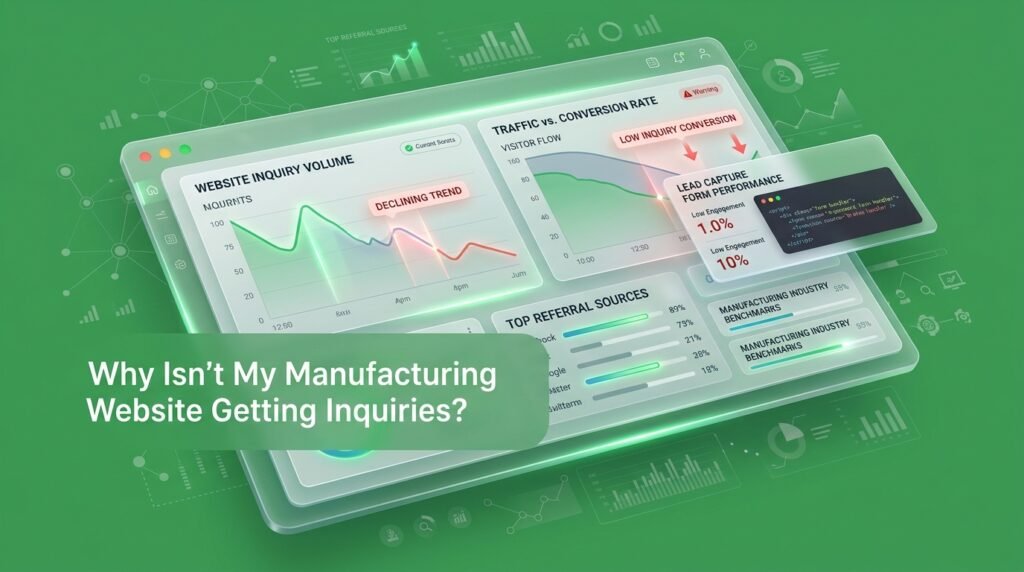
Why Isn't My Manufacturing Website Getting Inquiries?

You checked the analytics again this morning. Sessions are up. Time on page looks decent. Someone even shared your capabilities page on LinkedIn last week.

And the inquiry form still sits empty.

Your sales team is asking why the “great new website” hasn’t produced a single qualified lead in three weeks. Your agency says to give it more time. We’ve sat across the table from enough manufacturers to know what’s actually happening: the traffic was never the problem. What happens to that traffic once it lands is.

Your Fastest Path to More Qualified Leads

Most traffic issues are actually clarity issues. When you replace generic statements with precise tolerances, clear lead times, and upfront material specs, high-value buyers can instantly verify that you’re the right fit. Eliminate the friction on your pages, give engineers the immediate answers they need, and turn your existing visitors into active, qualified quote requests starting this week.

Your Traffic Is Growing And Your Inbox Is Still Empty

Here’s what nobody tells you when you launch a new site: getting found and getting contacted are two completely different jobs.

A buyer typing “CNC machining tolerances aluminum” into Google isn’t browsing. They’re mid-project, comparing three or four suppliers, and trying to figure out in under a minute whether you can actually do the job. If your homepage opens with a mission statement and a stock photo of a handshake, you’ve already lost them.

Most manufacturing websites are built to look credible, not to get contacted. There’s a difference. Credible means the logo looks clean and the “About Us” page is nicely written. Contacted means the buyer found their exact part type, their exact tolerance range, or their exact material spec within the first two clicks, and knew who to talk to about it.

Walk through your own site the way a first-time buyer would. Can you find pricing logic, capability specs, or lead times without hunting? Most manufacturers can’t answer that honestly, because they built the site to please the ownership team, not the engineer trying to source a part on a Tuesday afternoon.

Most Buyers Already Decide Before They Ever Find Your Form

Here’s the part that changes how you should think about your website entirely.

By the time a buyer fills out your contact form, they’ve usually already made up their mind. According to 6sense’s 2025 B2B Buyer Experience Report, the vendor a buyer eventually chooses is almost always already on their shortlist before that first conversation ever happens, and buying decisions are largely locked in well before a rep gets involved.

That means your website isn’t a brochure that supports a sales conversation. It is the sales conversation. For most manufacturers, it’s the only interaction a buyer has with you before deciding whether you’re even in the running.

Most manufacturing sites still get built like it’s 2012 a static “About Us,” a services list with no specifics, and a generic contact form buried in the footer. That approach assumes the buyer will pick up the phone and let you close the gap. They won’t. They’ll bounce to a competitor’s site that answered their question in fifteen seconds, and you’ll never know they were there.

The inquiry form isn’t the start of the relationship. It’s the finish line of a research process that already happened without you in the room.

Stop Leaking Revenue to "Optimized" Mediocrity

Key Takeaway

What Actually Gets a Buyer to Hit Submit

This isn’t about redesigning your logo or adding another stock photo of a factory floor. It’s about closing the specific gaps that make a serious buyer hesitate, click back, and try the next supplier on their list.

Show Your Work Before They Ask to See It

Buyers researching suppliers want proof, not adjectives. “High-quality precision parts” tells them nothing. A tolerance chart, a materials list, or a certification badge tells them everything.

  • Publish your actual capabilities: materials, tolerances, batch sizes, lead times
  • List certifications (ISO, AS9100, ITAR) where a buyer can see them in seconds, not buried in a PDF
  • Show real project photos or 3D renders of actual parts, not generic factory stock images

If a competitor’s site answers “can they do this?” faster than yours, the inquiry goes to them. It’s that simple.

Your homepage has one job in the first five seconds: prove you make what the buyer is looking for. Not “who we are.” Not “our story.” What you make, for whom, and how well.

A generic hero banner and a paragraph of mission-statement language wastes the exact window where a buyer decides whether to keep reading or leave. That’s a job for real product visuals, not stock photography. If your parts are complex or the buyer can’t physically hold one, a 3D render pulled straight from your CAD file does more convincing in one screen than three paragraphs of copy.

A contact form asks the buyer to trust you with their time before you’ve earned it. A quote calculator or an instant estimate tool asks nothing it gives something back immediately.

If your process has known variables (material, quantity, finish, dimensions), build a simple calculator around them. Buyers who get a rough number in thirty seconds are far more likely to follow up than buyers staring at a “Fill out this form and we’ll get back to you within 48 hours” message.

This one’s uncomfortable, but it’s true: a slow website reads as a slow company. Google’s own mobile research found that more than half of mobile visits get abandoned once a page takes longer than three seconds to load. If your product catalog or spec sheets are hosted as giant, unoptimized PDFs, you’re bleeding buyers before they even see your capabilities.

Run your site through a speed test today. If it’s slow, that’s not a technical footnote. It’s inquiries you’re losing every single week without knowing it.

Track Where They're Actually Dropping Off

You can’t fix what you can’t see. Most manufacturers have Google Analytics installed and never open it again. That’s not tracking that’s decoration.

Set up proper behavioral tracking and funnel analysis so you know exactly where buyers land, what they click, and where they leave. If forty percent of visitors hit your capabilities page and never make it to a contact point, that’s not a mystery. That’s a fixable leak.

A website you can’t measure is a website you’re guessing about. And guessing is expensive when the buyer on the other end has a $40,000 order to place.

This Is the Same Audit We Run for Every New Manufacturing Client

Before we touch a single page of a client’s site, we run a full breakdown of where their traffic is actually going, and where it’s dying. It usually takes us about 48 hours, and it almost always turns up the same three or four leaks: buried capability data, no proof points above the fold, and a contact form doing the job a quote tool should be doing.

Fixing your website’s traffic isn’t the hard part. Turning that traffic into people who actually reach out is where most manufacturers are quietly losing business every month. That’s a conversion rate optimization problem, not a marketing budget problem, and it’s usually cheaper to fix than most owners expect.

If your site is getting visitors but not inquiries, we should look at it together. Book a free audit call at THEMAYK and we’ll tell you exactly where the leak is, whether or not you end up working with us.

Conclusion

Fixing a underperforming manufacturing website doesn’t require a total redesign it just takes aligning your site with how buyers actually source suppliers. By displaying clear capability specs, reducing friction with interactive tools, and speeding up load times, you turn existing traffic into active leads. Stop guessing where buyers are leaving. Book your free 48-hour site audit with THEMAYK today and start capturing the high-value orders your website is currently missing.

See How Our Agency Grow Your Traffic Into Conversions

SEO – unlock sustainable growth with proven search strategies.
Content Strategy – magnetic content that earns links, shares, and brand authority.
Paid Media – precision campaigns built for measurable ROI.

Blogs

How to Create a Digital Marketing Plan for a Small Buisness

How to Create a Digital Marketing Plan for a Small Buisness You’ve got a website, an Instagram account you post to when you remember, and a Google ad campaign someone set up eight months ago that nobody’s touched since. That’s not a plan. That’s marketing by accident. We’ve sat across the table from dozens of […]

Why Isn’t My Manufacturing Website Getting Inquiries?

Why Isn’t My Manufacturing Website Getting Inquiries? You checked the analytics again this morning. Sessions are up. Time on page looks decent. Someone even shared your capabilities page on LinkedIn last week. And the inquiry form still sits empty. Your sales team is asking why the “great new website” hasn’t produced a single qualified lead […]

Do You Have to Label AI-Generated Ads on Meta, Google And Tik Tok?

Do You Have to Label AI-Generated Ads on Meta, Google And Tik Tok? You built a killer ad with an AI-generated model, a synthetic voiceover, or a background your designer never touched with a camera. Someone on your team asks: “Do we need to label this?” You Google it, get three different answers, and now […]

LET'S TALK GROWTH

Ready to scale your brand?

Tell us a bit about your goals, and we’ll show you how we can help.

How we use your info: Used strictly to review your project, prepare tailored insights, and reach out for a 1-on-1 strategy call. Zero spam, zero shared data.