How to Avoid Regret Buying the Xbox Nano Controller
How to Avoid Regret Buying the Xbox Nano Controller The Xbox Nano Controller is $49.99, pocket-sized, and open for pre-order. The headlines make it sound like…
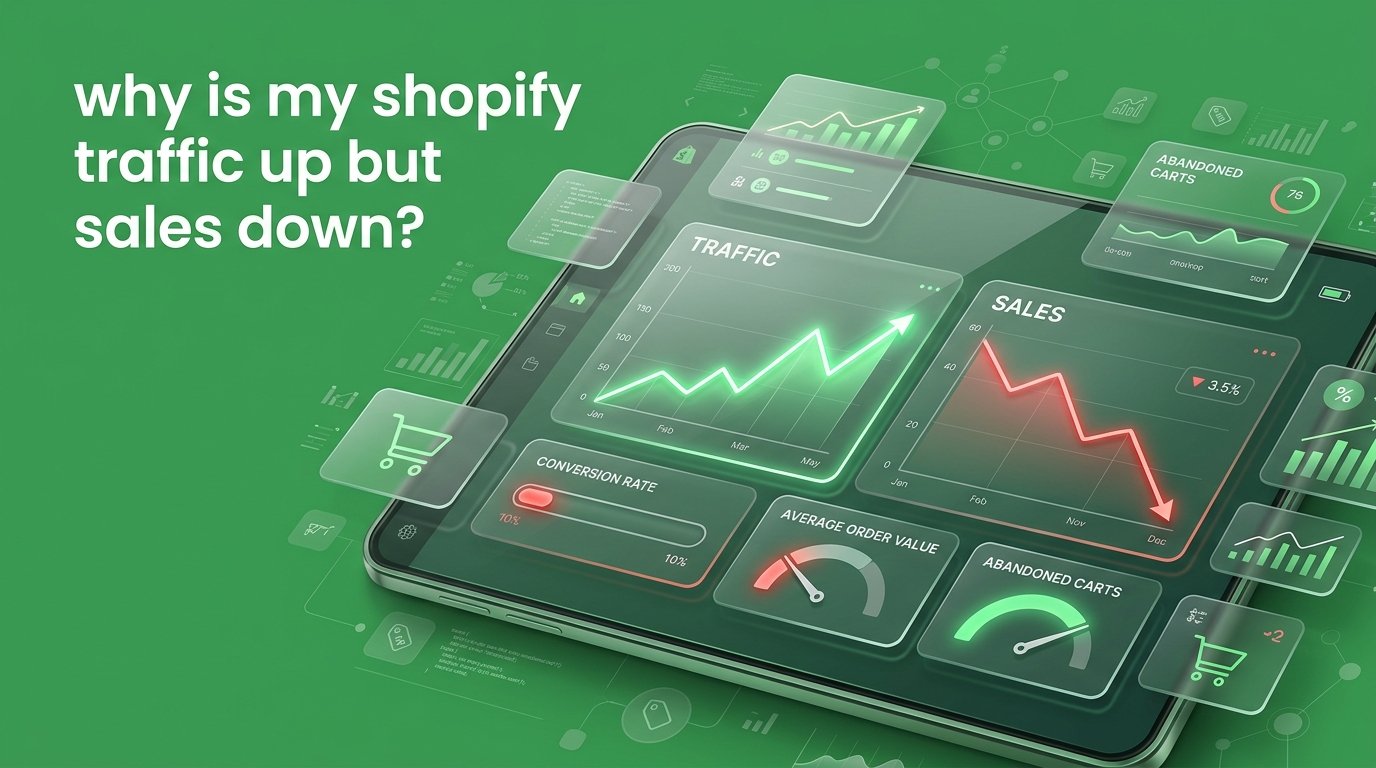
Your Shopify dashboard says sessions are up 40% this month. Your payout report says something else entirely. Someone on your team already blamed a slow week, or the economy, or “it’ll even out.” It won’t.
We’ve pulled the analytics on dozens of Shopify stores stuck in this exact spot, and the traffic spike is almost never the good kind.
Throwing more money at marketing won’t fix a leaky conversion funnel. Until you filter out non-human bots and identify where qualified shoppers are dropping off, extra traffic only increases your bounce rate and burns your budget. Fix the structural issues on your site first then scale your campaigns with confidence knowing every paid click actually has a chance to convert.
For most store owners, traffic is the scoreboard. More visitors, more revenue that’s the deal you signed up for. So when the sessions graph climbs and the sales graph doesn’t, it doesn’t just hurt. It’s confusing.
You start second-guessing things that used to work. Maybe the product photos are stale. Maybe the ad creative is fatigued. Maybe you need a discount code to shake things loose.
Here’s what we’d tell you before you touch any of that: more traffic is not the same thing as more customers. Those are two different metrics measuring two different things, and Shopify’s dashboard makes them look like one story when they’re not.
Conversion rate is the number that actually pays your bills. Sessions are just the number that makes the chart go up. A store can win on one and quietly lose on the other for months before anyone notices.
Chasing a fix at the wrong layer just burns budget while the real leak keeps leaking. Before you touch pricing, creative, or your ad spend, you need to know which layer is actually broken.
Here’s the part almost nobody tells store owners: a huge share of “visitors” showing up in analytics tools aren’t shoppers. They’re not even people.
According to Imperva’s 2026 Bad Bot Report, automated bot traffic accounted for more than 53% of all web traffic in 2025, up from 51% the year before. Human activity is now the minority online, not the majority.
Some of that is AI crawlers indexing your product pages for search engines and chat assistants. Some of it is scraper bots price-checking your catalog for competitors. Some of it is uptime monitors, broken pixel fires, and outright fraud tools testing stolen card numbers against your checkout. None of it is buying anything.
If your traffic jump lines up with a new PR mention, a viral post, or a spike in AI-assistant referrals, there’s a real chance you’re measuring machines, not customers. GA4 doesn’t filter all of this out by default, and Shopify’s own analytics filters even less.
We walked through exactly how to separate the two in our piece on tracking AI and bot traffic inside GA4 and Search Console it’s usually the first thing we check on a new audit, before we look at anything else.
A bigger number on the dashboard doesn’t mean a bigger audience showed up to buy.
Say you filter the bots out and the traffic is still up. Real humans, real sessions, real clicks. That doesn’t mean the traffic is good traffic.
A lot of “growth” comes from channels that bring volume without intent. A viral TikTok clip pulls in browsers, not buyers. A broad match keyword pulls in people comparing five brands, not choosing yours. A press mention pulls in curiosity, not credit cards.
Traffic quality matters more than traffic quantity, and most Shopify dashboards don’t separate the two anywhere near clearly enough. You have to go segment by segment to see it.
Rule of thumb: if your new traffic is concentrated in one channel and your conversion rate on that channel is far below your site average, you haven’t grown your audience. You’ve just added noise on top of it.
Now say the traffic is real, human, and reasonably qualified. The math still doesn’t add up for a lot of stores and that’s usually because the new traffic is running straight into a funnel problem that was always there. It just wasn’t visible at the old volume.
Two things tend to be doing the damage.
The first is speed. Google’s own research on mobile performance found that as load time increases from one second to three seconds, the probability of a mobile visitor bouncing climbs by 32% and jumps to 90% at five seconds. If your new traffic is landing on a heavy product page, a bloated app stack, or an unoptimized image gallery, most of it never makes it past the first screen.
The second is checkout friction. This one isn’t new, but it’s brutal at scale. The Baymard Institute has tracked cart abandonment across 50 separate studies and puts the average at 70.22% surprise shipping costs, forced account creation, and clunky payment forms are the usual culprits.
Neither problem shows up when you only have a trickle of visitors. Ten people hitting a slow page is a rounding error. Ten thousand people hitting the same slow page is a revenue collapse and on paper, it looks exactly like “traffic up, sales down.”
Here’s where it gets interesting: the traffic didn’t break your store. It just turned the volume up on a crack that was already there.

This is the exact sequence we walk through with a new client before we touch spend, creative, or pricing. Do it in order each step tells you whether it’s even worth moving to the next one.
Filter by known bot signatures and check the AI-referral channel separately. If the “spike” disappears once bots are filtered out, you’ve found your answer already.
Break sessions down by channel organic, paid, email, direct, social. A drop in sales usually traces back to one or two channels underperforming, not all of them at once. Our website analytics work is built around finding exactly this instead of guessing at averages.
Session recordings and heatmaps show you where real visitors hesitate, rage-click, or bail entirely. We run this as behavioral tracking on every audit it surfaces problems a spreadsheet simply can’t show you.
Landing page, product page, cart, or checkout each have a different fix, and treating them as one problem wastes time. Our funnel and drop-off analysis exists specifically to pin this down.
Not your homepage in isolation the exact pages your new traffic is landing on, tested on an actual mobile connection, not a fast office wifi network.
Most new traffic skews mobile. If your mobile conversion rate is well below desktop, that gap is where your answer is hiding.
Run through all six and you’ll know, with evidence, whether the problem is your traffic, your funnel, or both. Most of the time it’s both just not in equal parts, and not in the parts you’d have guessed.
Once you know where the leak is, fixing it is the easy part. Finding it is where most stores get stuck.
This is the exact process our conversion rate optimization team runs on every new Shopify account, usually inside 48 hours. It almost always turns up two or three specific leaks nobody had flagged before we looked.
Stop guessing at which lever to pull. Book a free audit call and we’ll show you exactly where your traffic is going and why it isn’t converting.
The problem is rarely that your Shopify store stopped working; it’s that your dashboard is lying to you. A traffic spike without revenue usually points to bot activity, low-intent channels, or hidden funnel friction. By isolating real human sessions and auditing mobile drop-offs, you can stop guessing and start fixing the exact leaks draining your revenue. Book your free audit call to find out where your traffic is going.
Because in 2026, the difference between a “No” and a “Yes” isn’t your tech stack it’s the human strategy behind it. Let’s turn your digital ghost town into a conversion machine.
How to Avoid Regret Buying the Xbox Nano Controller The Xbox Nano Controller is $49.99, pocket-sized, and open for pre-order. The headlines make it sound like…
Is the Xbox Nano Controller Actually Comfortable? You’ve read the headlines: five inches, 3.5 ounces, $49.99, all 18 inputs. Everyone’s calling it cute. Nobody’s answered the…
How to Master Social Media Marketing Fast You are posting three times a week on Instagram and LinkedIn. Your designer makes pristine templates, and your team…
How we use your info: Used strictly to review your project, prepare tailored insights, and reach out for a 1-on-1 strategy call. Zero spam, zero shared data.