
How to Avoid Regret Buying the Xbox Nano Controller
How to Avoid Regret Buying the Xbox Nano Controller The Xbox Nano Controller is $49.99, pocket-sized, and open for pre-order. The headlines make it sound like…
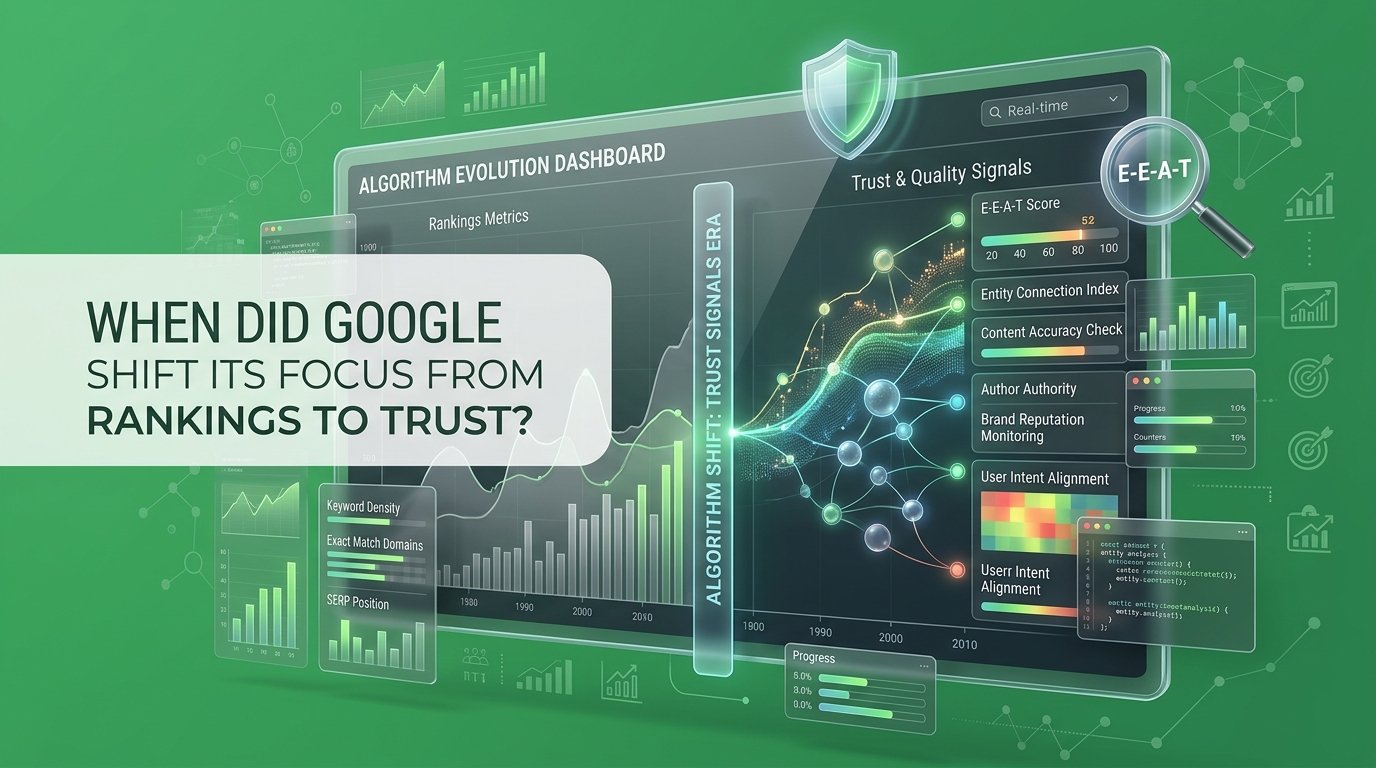
You’ve done everything right. The meta titles are clean, the keywords are placed, the backlinks are coming in. And still someone publishing content every two weeks is outranking you.
Most agencies will tell you to build more links. Some will say you need more content. We’ve audited enough sites to know the problem is almost never what you’re told it is. Google isn’t ranking the best-optimized page anymore. It’s ranking the most trusted one. Those two things are very different and the gap between them is where most businesses are quietly losing.
Google no longer rewards pages that merely check optimization boxes. It elevates those demonstrating real-world experience and authority. Brands publishing generic, volume-driven content are quietly losing ground to competitors who invest in credible authors, original case studies, and user focused depth. This shift rewards genuine expertise over keyword density turning content into a long-term trust asset rather than a short-term ranking gamble.
For a long time, SEO was a math problem. More backlinks equaled better rankings. More keywords equaled more visibility. The whole industry was built around reverse-engineering Google’s formula and gaming it.
And it worked. For years.
Then Google started losing. Its results were getting worse. Content farms were dominating. Thin, automated pages were flooding the top 10 for queries that deserved real answers. Users were clicking on results and immediately bouncing back. Google’s core product the search engine people trusted was being polluted by the exact optimization tactics it had accidentally incentivized. So it started changing the rules. Not overnight, but systematically, over more than a decade. And if you’re still playing by the 2015 rulebook, you’re not losing slowly. You’re losing fast.
This is the part most SEO content gets wrong. People talk about Google’s trust shift like it was a single update. It wasn’t. It was a decade-long reorientation.
2011: Panda. Google’s first real signal that content quality was going to matter. Panda targeted thin content and content farms sites that existed purely to rank, not to inform. According to Google’s own timeline of ranking systems, this began what would become a multi-year mission to reward content that genuinely served users.
2012: Penguin. The link game changed. Penguin targeted manipulative link-buildin paid links, link networks, anchor text schemes. Sites that had been ranking because of manufactured authority started falling off the first page. What Google was saying was clear: we don’t just want links. We want legitimate links.
2014: E-A-T enters the conversation. Google’s Search Quality Rater Guidelines started formally documenting Expertise, Authoritativeness, and Trustworthiness as the framework human reviewers would use to assess content quality. These aren’t ranking signals in the traditional sense. They’re the philosophy behind them.
2022: Everything accelerates. In August 2022, Google launched the Helpful Content Update a site-wide signal designed to surface “original, helpful content written by people, for people.” The language was deliberate. For people. Not for algorithms. Not for rankings. For the human on the other end of the search.
Then, in December 2022, Google added a second ‘E’ to the framework. E-E-A-T. The new addition: Experience. Not just expertise first-hand lived experience with a topic. That’s a fundamentally different bar. It’s not enough to know your subject. Google now wants evidence that you’ve done it.
Here’s the uncomfortable truth: you can rank without being trusted. For a while.
But ranking without trust has a shelf life. Every core update narrows that window. And as AI-generated content floods the web, genuine trust signals are becoming the only thing that separates brands that sustain their visibility from brands that disappear after the next algorithm change.
Trust, in Google’s framework, isn’t a feeling. It’s measurable. It shows up in:
None of these things can be manufactured overnight. That’s exactly why Google weighted them.
A site that’s been ranking on keyword density alone can be outmaneuvered by a site with half the content volume but real authority. We see this pattern in almost every audit we run. The business that’s been publishing two posts a week for three years is losing to a competitor who publishes eight posts a year because those eight posts are cited, linked, and written by someone with actual skin in the game.
If you want to understand how trust signals connect to your organic search performance, this is exactly the layer most businesses are missing from their SEO strategy.
The March 2024 core update was arguably the biggest signal yet. Google stated explicitly that it was building on everything it learned from the 2022 Helpful Content Update and that it was designed to reduce “unoriginal content” in search results at scale.
The target wasn’t bad writing. It was purpose-built-for-ranking writing. Content that existed to chase traffic rather than serve a real reader.
What got hit hardest:
If that sounds familiar, it should. It’s the way most marketing teams have been briefing content for the last decade. The fix isn’t to write less. It’s to write differently. With intent. With attribution. With proof that you know what you’re talking about and that a real person with real experience wrote it.
Your content strategy isn’t just a publishing calendar anymore. It’s a trust-building system. Or it’s a liability.
The E-E-A-T framework isn’t a checklist you tick off. It’s a question Google is asking about every page on your site: does this content come from someone with the experience and authority to be trusted on this topic?
Here’s what that looks like in practice:
Generic bylines don’t build trust. Author pages with real credentials, professional history, and verifiable expertise do. Google’s quality raters are specifically looking at author information as a trust signal. If your content is being published under “Admin” or a placeholder name, that’s a quiet ranking problem.
Not just information observation. The specific detail that only someone who has actually done the thing would include. In an audit we ran for a client in a competitive professional services niche, adding outcome-specific case studies and first-person process walkthroughs moved three pieces from page three to page one within six weeks. That’s not coincidence.
There’s a difference between a link you bought or exchanged and a link from a publication that cited you because your content was worth citing. Google’s systems are increasingly good at reading the difference. Building real authority means creating content worth referencing and being findable by people who would naturally want to cite it.
Trust isn’t just about content quality. It extends to how your site behaves. Load times, mobile performance, and conversion-rate signals all factor into how Google interprets whether your site is actually serving its users or just trying to rank. A site that users bounce from immediately is telling Google something. And Google is listening.
This is what most businesses underestimate. Google doesn’t just evaluate pages in isolation anymore. It evaluates sites. A domain with 200 pages of thin content and 10 strong pages is going to be dragged down by the 200. Quality isn’t a content-by-content decision it’s a site-wide commitment.
This is the hardest part. And it’s why so many businesses find themselves stuck.
You spent three years publishing content to hit keyword targets. The content wasn’t bad it just wasn’t for anyone in particular. It was for the algorithm. Now the algorithm has changed and it wants something you can’t spin up overnight. The businesses winning in organic search right now aren’t the ones with the biggest content budgets. They’re the ones who treated their audience like a real person and their content like a real product. They built something genuinely useful and then proved they were the right people to have built it.
That proof is what Google is rewarding. And if you want to rebuild it, the path isn’t complicated but it’s not fast either.
Start by auditing what your current content is actually communicating about your brand not just what keywords it’s targeting. Then rebuild from the trust layer up.
When a new client comes to us with an organic traffic problem, the first question we ask isn’t about keywords. It’s about credibility. Who is publishing this content? What do they actually know? What first-hand outcomes can we document? Where does this brand have the right to be considered authoritative?
The answers to those questions shape everything the content strategy, the author framework, the internal linking architecture, the external citation plan. Our SEO frameworks are built on the same trust signals Google is now explicitly rewarding.
We’ve seen the inside of enough traffic drops to know that most of them weren’t algorithm problems. They were trust deficits that the algorithm finally caught up to. If your content is doing the work of targeting keywords but not the work of building trust, you’re not just leaving traffic on the table. You’re building something that won’t hold.
Stop guessing at the algorithm. Start building the thing it’s looking for.
Let’s look at where your trust signals actually stand. Book a strategy call at www.themayk.com.
Because in 2026, the difference between a “No” and a “Yes” isn’t your tech stack it’s the human strategy behind it. Let’s turn your digital ghost town into a conversion machine.
How to Avoid Regret Buying the Xbox Nano Controller The Xbox Nano Controller is $49.99, pocket-sized, and open for pre-order. The headlines make it sound like…
Is the Xbox Nano Controller Actually Comfortable? You’ve read the headlines: five inches, 3.5 ounces, $49.99, all 18 inputs. Everyone’s calling it cute. Nobody’s answered the…
How to Master Social Media Marketing Fast You are posting three times a week on Instagram and LinkedIn. Your designer makes pristine templates, and your team…
How we use your info: Used strictly to review your project, prepare tailored insights, and reach out for a 1-on-1 strategy call. Zero spam, zero shared data.