How to Make Your Personal Brand Stand Out
How to Make Your Personal Brand Stand Out You’ve got the headshot, the tidy LinkedIn and a posting habit that’s lasted six months. Nobody’s replying, and…
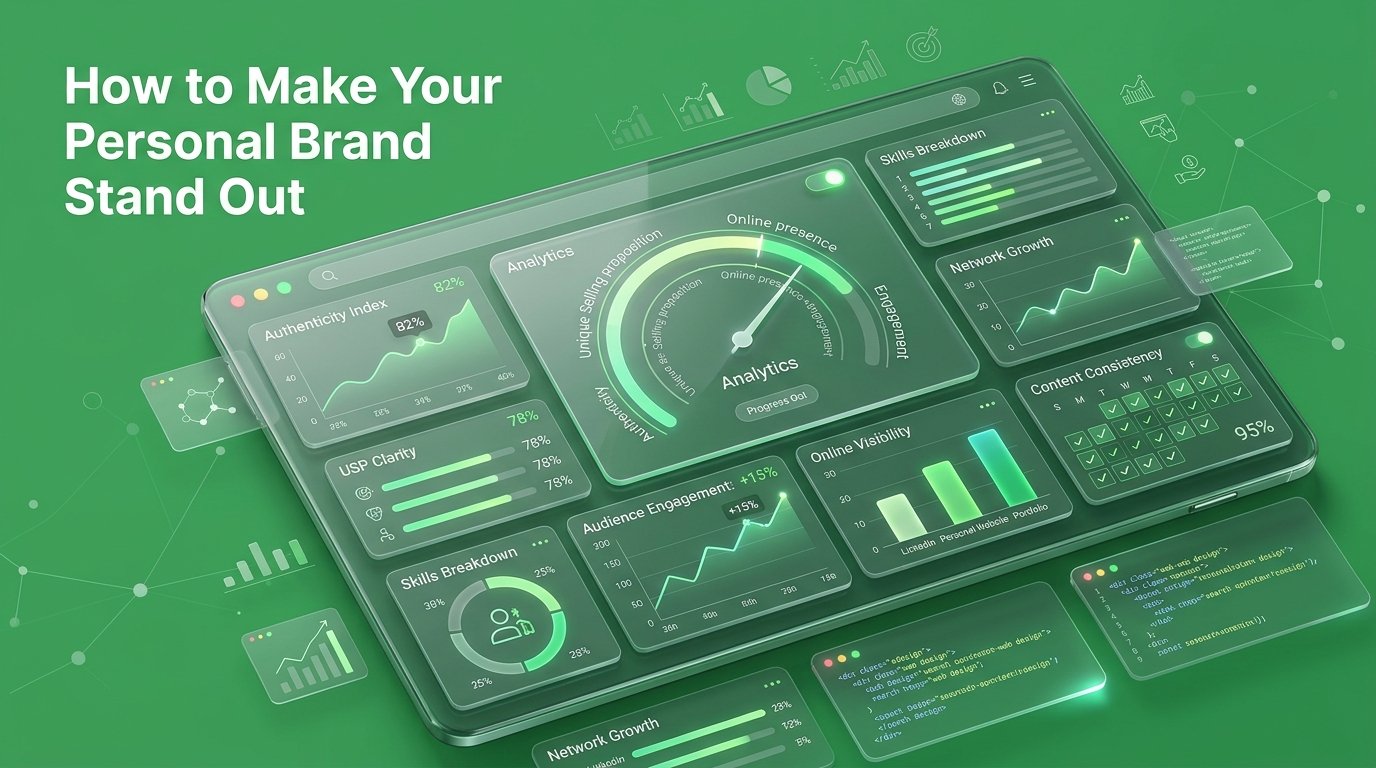
You’ve got the headshot, the tidy LinkedIn and a posting habit that’s lasted six months. Nobody’s replying, and your network says you just need to stay consistent.
We’d say consistency isn’t the problem. If you want to make your personal brand stand out, the issue is that you look exactly like every other consistent founder in your feed.
More of the same only makes you louder. It doesn’t make you different.
Standing out isn’t about increasing your posting frequency; it is about sharpening your message. By crafting a focused, repeatable positioning statement and grounding it in genuine substance, you transform passive profile views into memorable authority. Stop blending into the background with generic titles claim a distinct perspective, prove your value with real data, and turn your personal brand into an irresistible client magnet.
Here’s the pattern we see most. Nothing on your profile is wrong. It’s clean, current and professional, and it’s interchangeable with your closest competitor’s.
Then comes the strange part. People say nice things about your content and hire someone else.
Here’s what “fine but forgettable” usually looks like:
None of that is a mistake, which is why it lasts. Nobody flags a profile that’s merely fine.
If page one of your name search is actively hurting you, start with our guide on fixing a bad online personal brand. This post is for the quieter problem, where nothing’s wrong and nothing sticks.
Fine isn’t neutral. Fine is invisible.
Now here’s the part most people miss. Nobody studies your profile.
Nielsen Norman Group’s eye-tracking research shows readers concentrate their attention in the first few lines of a page and along its left edge. NN/g says that pattern still holds on desktop and mobile.
It isn’t the only way people scan. It’s the one worth planning for.
So picture where your best line sits. Probably in the fourth paragraph of your About section, under three lines of “experienced leader driven by results.”
The part buyers actually read says nothing. The part that would make them stop is buried where they never get to.
Your best sentence is hiding where nobody reads.
Timing makes it worse. According to research the LinkedIn B2B Institute ran with Ehrenberg-Bass professor John Dawes, only about 5% of B2B buyers are in the market at any given time. The other 95% won’t buy for months or even years.
Treat it as a rule of thumb, not a law. It describes B2B buying in general, not your pipeline specifically.
But the implication is hard to dodge. Most people who see your content this week aren’t buying. They’re filing you away.
When they finally do need someone, they won’t scroll back through your feed. They’ll remember a person, or they won’t.
You’re not competing for attention today. You’re competing for recall later.
Most advice treats standing out as an attention game. Post more, show up more, get seen. But attention is gone the second someone scrolls.
What lasts is a sentence. Specifically, the one a buyer says to a colleague when you’re not in the room: “You should talk to them, they’re the one who…”
Everything you publish either gives people the end of that sentence or leaves them to invent one.
Substance is what makes that sentence believable. In Edelman and LinkedIn’s 2024 B2B thought leadership study, 73% of the roughly 3,500 decision-makers surveyed called thought leadership a more trustworthy way to judge a company’s capabilities than its marketing materials.
That study covers organizations, not individuals. But the logic carries over. Buyers trust substance over polish.
A tagline is polish. A position you can defend is substance.
So we break standing out into three things people can repeat:
Take one away and the sentence collapses. Without the first, you’re for everyone. Without the second, you sound like everyone. Without the third, you’re just saying it.
Buyers don’t remember your brand. They remember what they can retell.

Do these in order. Skip ahead and you’ll polish the wrong sentence.
Read your last five posts out loud. If they sound like a dry textbo
Ask five people to finish this line about you: “They’re the person who…” Pick two clients, two peers and one person who barely knows you. Don’t coach them, and write down their exact words.
Five different answers means you don’t have a position yet. Five similar answers that sound like a job title means you have a category, not a brand.
What you want back is specific enough that nobody else in your market could own it.
If five people give you five answers, you don’t have a brand yet. You’ve got a profile.
ok, rewrite them with a specific, spicy opinion.
Fill this in: “I help [specific person] stop [specific mistake], and I won’t [what your industry does by default].” Then delete every adjective a competitor could also claim.
The refusal is what makes it stick. “I help founders grow” is forgettable. “I help founders stop paying for traffic their site can’t convert” gives people something to repeat.
If you’re stuck on the foundation, our guide to fixing a weak brand identity walks through claiming a territory before anyone designs anything.
A position without a refusal is just a job title.
This is where the scanning research earns its place. Your sentence goes in your LinkedIn headline, the opening lines of your About section, the top of your founder page, your speaker bio and your email signature.
Compare these two headlines:
Don’t write five versions. Write one, then check that every platform repeats it. Our post on fixing inconsistent branding across platforms has the touchpoint audit if you’re not sure where yours drifts.
If your personal Instagram is part of the problem, plan the feed as one piece first with our Insta Grid Planner.
If your best line isn’t in the first two, buyers never see it.
Stop posting opinions about everything. Pick one idea you’d defend in public and keep coming back to it. A named framework, a mistake you see constantly, or a result from your own work all count.
Edelman’s research shows what buyers rate highest. B2B decision-makers say the best thought leadership features strong research and data (55%), helps them understand their own business challenges (44%) and offers concrete guidance and case studies (43%).
So give them that. Your numbers, your cases, with client permission. Publish one long piece a month that argues the idea, then use short posts to take it apart one claim at a time.
Lead every piece with the answer, then the proof. That answer-first structure is also how we write for search engines and AI assistants, which we call generative engine optimization. Nobody can promise you a citation, but a buried answer never gets quoted.
One idea you own beats ten opinions anyone could have.
Pick three numbers and write down where they stand today:
Put them in one dashboard so you see movement monthly. Your business and website analytics will show where the profile visits come from.
After 90 days, run move one again with five new people. If their answers moved closer to your sentence, it’s working. If not, move two wasn’t specific enough. Go back.
Likes tell you someone saw it. Repeats tell you someone kept it.
Everything above is a compressed version of how we open a brand engagement at THEMAYK. Strategy and storytelling come first, visuals second, and nothing ships without a job to do. We start with a documented audit of what your brand is already saying and where it contradicts itself.
If your profile looks fine and still doesn’t get remembered, let’s find out why. Book a free strategy call at www.themayk.com. In 30 minutes we review your brand, funnel and ad spend, then send you a written summary whether or not you hire us.
Stop guessing. Start growing.
Building an unforgettable personal brand requires strategy, focus, and authentic proof over superficial consistency. When you stop chasing temporary attention and start engineering long-term recall, the right opportunities will naturally follow. Align your unique value with a sharp, repeatable message today, and let your brand consistently open doors for your future growth.
Because in 2026, the difference between a “No” and a “Yes” isn’t your tech stack—it’s the human strategy behind it. Let’s turn your digital ghost town into a conversion machine.
How to Make Your Personal Brand Stand Out You’ve got the headshot, the tidy LinkedIn and a posting habit that’s lasted six months. Nobody’s replying, and…
How to Build a Strong Personal Brand Online You’ve got a sharp company, a site that loads fast and ads that finally pay back. Your own…
How to Fix a Bad Online Personal Brand A buyer you’ve never met just Googled your name before the call. They found a LinkedIn headline from…
How we use your info: Used strictly to review your project, prepare tailored insights, and reach out for a 1-on-1 strategy call. Zero spam, zero shared data.