
Blogs > Why AI Search Gets Your Brand Wrong and What to Fix
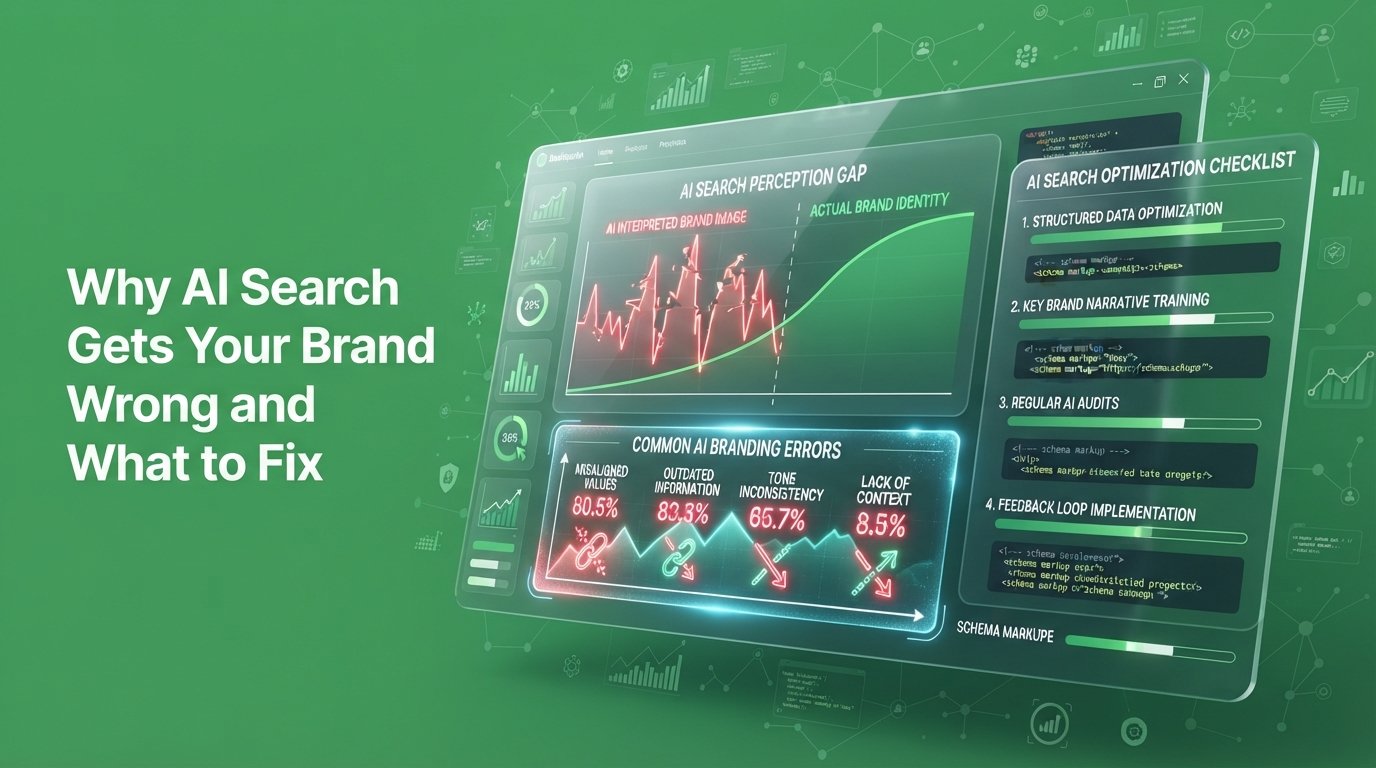
Why AI Search Gets Your Brand Wrong and What to Fix
- Sundus Sohail
- 14
You type your company name into ChatGPT or Gemini before a sales call, and the summary reads like a stranger wrote it. Your old pricing shows up, a service you dropped two years ago is listed front and center, and your positioning sounds generic. Most teams react by tweaking meta tags or rewriting their homepage which misses the real issue completely. AI search isn’t glitching; it’s repeating the mixed signals your brand puts out across the web.
Outdated listings keep feeding AI the wrong pitch
Old directories, stale partner pages, and forgotten bios still float around the web long after your offer changes. When an AI assistant pulls context for your brand, those leftovers carry real weight. You can’t out-write old web footprints with a fresh homepage alone. Clean up the outside trail first, then make sure every channel matches.
Your site is only a fraction of the evidence
You probably assume AI tools treat your website as the final word on who you are. They don’t.
AirOps research found that 85% of brand mentions in AI search come from third-party sources rather than a brand’s own domain. When a buyer asks an assistant about your category or your company, the model pulls from directories, reviews, roundups, and outside articles.
When your own site says one thing and ten outside pages say something older or looser, the model blends them. That’s how half-true services and stale offers end up in front of prospects.
If your outside footprint contradicts your site, AI search will happily repeat the wrong version.
AI answers expose brand drift you already normalized
Inside your company, small contradictions feel harmless. A deck uses last quarter’s offer, a directory still lists an old service line, and a LinkedIn bio describes your business in broad strokes.
In our work on how to fix inconsistent branding across platforms, we see teams treat those mismatches as minor cleanup items. AI models don’t see “minor” they see competing facts with no clear hierarchy.
And when a brand looks scattered across touchpoints, buyers hesitate just like we point out in our breakdown of 7 branding mistakes that make your business look cheap. AI search just puts that internal drift on display in public.
AI doesn’t invent a bad brand story it stitches together the messy one you left lying around.
Key Takeaway
Fix the story before you chase AI rankings
Chasing tricks without fixing your core facts is backward. If you want a broader look at visibility mechanics, read our guide on how to rank in AI search engine overviews in 2026, then lock down the source material first.
Lock one single source of truth for core facts.
Write down your current core services, pricing posture, target buyer, and exact company name so every writer and channel pulls from the same sheet.
Audit the outside pages AI pulls from most.
Search your brand name and category prompts across ChatGPT, Gemini, and Google, and list every third-party profile, directory, or article that gets it wrong.
Update high-authority third-party listings first.
Fix outdated descriptions, old offers, and stale links on directories, review profiles, and partner pages where buyers and models check details.
Align your site copy with your real-world proof.
Make sure your service pages, case studies, and positioning match what third-party sources actually confirm about your business.
At “TheMayk”, we untangle brand drift across touchpoints before scaling campaigns so your positioning holds up everywhere buyers look. If AI search is telling the wrong story about your company, let’s fix the foundation at themayk.com.
Stop guessing what AI says about you lock down the facts and own the narrative.
Conclusion
Bad AI answers aren’t a technical mystery they’re a mirror of scatter d brand facts. When outside profiles, old listings, and internal decks tell different stories, assistants repeat the confusion. Fix your core facts first, clean up third-party mentions, and line your site up with reality. At “TheMayk”, we straighten out brand drift before scaling growth. Stop guessing own your story at themayk.com.
Because in 2026, the difference between a “No” and a “Yes” isn’t your tech stack—it’s the human strategy behind it. Let’s turn your digital ghost town into a conversion machine.