Why Your Content Marketing Strategy Is Failing
Why Your Content Marketing Strategy Is Failing You’re publishing every week and the pipeline hasn’t moved. Your agency says content takes time. Maybe. But when a…
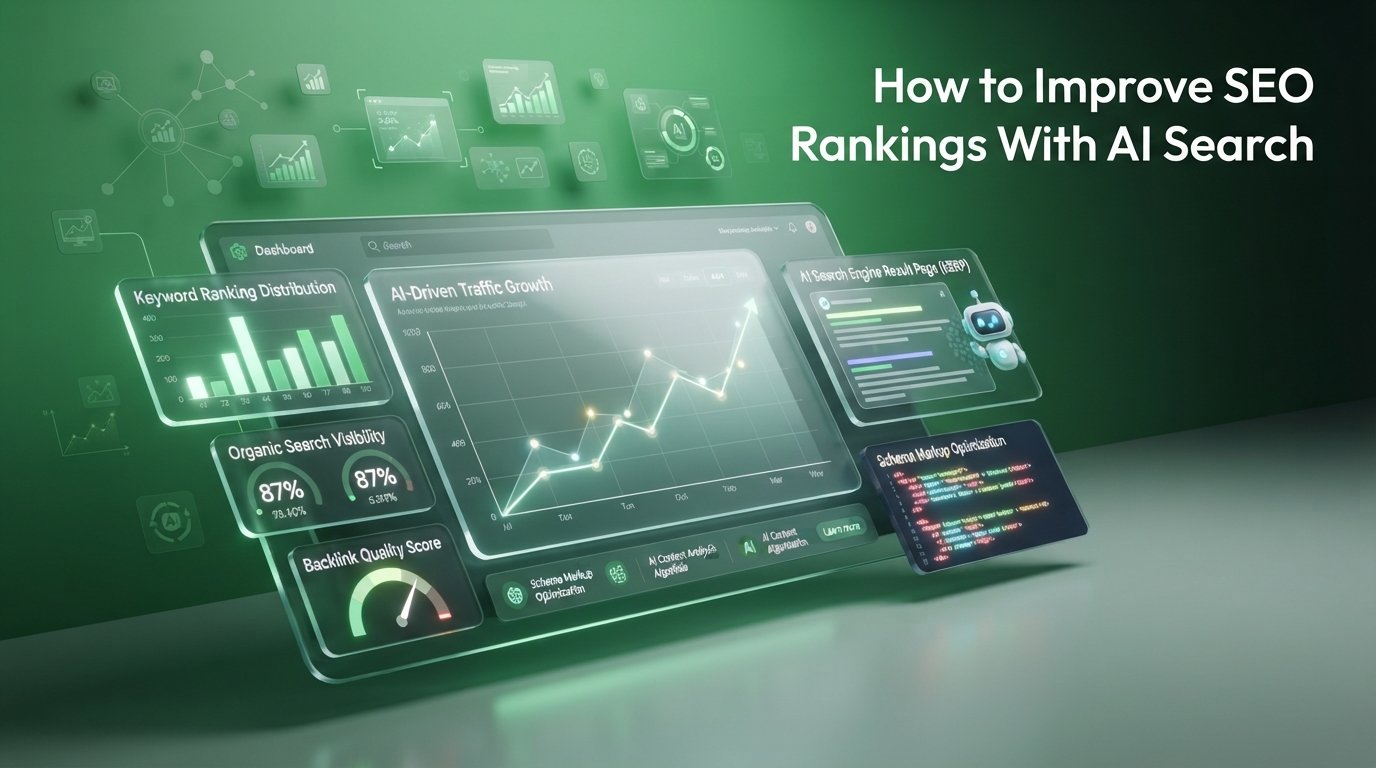
You’re ranking on page one for the terms that pay the bills, and your clicks keep sliding anyway. Your agency says AI Overviews are a phase and sends another green report. We’d say the report is measuring the wrong thing.
If you want to improve SEO rankings with AI search, stop treating it as a second channel. It’s the clearest view you’ll get of the questions your pages aren’t answering.
To succeed in modern search, align your strategy with how generative engines gather answers. Instead of targeting short keywords, address long-tail questions and query fan-out subtopics directly. Upgrade your top content by putting direct answers upfront, adding unique internal data, and filling content gaps identified in Search Console and AI tools. This cohesive approach turns AI summaries from traffic thieves into powerful drivers of qualified, high-converting traffic.
Here’s the number that should bother you. Pew Research Center tracked the browsing of 900 U.S. adults in March 2025. When a Google results page showed an AI summary, people clicked a regular result in 8% of visits. Without one, they clicked in 15%.
The links inside the summary fared worse. They were clicked in just 1% of visits. And users ended their browsing session entirely on 26% of pages with a summary, against 16% of pages without one.
Odds are your buyers are in that group. About six in ten of those adults (58%) ran at least one Google search that month that produced an AI summary.
Keep the context straight, though. That’s one U.S. panel, Google only, with data from early 2025. Only about one in five searches in the study (18%) produced a summary at all.
So why should you care? Because of which searches trigger one.
Just 8% of one- or two-word searches did. For searches of ten words or more, it was 53%. And 60% of searches that began with who, what, when or why produced a summary.
Now look at your rankings report. It usually tracks short keywords, the searches least likely to trigger an AI answer. The long, specific questions are where the answer box lives, and most reports don’t measure them at all.
Every month the same meeting runs. Rankings are up, traffic is flat, and someone suggests more posts. Meanwhile the buyer gets an answer before they ever reach your site.
You paid for the page, the content and the retainer. You’re just not getting the click.
Here’s what we find missing when we audit one of these reports:
A green report can sit on top of a shrinking click.
Here’s the part most agencies skip, because it makes the invoice harder to explain. AI search and classic search aren’t two separate games.
Pew’s analysis found that Wikipedia, YouTube and Reddit are the most-cited sources in AI summaries and standard results alike. Together they made up 15% of the sources in summaries and 17% in regular results.
Google says the same thing from its side. Its documentation on AI features states there are no additional requirements to appear in AI Overviews or AI Mode, and no special optimizations needed. The SEO fundamentals still apply.
That doesn’t mean a top ranking guarantees a citation. It means you can stop budgeting for two programs and start running one.
A separate “AI SEO” retainer is usually a second invoice for the same work.
Now here’s the part most people miss.
When someone types a long question, Google may not run one search. Its documentation says AI Overviews and AI Mode may use a technique called query fan-out: several related searches across subtopics and data sources, stitched into one answer.
Google’s own advice for these experiences notes that people are asking longer, more specific questions, plus follow-ups to dig deeper. That’s the shift. The question is no longer a keyword. It’s a brief.
Picture a buyer typing: “how do I migrate my store without losing rankings, and how long does recovery take?” That’s one question on screen. Underneath, it’s several: what breaks during a migration, how redirects work, how long recovery takes, what it costs.
That’s an illustration, not Google’s actual sub-searches. We can’t see those, and neither can you. But a page that answers only “how to migrate a store” is missing most of the brief.
Most pages answer one question. The machine asks several.
You can still see the shape of it. Ask an assistant your buyer’s question and read which subtopics the answer covers. Those are the sections your page owes the reader.
AI search shows you the brief your page should’ve been written from.

Run these in order. Each one closes a gap between what buyers ask and what your pages answer.
Start with eligibility. Google says a page must be indexed and eligible to show with a snippet before it can appear as a supporting link in AI Overviews or AI Mode.
Then check three things from Google’s own list:
Do this and you’re eligible. Skip it and nothing below matters.
Eligibility isn’t strategy. It’s the ticket.
Open the Performance report in Search Console, add a custom regex filter on queries, and sort by impressions. Two filters earn their keep:
(\S+\s){9,}\S+ catches queries of ten words or more^(who|what|when|why|how)\s catches question-style searchesThen add what Search Console can’t show you: the questions your sales team hears every week and the ones sitting in your support inbox. Aim for 25 real questions in your buyers’ own words.
Write down the questions buyers actually ask, not the keywords you wish they used.
Run each question through ChatGPT, Perplexity and Google’s AI Mode. For every one, log three things:
Run each question twice. Answers can shift between runs, so trust patterns, not one-offs.
The gaps are your content plan. A subtopic that shows up answer after answer and isn’t on your page is a section you owe your reader. We break down the full scoreboard method in our guide to ranking in AI search (GEO).
One answer is noise. Ten answers are a brief.
Take your ten most valuable pages and rebuild the structure around the gaps from move three.
That last one matters most. Google’s guidance for its AI experiences keeps coming back to unique content people find valuable. Your business and website analytics and behavioral tracking already hold original numbers. Most brands never publish them.
If you draft at volume, AI-assisted content only works when a human strategist rewrites every piece for voice and accuracy before it ships.
If a competitor could paste your paragraph on their site, delete it.
Fewer clicks means every one is more expensive to waste. Google says clicks from pages with AI Overviews are higher quality, meaning visitors are more likely to spend longer on your site. Pew’s numbers say there’ll be fewer of them. Both can be true.
So send those visitors somewhere built to convert. Run conversion rate optimization on the pages earning the traffic first.
Then measure. In June 2026, Google launched Search Generative AI performance reports in Search Console to show your site’s visibility within its AI features. Check whether the report is live on your property, and pair it with the monthly question log from move three.
Visibility is a number. Revenue is the proof.
Before you spend a dollar, know what not to buy.
Skip the shortcuts. The questions are the work.
At “TheMayk”, our search work opens with a documented audit, not a hunch. We fix tracking first so we can see which pages earn money, then rebuild those pages around the questions buyers actually ask.
It’s the same generative engine optimization method we run on our own site, which is why AI assistants can quote us accurately. Most clients see their first measurable lift within 60 to 90 days.
If you’d rather start with the pages Google already half-trusts, we covered that in how to improve SEO rankings.
Stop guessing. If your rankings look fine and your clicks don’t, let’s find out why. Book a free strategy call at www.themayk.com. In 30 minutes we review your brand, funnel and ad spend, then send a written summary whether or not you hire us.
Navigating the shift to AI search requires more than traditional keyword tactics it demands a refined content and technical strategy. Our agency helps you identify critical content gaps, optimize for complex query fan-out subtopics, and turn search summaries into high-converting traffic. Instead of letting AI answers steal your clicks, let our expert team audit your performance and implement data-driven updates. Contact our agency today to future-proof your search rankings and drive sustainable revenue growth.
Because in 2026, the difference between a “No” and a “Yes” isn’t your tech stack—it’s the human strategy behind it. Let’s turn your digital ghost town into a conversion machine.
Why Your Content Marketing Strategy Is Failing You’re publishing every week and the pipeline hasn’t moved. Your agency says content takes time. Maybe. But when a…
How to Improve SEO Rankings With AI Search You’re ranking on page one for the terms that pay the bills, and your clicks keep sliding anyway.…
Don’t let your website be a Ghost Town Your ROAS used to be comfortable. Now it’s barely above break-even, and every week brings a new theory.…
How we use your info: Used strictly to review your project, prepare tailored insights, and reach out for a 1-on-1 strategy call. Zero spam, zero shared data.