
Blogs > Why is My Google Ads CPA Higher Since August?

Why is My Google Ads CPA Higher Since August?

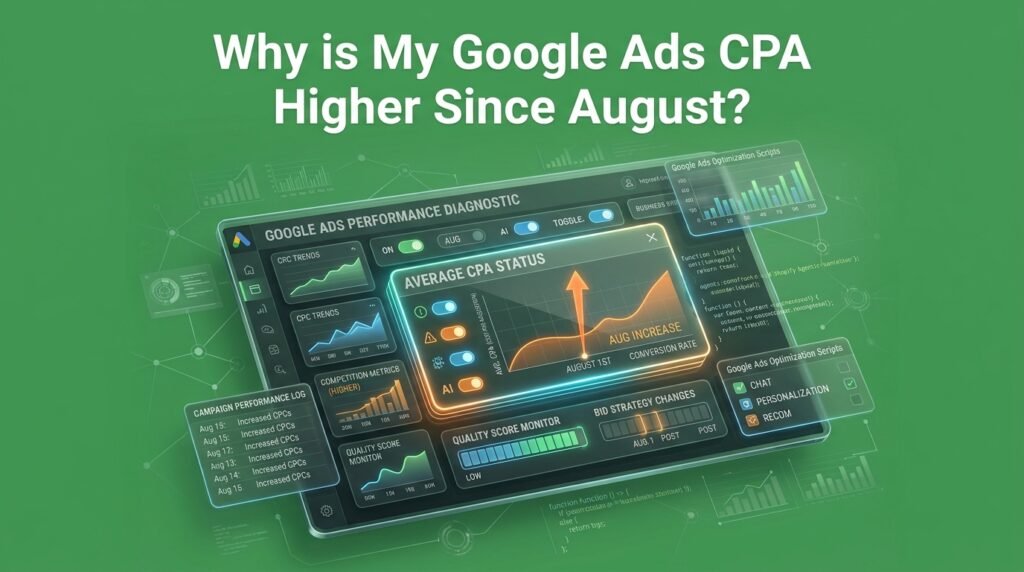
You didn’t touch your bids. You didn’t change creative. You didn’t even log in that week. And your cost per acquisition still climbed 20%, 40%, sometimes double.

Your rep says it’s seasonal. Your dashboard says nothing useful at all. Neither one is wrong, exactly. Neither one is the real answer either.

There’s a specific, dated reason a lot of Target CPA and Target ROAS campaigns got more expensive this month, and it has nothing to do with your account getting worse.

Mastering Google's Target CPA Update

Don’t let algorithmic shifts dictate your ad profitability. By identifying affected campaigns, aligning your targets with historical performance, and ensuring precise conversion tracking, you can quickly neutralize unexpected cost spikes. Proactively managing your bid strategies now shields your account from seasonal market inflation and keeps your Q4 marketing spend focused on predictable, profitable growth.

Your CPA didn't creep up. It jumped and stayed there

A slow CPA drift is normal. Auctions tighten, competitors show up, a season turns over. You’d expect a few points of movement here and there.

What you’re describing is different. A number that was stable for months and then stepped up almost overnight, with no campaign change on your end to explain it. That pattern is the tell.

If your CPA jumped specifically in the second half of August, this almost certainly is not your account’s fault. Something upstream changed, and it changed for a huge number of advertisers at once, not just you.

Here’s what makes this worse than a normal cost spike: most PPC managers spend days auditing keywords, checking search terms, and second-guessing their own account before they find the real cause. That’s a week of panic over a problem that was never inside the account to begin with.

Here’s a quick way to check if this is you. Open any campaign showing the spike and look at its status. If it’s ever shown “Limited by budget” in the last year, and it’s running Target CPA or Target ROAS, you’re looking at a candidate. If it’s never been budget-constrained, this specific cause doesn’t apply, and the real answer is somewhere else in your account.

Google didn't raise your costs. It stopped ignoring your own settings

Here’s the part almost nobody explains clearly. Starting August 17, 2026, Google changed how Target CPA and Target ROAS behave on any campaign marked “Limited by budget.”

Before that date, a budget-constrained campaign could quietly beat its target for months. You’d set a $10 Target CPA, the algorithm would find $5 conversions instead, and you’d bank the difference as “the account performing well.”

That gap was never a target you earned. It was a target Google’s system hadn’t been asked to enforce yet.

After August 17, Google’s own documentation lays it out in plain terms: a campaign that’s been delivering a $5 actual CPA against a $10 target starts drifting back toward that $10 figure, on a staged rollout Google has described as unfolding over several weeks rather than all at once.

Nothing in your account broke. Google just started taking the number you typed into that Target CPA field literally, instead of letting the algorithm quietly outperform it. If that number was set a year ago and never revisited, you’re now paying for a guess you made a long time back.

This is exactly the kind of change that hides in “it’s probably Q4 pressure,” because it happened to land in the same stretch of the calendar where genuine seasonal competition also ramps up. Cross-industry cost per click is already running about 12% higher year over year in 2026, so the two effects are stacking on top of each other right now. One is temporary market noise. The other is a permanent shift in how your bid strategy behaves.

The fix for a fake seasonal dip is patience. The fix for this is a target you actually set on purpose. Those are not the same move, and applying the wrong one wastes the one lever that actually works.

Stop Letting "Automated" Campaigns Drain Your ROI

Why this hits harder if you're heading into Q4

If your target has been quietly outperformed for a while, you’ve probably been budgeting off the wrong number without knowing it. A campaign that’s actually been closing at a $13 CPA but reporting toward a $25 target looks like it has headroom to scale. Once the real target kicks in, that headroom disappears exactly when Q4 competition is already pushing costs up on its own.

That’s two separate cost increases landing in the same forecast. Advertisers who catch this now can separate the two and plan around each one. Advertisers who don’t end up blaming the whole thing on “the holidays” and budgeting for the wrong problem.

Key Takeaway

Here's what actually fixes a spiking CPA

Forget “wait it out.” That’s the advice for a problem you don’t have. Here’s the sequence that actually moves the number back down.

Pull every campaign that's been "Limited by budget" in the last 12 months.

That status is the trigger. Campaigns that were never budget-constrained aren’t affected by this change at all.

If your $10 Target CPA has really been delivering $5, that gap is the exact size of the increase headed your way.

Google’s rollout has staged this tool inside the account since early July, and it lets you lower a target to match what the campaign has genuinely been earning, rather than the number you guessed months ago.

Multi-channel campaigns can also shift how they split traffic across Search, Shopping, Display, and YouTube once the target starts being enforced for real, so a jump in CPA can come with a change in channel mix too. We covered the mechanics of that kind of drift in why Performance Max campaigns stop performing without warning.

Confirm your conversion tracking before you touch a single target.

A target strategy only optimizes toward what it’s told is a conversion. If your tracking setup has been miscounting for months, resetting the target just locks in the wrong number with more confidence.

Smart Bidding needs a stretch of real data to settle. Reacting to the first three days of a new target is how good accounts get talked into bad decisions.

Do it in that order. Status first, target math second, tracking third. Skip a step and you’re fixing the wrong number with real budget.

One more option worth naming: switching off targets entirely. Maximize Conversions and Maximize Conversion Value spend your full budget without a fixed target, so your CPA still moves with your budget, just without the “target versus actual” gap that’s causing this specific spike. It’s not automatically the right call. It trades a predictable number for a flexible one, and that trade only makes sense if you’re comfortable managing profitability through budget instead of through a target field.

This is the same audit we run before touching a client's Target CPA

Before we change a single bid, we pull budget-limited status, target history, and conversion accuracy for every account we take on. It usually takes us about 48 hours, and it’s almost always one of two things: a target nobody has revisited since it was set, or funnel data that’s been quietly miscounting what actually counts as a sale.

That’s not a hunch. It’s the reason “just lower your bids” so rarely fixes this specific spike, because the bid was never the broken part.

If your Google Ads account has been running warmer than it should since mid-August, let’s find out whether it’s this update, real seasonal competition, or something in your tracking. Book a free audit at themayk.com.

Conclusion

This sudden CPA increase isn’t a failure of your campaign strategy—it’s Google’s Smart Bidding algorithm enforcing the exact Target CPA and Target ROAS numbers you originally set. Rather than letting the system drift toward higher costs as Q4 approaches, audit your budget-constrained campaigns, evaluate your actual historical metrics, and reset your targets intentionally. Taking control of your targets now prevents seasonal competition from compounding your ad spend.

See How Our Agency Grow Your Traffic Into Conversions

SEO – unlock sustainable growth with proven search strategies.
Content Strategy – magnetic content that earns links, shares, and brand authority.
Paid Media – precision campaigns built for measurable ROI.

Blogs

Why is My Google Ads CPA Higher Since August?

Why is My Google Ads CPA Higher Since August? You didn’t touch your bids. You didn’t change creative. You didn’t even log in that week. And your cost per acquisition still climbed 20%, 40%, sometimes double. Your rep says it’s seasonal. Your dashboard says nothing useful at all. Neither one is wrong, exactly. Neither one […]

Can you Opt Out of Shopify Agentic Storefronts?

Can you Opt Out of Shopify Agentic Storefronts? You logged into Shopify one morning and found a new sales channel already active. Nobody asked first. Nobody sent an email you actually read before it happened. Your products were sitting inside ChatGPT, Copilot, and Gemini before you ever decided whether you wanted them there. Most merchants […]

How much Does AI Search Optimization Cost?

How much Does AI Search Optimization Cost? You asked three agencies what AI search optimization costs. One quoted $500 a month. Another quoted $18,000. A third wouldn’t give you a number until you booked a call. Your first instinct is to assume the cheap one is a steal and the expensive one is padding its […]

LET'S TALK GROWTH

Ready to scale your brand?

Tell us a bit about your goals, and we’ll show you how we can help.

How we use your info: Used strictly to review your project, prepare tailored insights, and reach out for a 1-on-1 strategy call. Zero spam, zero shared data.