
How to Avoid Regret Buying the Xbox Nano Controller
How to Avoid Regret Buying the Xbox Nano Controller The Xbox Nano Controller is $49.99, pocket-sized, and open for pre-order. The headlines make it sound like…
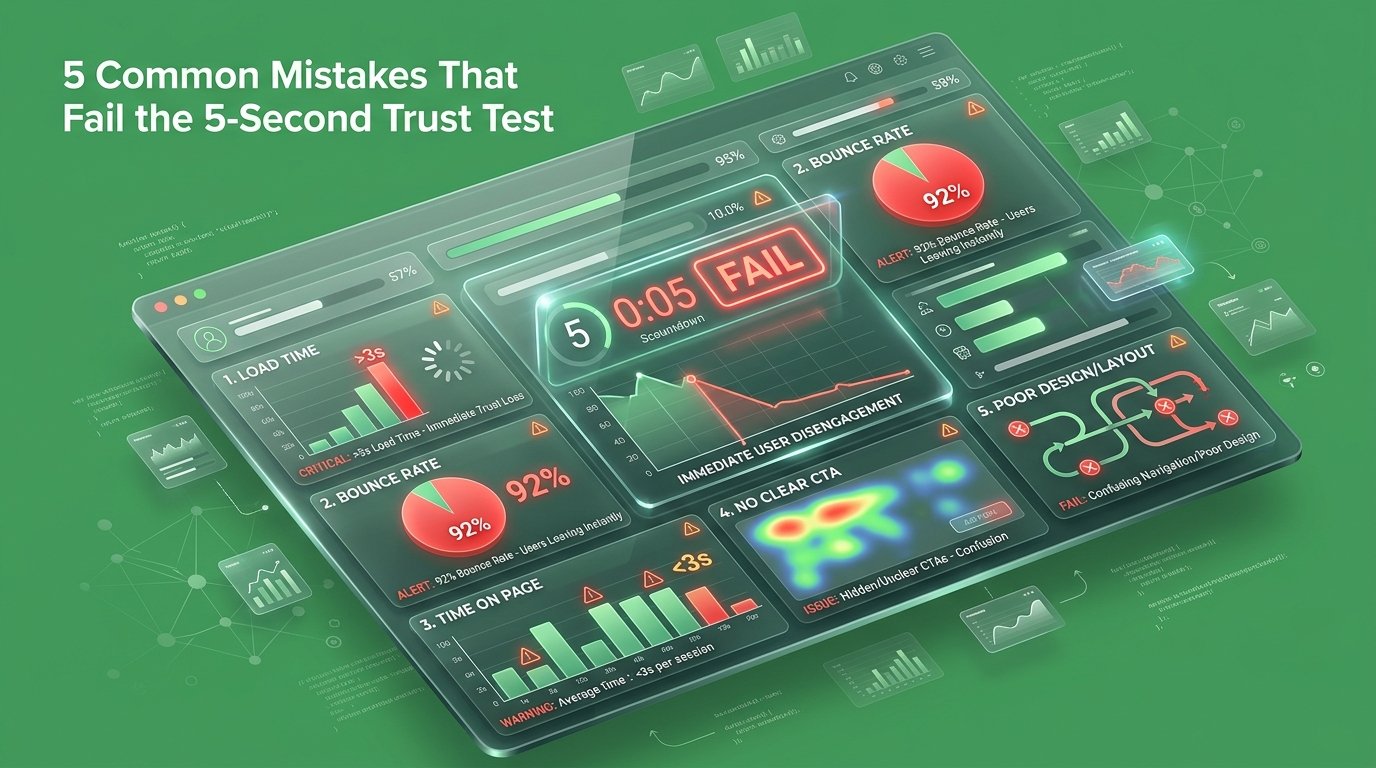
Here’s an uncomfortable truth: your visitor has already decided whether to trust you. Not after reading your about page or checking your testimonials in the first five seconds of landing on your site.
Stanford web credibility research shows that 75% of people judge a company’s credibility based on website design alone. Not your product. Not your track record. Your design. That verdict lands before they’ve processed what you actually do.
The fix isn’t a rebrand. It’s understanding exactly what’s triggering the “I don’t trust this” reflex and the five mistakes below are responsible for most of it.
Passing the five-second trust test requires moving away from aesthetic decoration and focusing on intentional trust architecture. Your website has a mere 50 milliseconds to signal competence, clarity, and respect for a visitor’s time. By prioritizing customer needs over corporate egos, placing specific proof early, simplifying choices, and optimizing mobile speed, you transform your site into a high-converting asset. True web credibility begins when you design for what your audience needs to feel.
Most homepages are built to impress. Big headline, sweeping brand statement, a full-screen hero image that took three revisions to approve. The problem: that’s not what your first-time visitor is actually asking.
What they’re asking immediately, subconsciously is three things: Is this for me? Do I trust this? What do I do next? If your homepage doesn’t answer all three within the first scroll, the test is already failing. Doesn’t matter how polished the gradient is.
We see this constantly with brands that have genuinely good products but above-the-fold content that leads with their brand story instead of their customer’s problem. A visitor who can’t immediately understand what you offer and who you serve won’t stick around to appreciate the typography choices.
Clarity converts before design does. Your above-the-fold content has one job: make the right person feel like they’ve found the right place. The fix isn’t complicated but it is counterintuitive. Stop leading with who you are. Start leading with who you help and what changes for them. That reorder alone has more impact on conversion rate optimization than almost any visual change you could make.
This one’s harder to hear. Your site isn’t broken. It’s not ugly. But it’s failing the trust test because of things you probably haven’t thought to look at.
A study from Northumbria University found that 94% of all feedback about websites relates to design, not content. Visual appeal and navigation had the biggest influence on first impressions and poor interface design was directly linked to rapid rejection and distrust. The visitor doesn’t consciously think “this typography is off.” They just feel something’s wrong, and they leave.
The five design signals that carry the most trust weight in the first scroll:
The halo effect runs both ways. A clean, deliberate layout makes people assume the whole business is equally professional. A cluttered, inconsistent one makes them wonder what else is neglected. Neither judgment is conscious. Both are immediate.
Almost every website has testimonials. Almost none of them are positioned where they actually do anything. If your social proof lives on a dedicated testimonials page that almost nobody visits, or it’s sitting at the bottom of the homepage after the visitor has already decided whether to trust you it’s not working. It’s decoration.
Social proof only functions as a trust signal when it appears at the moment of doubt. For a first-time visitor, that moment is the first scroll. Research on landing page optimization shows that client logos perform best when placed above the fold, establishing credibility before a visitor invests any time scrolling further.
The other mistake inside this mistake: generic testimonials. “Great service, would recommend!” does almost nothing for trust. A specific, named result “Our leads tripled in six weeks” lands differently because it’s verifiable. The specificity is the signal. Our behavioral tracking work consistently shows that visitors who encounter specific proof early in their page journey spend significantly more time exploring the rest of the site.
Positioning proof early isn’t a design preference. It’s a conversion decision. The moment of doubt for a first time visitor isn’t at the bottom of the page it’s at the top.
Numbers, specific outcomes, and named clients belong in the first hundred pixels of visible content. Not after your mission statement.
Here’s a pattern that quietly kills trust: too many options in the first five seconds.
Three equally prominent buttons. A live chat bubble. A newsletter popup triggering on entry. A sticky nav with six items. Every choice you add to that first view is a cognitive tax and cognitive tax reads as friction. Friction reads as a site that doesn’t know what it wants from you. A site that doesn’t know what it wants from you makes you feel like you might be in the wrong place.
One primary CTA. One action you want them to take next. Everything else becomes secondary meaning: smaller, less prominent, lower on the page. The visitor needs to feel immediately that you know exactly where they should go. That confidence is itself a trust signal.
The button text matters too. “Learn more” is not a CTA it’s an avoidance of a decision. “Book a strategy call” is specific. It reduces perceived risk because the visitor knows exactly what they’re committing to. Specificity is the direct path from attention to action, and it starts in your content strategy before it shows up on the page.
Speed is not just a technical issue. It’s a trust issue.
A slow site tells the visitor before a single element renders that no one’s actively maintaining this thing. Or that you don’t respect their time. Either interpretation is damaging. Both happen subconsciously. Google’s research found that 53% of mobile visitors will leave a page if it takes more than three seconds to load.
And the mobile piece matters more than most brands account for. The majority of first-time visitors are arriving on their phones. A site that hasn’t been genuinely optimized for mobile not just “technically responsive” but actually built for the mobile experience is communicating neglect. Neglect reads as risk to someone who’s never bought from you. The target is under three seconds on mobile. Not as a nice-to-have. As a baseline. Tools like Google’s PageSpeed Insights will give you a performance baseline in under two minutes. If you’re above three seconds, your trust test is failing before your design even gets a chance.
Speed isn’t glamorous. It’s also not optional if you’re serious about passing a trust test that starts in fifty milliseconds.
Here’s what connects every mistake on this list: they all come from building a website around what you want to say, instead of what your visitor needs to feel.
Most businesses design for approval from themselves, from their investors, from their team. They optimize for the moment someone familiar with the brand opens the site and thinks “this looks great.” But the visitor experiencing the site for the first time isn’t familiar with anything. They’re doing a fast, unconscious pattern-match against every credible website they’ve ever trusted. The sites that pass the test aren’t the most impressive ones. They’re the clearest ones. Specificity over aspiration. Proof over promise. One clear action over five equal options. Design that signals competence without demanding attention. Copy that signals: we know exactly who you are and what you need.
Building that kind of web experience is what we do in conversion-focused design at “TheMayk” it’s not an aesthetic exercise, it’s a trust architecture exercise. And it starts with knowing which signals you’re sending right now, before you assume you’re passing a test that’s already in progress.
Passing the five-second trust test isn’t about visual decoration; it is about intentional trust architecture. Your website has a mere 50 milliseconds to signal competence, clarity, and respect for a visitor’s time. By prioritizing customer needs over brand egos, placing specific proof early, simplifying choices, and optimizing mobile speed, you transform your site into a high-converting asset. True web credibility begins when you design for what your audience needs to feel.
We audit exactly what’s breaking trust in those first five seconds and we fix it. Book a free strategy call.
How to Avoid Regret Buying the Xbox Nano Controller The Xbox Nano Controller is $49.99, pocket-sized, and open for pre-order. The headlines make it sound like…
Is the Xbox Nano Controller Actually Comfortable? You’ve read the headlines: five inches, 3.5 ounces, $49.99, all 18 inputs. Everyone’s calling it cute. Nobody’s answered the…
How to Master Social Media Marketing Fast You are posting three times a week on Instagram and LinkedIn. Your designer makes pristine templates, and your team…
How we use your info: Used strictly to review your project, prepare tailored insights, and reach out for a 1-on-1 strategy call. Zero spam, zero shared data.