
Blogs > The $0 order mystery solved by one radical shift in 2026 strategy

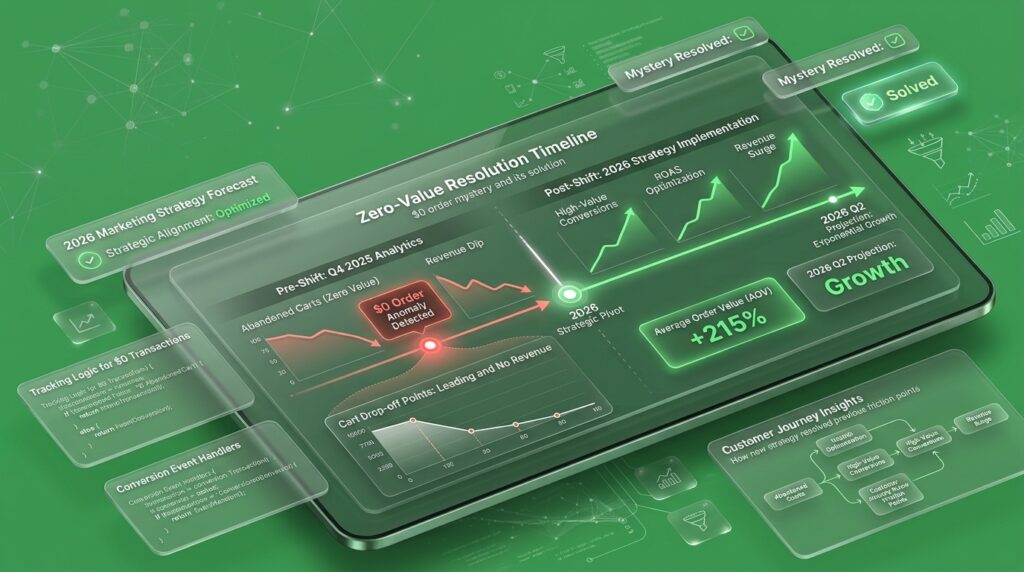
The $0 order mystery solved by one radical shift in 2026 strategy

your $0 orders aren’t a budget problem. They’re a strategy problem. You opened your dashboard Monday morning. The ad spend is there. The clicks are there. The traffic numbers look fine on paper. And yet zero orders. Again. Your agency says the creative needs testing. Your developer says the site is fine. And everyone agrees you should probably increase the budget.

We’ve audited hundreds of accounts across Meta, Google, and TikTok at “TheMayk”. And almost every time someone comes to us with the $0 order problem, they’re looking in exactly the wrong place. The ad isn’t broken. The post-click experience is. And in 2026, that gap just got a lot wider and a lot more expensive to ignore.

Stop Blaming Your Ads Fix the Funnel That’s Quietly Killing Your Conversions Instead

The real issue behind $0 orders isn’t traffic or creative it’s what happens after the click. In 2026, high-intent users expect fast, relevant, and frictionless experiences. If your funnel fails to deliver, no amount of ad spend will save it. Fix the journey, and the results follow.

The campaign looks healthy. The business isn't.

Here’s what makes this so maddening: a $0 order funnel can generate perfectly respectable vanity metrics. Your CTR sits at 3 to 4%. Your CPM looks reasonable. The campaign exits the learning phase. And then silence. cxMost founders and marketing managers do the logical thing. They pull the ad. They change the creative. They try a different audience. They chase the variable that’s most visible. And the cycle repeats. What they rarely question is what happens after the click.

The ad is not the product. The ad is the doorbell. What’s behind the door is what sells.

According to Triple Whale’s 2026 ecommerce benchmarks, the global average ecommerce conversion rate sits at 1.9 to 2%. Shopify stores in that top-performing bracket hit 2.5 to 3%. If your store is pulling anything below 1.5%, you don’t have an ad problem. You have a funnel problem and no amount of creative testing will fix it. 

70% is the average cart abandonment rate across all ecommerce industries. That’s an estimated $260 billion in recoverable revenue sitting untouched in the US alone. Your ads brought those people to the cart. Something after the click pushed them out. Seven out of ten people who add something to a cart don’t complete the purchase. That’s not a targeting failure. That’s a trust failure. A friction failure. A message failure that happened after your ad did its job.

What changed in 2026 that made this worse

The post-click problem isn’t new. But 2026 broke the old playbook for diagnosing it in ways most brands haven’t fully processed yet.

For years, you could track the full customer journey with reasonable accuracy. Click the ad → land on the page → add to cart → checkout → purchase. Each step was attributable. You could see exactly where people dropped off and fix it.

That clean visibility is gone.

Research published in early 2026 found that 93% of queries in Google’s AI Mode result in zero clicks. Organic CTRs have dropped 61% on queries where AI Overviews appear. AI agents inside ChatGPT, Gemini, Perplexity, and others are now comparing your products and completing purchases without the customer ever landing on your site. The transaction appears in your payment processor. Your GA4 calls it “direct.” Your attribution model calls it a mystery. Meanwhile, the buyers who do click through are arriving with higher intent and shorter patience. They’ve already been pre-qualified by AI recommendation. They’re not browsing. They’re deciding. And if your landing page greets them with a generic hero image, a 4-second load time, and no social proof above the fold they’re gone in under 8 seconds.

“The brands obsessing over their creative in 2026 are polishing the doorbell while the house is on fire. Fix what’s behind the click first.”

There’s also an attribution crisis quietly bleeding budgets. Most ecommerce brands are still running last-click attribution which means the last touchpoint before purchase gets 100% of the credit, regardless of the five channels that primed the customer to buy. This systematically over-rewards bottom-funnel retargeting ads while punishing the top-of-funnel content that actually creates demand. So brands cut the campaigns that are working and double down on the ones that are just capturing existing intent.

You end up with a funnel that’s optimized to harvest not to build. And eventually, the harvest runs dry because nothing’s growing upstream. 

The one shift that unlocks orders in 2026

The radical shift isn’t a new ad format. It’s not a better creative brief. It’s a structural change in how you think about your sales funnel. Stop optimizing the click. Start engineering what happens after it.

Here’s exactly how we approach this for clients at “TheMayk”:

Audit the post-click experience before touching the ad.

Use behavioral tracking to watch heat maps and rage clicks. If you don’t know why they’re leaving, you’re flying blind.

Whatever your ad promises must be delivered on the landing page in the first five seconds. Mismatched expectations are the fastest way to kill a conversion.

According to the Baymard Institute, the average cart abandonment rate is over 70%. Reduce form fields and add one-tap mobile payments to stop losing customers at the finish line.

Relying on last-click attribution only shows you who closed the deal, not what actually drove the decision. A full-funnel approach gives you multi-touch visibility across channels, helping you understand which campaigns are introducing new customers and which are simply converting those already primed to buy. With that clarity, you can allocate budget more effectively prioritizing the channels that build demand, not just the ones that capture it. At “TheMayk”, this is where our analytics and marketing intelligence work begins every time.

Activate your abandoned funnel systematically.

Cart abandonment flows, post-visit retargeting, and back-in-stock emails aren’t optional anymore they’re core infrastructure. Automated email flows can generate up to $3.65 per recipient compared to just $0.11 from one-off campaigns, making them one of the highest-leverage systems in your funnel. If your abandonment recovery isn’t actively running and optimized, you’re not just missing out on conversions you’re wasting a significant portion of the traffic you’ve already paid for.

In 2026, it’s not just ads that determine visibility your product data, schema markup, and structured content play a critical role in whether AI shopping agents surface your brand in recommendations. SEO and content strategy are no longer just about ranking on search engines; they now directly influence AI-driven purchase decisions that often happen beyond traditional attribution. You may not see every touchpoint in your analytics, but the impact will show up where it matters most your revenue.

The one thing that ties it together

Every one of those steps is a conversion rate optimization play. Not a creative play. Not a targeting play. A systems play.

The businesses that cracked this in 2026 didn’t find a magic audience segment. They rebuilt the pipe that their ad spend was running through. They fixed the holes first. Then they turned up the pressure.

More spend into a leaking funnel just accelerates the leak.

How we diagnose a $0 order problem at THEMAYK

Every time a new client comes to us with this problem, we run the same audit before we touch a single ad. We look at post-click behavior first where people are landing, where they’re dropping, and what the page is actually communicating to someone arriving with paid intent. We look at attribution setup because nine times out of ten, the brand doesn’t actually know which channels are driving demand versus just capturing it.

Then, and only then, do we look at the creative and the targeting.

That process usually takes us 48–72 hours. And it almost always uncovers two or three specific leaks that no amount of ad testing would have found because the problem was never in the ad.

The $0 order mystery gets solved the moment you stop asking “what’s wrong with my campaign?” and start asking “what happens after the click?”

Key Takeaway

Conclusion

The $0 order problem isn’t solved by better ads it’s solved by fixing what happens after the click. In 2026, growth comes from strengthening your funnel, aligning message to experience, and removing friction at every step. When the system works, conversions follow because demand isn’t just captured, it’s properly converted.

See How Our Agency Grow Your Traffic Into Conversions

SEO – unlock sustainable growth with proven search strategies.
Content Strategy – magnetic content that earns links, shares, and brand authority.
Paid Media – precision campaigns built for measurable ROI.

Blogs

Where to Find the Best Techniques to Improve SaaS Conversions?

Where to Find the Best Techniques to Improve SaaS Conversions? Struggling to turn visitors into paying customers despite heavy ad spend? When your free-to-paid trial conversion rate stalls, it’s easy to get distracted by vanity metrics like button colors or generic blog advice. However, if you want to effectively improve SaaS conversions, you need to […]

Why Is It Important to Improve Conversion Rates in SaaS?

Why Is It Important to Improve Conversion Rates in SaaS? You’re running a SaaS product with real signups coming in every week. The trial numbers look healthy on your dashboard. Then the billing cycle rolls around and half those accounts just… disappear. Your team probably calls that churn. It’s not churn. It’s a conversion rate […]

Top 5 Features of the TikTok Ads Library You Need to Know

Top 5 Features of the TikTok Ads Library You Need to Know You’ve spent three weeks scripting a TikTok ad from scratch with nothing but a hunch to guide you, while your top competitor spent five minutes launching profitable TikTok ad campaigns by simply copying what already works. The secret isn’t a massive creative budget; […]

Contact Us