
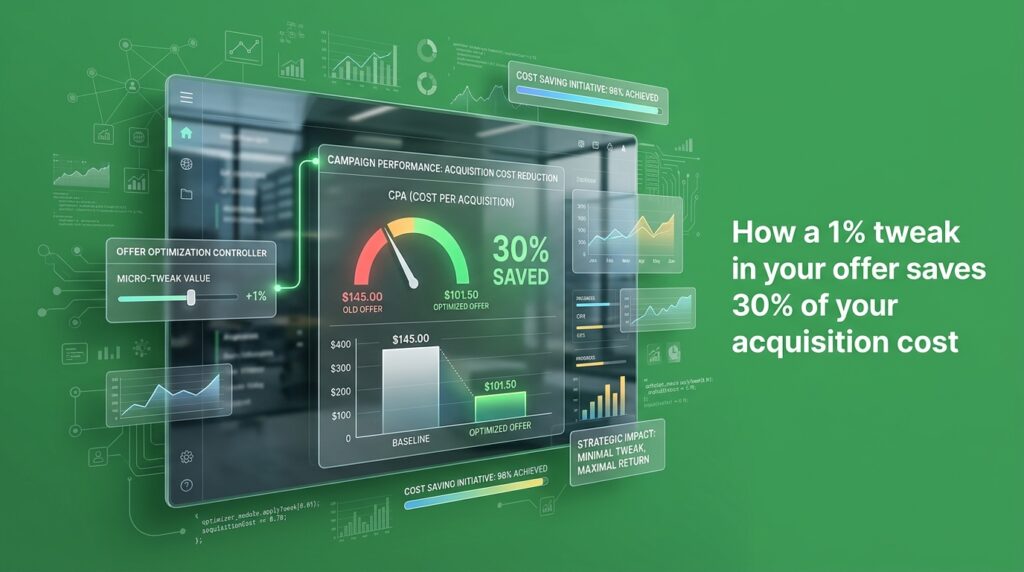
Blogs > How a 1% tweak in your offer saves 30% of your acquisition cost

How a 1% tweak in your offer saves 30% of your acquisition cost

You’re spending real money to acquire customers. Ads, content, retargeting, paid placements and the cost just keeps climbing.Your agency says it’s a targeting issue. Your team thinks you need a new creative. You’ve tested both. The needle barely moved.

Here’s what almost no one tells you: the offer not the ad, not the funnel, not the platform is the primary driver of acquisition cost. And most businesses are running an offer that’s off by a small but fatal margin.

Not wrong. Not broken. Just not sharp enough. And that gap is quietly costing 30% of everything you’re spending to acquire customers

Your Ads Aren’t the Problem Your Offer Is

Most businesses think rising acquisition costs are a traffic problem, but the real leak is often invisible: the offer itself. A slightly sharper message, clearer outcome, or better framing can quietly outperform bigger budgets and better creatives. Before you scale ads or switch agencies, the real question does your offer instantly make the right people say yes, or hesitate?

Your acquisition cost isn't a media problem

Customer acquisition costs are rising fast. Research tracking ecommerce CAC trends shows it climbed roughly 40% between 2023 and 2025 for the average brand. Paid search costs went up 12.88% year over year in 2025. Meta CPMs rose 20%. The math is getting brutal.

Most businesses respond to that pressure the same way: they increase budgets, test new creatives, or blame the platform. Some hire a new agency and run the same experiment with a different logo on the invoice.

The real problem is almost never the channel. It’s that the offer the actual thing you’re presenting to a cold prospect isn’t specific enough, differentiated enough, or framed correctly for the person seeing it.

When the offer is fuzzy, conversion rates drop. And when conversion rates drop, your cost-per-acquisition goes up because you’re paying for the same traffic volume with fewer people saying yes.

Most businesses treat CAC as a media efficiency problem. It’s actually an offer clarity problem.

The offer does most of the work before the ad even runs

Most people think the secret to better paid ads is better creative, but that’s not true the real driver is your offer. Research from MarketingExperiments shows that while customer motivation has the biggest impact on conversions, it’s something you can’t control; what you can control is how clearly you communicate your value. And that’s where most businesses fall short they spend too much time tweaking visuals and not enough time sharpening their offer. When a cold prospect sees your ad, they don’t know you, trust you, or care about your brand story, and you have about eight seconds to grab their attention. If your offer isn’t instantly clear, specific, and valuable, they’ll scroll past no matter how good your creative looks.

In those eight seconds, your offer needs to answer three questions without making them think:

  • What is this?
  • Why should I care right now?
  • Why you and not someone else?

Most offers answer the first question at best. They describe what the product is without communicating the immediate value of acting on it.

The result? Low conversions, expensive traffic, and a CAC that keeps rising. But it’s often not your ads it’s your offer. Research from Invesp shows that simply improving how you present your value can boost conversions by 55% to 90%. No redesign. Just a clearer, stronger offer.

The offer is the first filter in your acquisition funnel. If it’s vague, everything downstream the ad spends, the landing page, the email sequence is compensating for a broken foundation.

What '1% tweak' actually means in practice

We’re not talking about a full rebrand. We’re not talking about creating a new product line. We’re talking about the difference between two versions of the same offer one that lands and one that doesn’t.

Here’s what that looks like:

Generic offer: “High-quality protein supplements for fitness goals.”

Sharpened offer: “27g of protein per serving. No chalky taste. Ships in 24 hours.”

Same product. Same price. Same audience. Entirely different conversion rate because the second version answers the prospect’s actual questions before they have to ask them.

This is exactly what Shopify’s conversion rate research points to: the brands consistently outperforming on conversion aren’t the ones with bigger ad budgets. They’re the ones with sharper, more specific offer framing that reduces the amount of mental work required to say yes.

The 1% tweak isn’t a creative exercise. It’s a precision adjustment to the language and specificity of your offer and its downstream effect on CAC is disproportionate.

When conversion rate goes up by a few percentage points, you’re acquiring more customers from the same traffic volume. That’s a direct, immediate reduction in what each customer actually costs you.

Here's the exact process we use to sharpen an offer

When a client comes to us with rising acquisition costs and flat conversion rates, this is the sequence we run. It’s not complicated. But it requires honesty about what the offer is currently saying and what it’s failing to say.

Run the 8-second test

Pull your current ad creative and landing page. Give them to someone who doesn’t work in your business. Set a timer for eight seconds. Ask them to explain what you’re selling and why they should buy it today.

If they can’t your offer is failing the first filter. Not because the product is wrong, but because the framing isn’t doing the job fast enough.

Benefits often sound like “premium quality” or “great features,” but what actually persuades people are outcomes like “reduce churn by 22% in 90 days,” because that’s the real change they care about. So when you look at your offer, ad copy, headline, or CTA, ask yourself whether you’re just describing the product or clearly showing what it does for them. If it’s only benefits, rewrite it into a specific outcome, and add numbers where possible to make it feel real, clear, and believable.

CRO data from Market.us suggests that real urgency and scarcity when used properly, not fake countdowns can significantly boost conversions. The key is making it genuine, like a delivery cutoff, limited batch, or pricing deadline. “Order by Thursday for weekend delivery” actually gives people a reason to act, while vague phrases like “limited time offer” don’t work anymore because they’ve lost credibility.

Audit message match across the whole funnel

Your offer doesn’t live in a single ad. It runs across the creative, the landing page, the email sequence, and the checkout page. When those touchpoints say different things even slightly conversion drops at every stage. This is what our conversion rate optimization work almost always uncovers: the ad makes a promise the landing page doesn’t keep.

Map every touchpoint in your acquisition funnel. Does the headline on the landing page use the same language as the ad? Does the CTA match the specific outcome you promised in the creative? Friction builds wherever those things diverge.

Most businesses run A/B tests on visual elements image A versus image B, button color, font size. Almost none test the actual offer frame.

Run two versions of your acquisition funnel with different offer framing. Keep the creative identical. Change only how the core offer is described. Track conversion-to-purchase, not just click-through rate. Our paid media team runs this as a standard diagnostic before any budget scaling decision because you can’t fix an acquisition cost problem by spending more on a broken offer.

The winning offer frame then becomes the foundation for every ad, every landing page, and every email in that acquisition sequence.

Before you scale another dollar of ad spend, fix the offer

We’ve reviewed hundreds of acquisition funnels at “TheMayk”. The pattern is almost always the same. The media is fine. The creative is decent. The offer is vague, generic, or positioned for the wrong outcome.

Our sales funnel breakdown process always starts with the offer before we touch ad creative, targeting, or budget allocation. Because we’ve seen it too many times: a technically perfect funnel built on a mediocre offer, producing mediocre CAC, and mistaken for a targeting problem.

A sharper offer converts more of the same traffic. More conversions from the same spend means a lower cost per customer acquired. That’s not a math trick it’s the most direct lever on acquisition efficiency that exists.

If your acquisition costs are rising and your offer hasn’t been touched in six months, the offer is the problem. Let’s fix it.

Stop guessing. Let’s build an acquisition system that actually converts. Book a free strategy session at www.themayk.com.

Key Takeaway

Conclusion

Your acquisition cost isn’t just controlled by ads or targeting it’s controlled by how clearly your offer lands. A small shift in framing, specificity, or outcome clarity can drastically change conversions. Before increasing spend, fix the offer. Because better clarity doesn’t just improve performance it lowers the cost of every customer you acquire.

See How Our Agency Grow Your Traffic Into Conversions

SEO – unlock sustainable growth with proven search strategies.
Content Strategy – magnetic content that earns links, shares, and brand authority.
Paid Media – precision campaigns built for measurable ROI.

Blogs

Where to Find the Best Techniques to Improve SaaS Conversions?

Where to Find the Best Techniques to Improve SaaS Conversions? Struggling to turn visitors into paying customers despite heavy ad spend? When your free-to-paid trial conversion rate stalls, it’s easy to get distracted by vanity metrics like button colors or generic blog advice. However, if you want to effectively improve SaaS conversions, you need to […]

Why Is It Important to Improve Conversion Rates in SaaS?

Why Is It Important to Improve Conversion Rates in SaaS? You’re running a SaaS product with real signups coming in every week. The trial numbers look healthy on your dashboard. Then the billing cycle rolls around and half those accounts just… disappear. Your team probably calls that churn. It’s not churn. It’s a conversion rate […]

Top 5 Features of the TikTok Ads Library You Need to Know

Top 5 Features of the TikTok Ads Library You Need to Know You’ve spent three weeks scripting a TikTok ad from scratch with nothing but a hunch to guide you, while your top competitor spent five minutes launching profitable TikTok ad campaigns by simply copying what already works. The secret isn’t a massive creative budget; […]

Contact Us