
Blogs > Why Your Rank Tracker Is Showing False Drops
Why Your Rank Tracker Is Showing False Drops
- Sundus Sohail
- 2
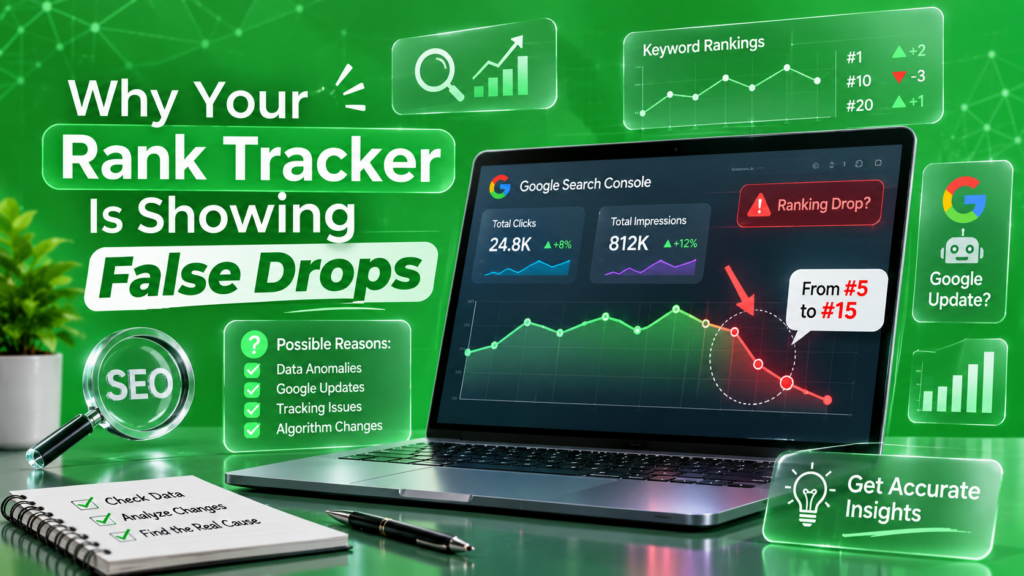
You open your rank tracker on a Tuesday morning and see ten money keywords wiped off page one. Your stomach drops, your team starts panicking, and someone suggests rewriting your top-converting pages before lunch. Meanwhile, your actual search traffic and orders look completely normal. Your tracker isn’t showing you reality it’s reading a distorted search results page that Google served to automated scrapers.
As a team at “TheMayk” focused on marketing intel and organic growth, we see operators waste hours chasing ghosts every time search data gets messy. Before you touch a single headline or panic over a sudden cliff in your dashboard, you need to know whether Google actually moved your site or fed your tool bad data.
Don't rewrite healthy pages on day one
Knee-jerk edits fix nothing when the drop isn’t real. Look at Search Console impressions and GA4 landing page conversions before touching a single headline or layout. Most tracker glitches clear fast, while real ranking losses leave footprints across actual user traffic and revenue. At “TheMayk”, we tie organic search data straight to real business performance so you stop guessing. Let’s check what’s actually moving the needle at www.themayk.com.
Your dashboard is reading a distorted search page
False ranking drops happen when automated tracking tools collect search results that look normal on the surface but swap out the usual organic listings. There’s no error screen, no captcha message, and no warning banner inside the raw page code. Your tracker records the missing position as a real drop even when real human searchers still see your page.
Research published by Nozzle in October 2026 across 27.5 million collected search pages found that 8.0% of judged results pages from September 13 through October 9 were “poisoned,” compared with a 0.17% baseline beforehand. On those affected pages, tracked sites disappeared from the top 10 in 58.6% of cases, while organic results kept only 20.7% of the previous page’s domains instead of the usual 88.5%.
What makes this worse right now is the timing. Google finished rolling out its November 2026 core update on November 24 and pre-announced a December 2026 core update the very same day. When algorithm updates collide with noisy rank tracking data, reactive teams end up breaking pages that were never hurt in the first place.
A single red arrow in a third-party tool is a signal to verify, not a reason to panic.
Google is fighting AI scrapers and collateral damage is hitting you
Here’s where it gets interesting: rank trackers aren’t usually the primary villain in Google’s sights large-scale automated scraping for AI systems is. Industry reporting from Search Engine Roundtable documents how Google has stacked defenses like wider IP blocks, human verification challenges, /goto link delays, and sign-in walls after initial searches. On October 27, 2026, Semrush also confirmed it has seen “poisoned SERPs” returning altered or loosely matched results to automated requests.
Think about it like this: if Google simply blocks a scraper, the scraper knows it got blocked and retries through another route. When Google returns a normal-looking page with shuffled or off-target listings instead, automated collection gets polluted without triggering an obvious error.
Nozzle’s data shows those altered pages tend to lean heavier on social platforms and forums like Reddit, Facebook, LinkedIn, Instagram, and Quora while showing fewer AI Overviews. Even better, most of those glitches don’t stick: Nozzle reported that 80% of poisoned spells lasted a single collection and 77.9% returned to their usual domains within three days.
When automated data collection gets noisy, ranking charts start lying about market reality.
Key Takeaway
Check your own traffic data before changing a word
Now here’s the part most people miss: you don’t have to guess whether a drop is real when you own first-party data. You can separate tracker noise from an actual ranking loss in minutes by checking what real users and Google’s own reporting show.
Follow these five steps whenever your rank tracker flags a sudden drop:
Open Google Search Console first:
Compare clicks, impressions, and average position for the exact query and URL over the past 14 to 28 days. If Search Console impressions and clicks hold steady while your tracker shows a crash, treat the tracker reading as noise.
Cross-check landing page behavior in GA4:
Look at organic landing page sessions, engagement, and conversions for the affected URLs. If qualified traffic and leads haven’t budged, your revenue engine isn’t broken.
Wait at least three days before editing:
Because Nozzle found 77.9% of poisoned SERP cases cleared within three days, knee-jerk rewrites on day one often hurt healthy pages. Real algorithm drops tend to persist across multiple days and weeks.
Inspect the SERP snapshot against prior weeks:
Don’t compare today’s results only against yesterday yesterday may have been skewed too. Check whether the top 10 domains look completely unfamiliar or off-topic compared to the prior two to three weeks.
Isolate core update timing and high-volatility segments:
Check dates against Google’s update history such as the November 2026 core update completion and December 2026 core update pre-announcement and filter Search Console by device and country.
What to do when Search Console and GA4 both drop: Audit page intent, internal links, and content depth on the affected URLs before launching major overhauls.
What to do when Search Console stays flat: Log a note in your monthly report, keep your content untouched, and track weekly trends instead of daily spikes.
What to ask your SEO partner or tool: Ask how your reporting separates third-party rank estimates from Search Console and revenue data.
Trust the data that measures real human demand, not a single snapshot from a scraper.
Stop reacting to noisy charts and build real visibility
At “TheMayk”, we look at organic growth through marketing intel and performance pairing search data with landing page conversion and revenue so you never make expensive moves off a bad reading. False ranking drops are a headache, especially around core updates, but they’re also a reminder to ground every SEO decision in real user behavior.
If your dashboards are flashing red and you want straight answers on what’s actually happening with your search performance, let’s look at the real numbers together at THEMAYK.
Meta Description: Seeing false drops in your rank tracker? Learn how to spot bad SERP data, verify drops in Search Console, and protect your rankings.
Conclusion
Don’t let a glitchy rank tracker trick you into wrecking pages that still bring in real money. Check Search Console, GA4, and your actual conversions before changing a single word, especially around core updates. At “TheMayk”, we pair search intel with real business outcomes so you stop guessing and start growing. Let’s audit your real numbers at www.themayk.com.
SEO – unlock sustainable growth with proven search strategies.
Content Strategy – magnetic content that earns links, shares, and brand authority.
Paid Media – precision campaigns built for measurable ROI.