Why Your Content Marketing Strategy Is Failing
Why Your Content Marketing Strategy Is Failing You’re publishing every week and the pipeline hasn’t moved. Your agency says content takes time. Maybe. But when a…
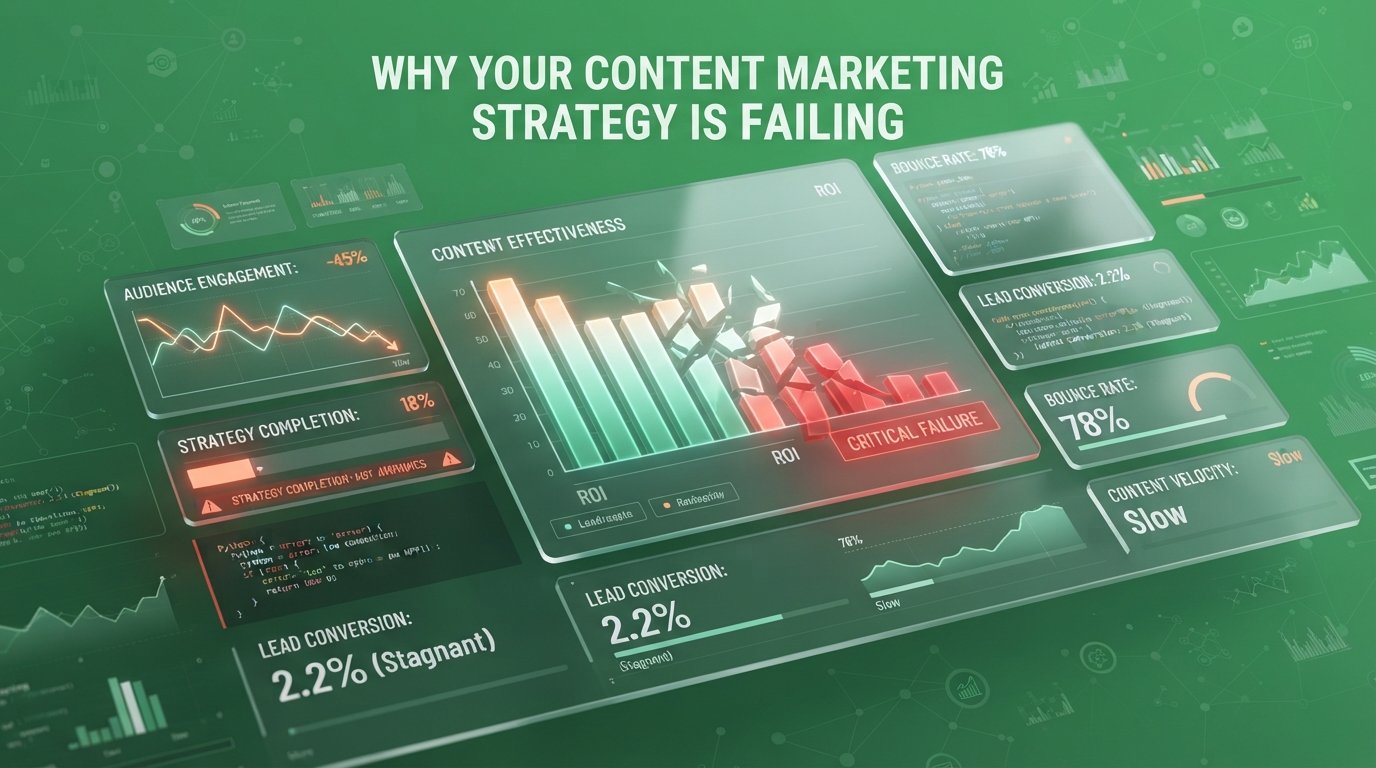
You’re publishing every week and the pipeline hasn’t moved. Your agency says content takes time. Maybe.
But when a content marketing strategy fails this quietly, the writing is almost never the problem. The problem is what the content was never built to do.
Most content marketing strategies fail because they focus on publishing volume rather than driving actual pipeline revenue. Simply maintaining a busy calendar, relying heavily on generic AI generation, or tracking vanity metrics like pageviews will not convert readers into buyers. Sustainable growth requires assigning every post a specific sales job, fixing behavioral tracking, and leveraging genuine expert insights.
Be honest about what you have. A calendar. A posting cadence. A list of topics somebody brainstormed in a meeting. A monthly report that says traffic is “trending up.”
That’s not a strategy. That’s a schedule.
A strategy tells you which piece moves which buyer one step closer to paying you. A schedule just tells you what goes live on Thursday.
And it’s getting worse, because producing content has never been cheaper. The Content Marketing Institute’s 2026 B2B research found that about nine in ten marketers now use AI to produce content, yet fewer than four in ten say it has improved their performance.
Volume is up. Proof that it’s working isn’t. Publishing more was never the bottleneck.
Now here’s the part nobody puts in the monthly report.
Try this in your next marketing meeting. Ask which blog post brought in your last three customers.
Silence. Or a guess. Or a screenshot of pageviews.
Traffic is the number people report when they can’t report revenue. It feels like progress because it moves. But a post can pull thousands of visits and zero leads, and your dashboard will still look healthy.
Usually the cause is tracking that stops at the pageview. No events on form fills. No view of the content a buyer read before they booked a call. Without that, every content decision is a vibe.
This is where proper business and website analytics and behavioral tracking stop being “nice to have.” If you can’t connect a post to pipeline, you’re not measuring content marketing ROI. You’re measuring attention.
You can’t improve what you can’t trace.
Let’s be fair. You’ve probably tried to fix this already, and every fix felt logical at the time.
Each one costs real money. And none of them touch the actual gap, which is what the content is for and whether anyone can see what it earned.
Think of it like repainting a shop while the front door is locked. The walls look better. Nobody’s getting in.
You’ve been optimizing the output when the problem lives upstream.
Fixing symptoms is expensive. Finding the cause is cheaper.
Here’s a budget pattern we keep seeing. Money goes into software, AI subscriptions, and publishing platforms. Very little goes into the people who actually know the customer.
CMI’s data puts a number on it. When B2B marketers named the areas where they planned to spend more in 2026, 45% picked AI-powered marketing tools. Salaries, training, and development landed at the very bottom, with just 9%.
A tool can draft a post in under a minute. It can’t tell you what your buyer said on the sales call that nearly killed the deal.
Tools produce content. People produce the reason to read it.
Software doesn’t have opinions. Your team does.
Here’s where it gets interesting.
Most strategies never say this out loud: every piece of content needs a job. One job. Specific.
In the content audits we run, the posts that earn their keep almost always fall into one of three jobs:
Most of what we find has no job at all. It was written because the topic looked interesting, or because the calendar had an empty slot.
Picture a DTC brand with 150 posts on its blog. Ask which ten bring in buyers. If nobody can answer, the other 140 aren’t strategy. They’re inventory.
No job means no next step. No next step means the reader nods, closes the tab, and forgets you exist. That’s why we start with a sales funnel breakdown, not a content calendar.
Content without a job isn’t content marketing. It’s a hobby with a budget.
Thought leadership is the biggest offender. CMI’s survey says 96% of B2B marketers report that their organization creates thought leadership. In many of those companies, fewer than 5% of staff ever contribute to it.
So who’s writing it? A content team guessing what the experts think. The founder, the head of sales, and the person answering support tickets are the ones holding the real insight, and they’re nowhere near the draft.
You get posts that could sit on any competitor’s blog. Nobody remembers them, and nobody buys because of them.
Google’s own guidance on helpful, reliable, people-first content says the same thing from the search side. Create content for people first, and treat SEO as something that works best on top of content that’s already useful.
If the person who knows the answer isn’t in the draft, the answer isn’t in the post.
Generic in, generic out.
Even good content fails when nobody can get through it.
Nielsen Norman Group’s eyetracking research on web reading found that on text-heavy pages with little formatting, readers’ eyes bunch up at the top and along the left edge in a rough F shape. Everything outside that path gets skipped.
So the 2,000-word post your team spent a week on? A big chunk of it probably never gets seen.
The fix isn’t shorter content. It’s content built for the skim: descriptive subheadings, short paragraphs, and bold signposts that carry the argument on their own. Skimmers decide whether you get read.
Write for the scan first. The read comes second.
Before the six moves, run a quick gut check. It takes ten minutes and it’s brutal on purpose.
Two or more “no” answers means you’re running a schedule, not a strategy. Which also means more output will only make the gap more expensive.
The good news: all three are fixable, and fixable in a clear order.

So what do you actually do about it? This is the order we’d work in, and the order matters. Jump to step six without doing step two and you’ll be back here in a year, with a nicer-looking report and the same pipeline.
Pull every post from the last 12 months. Tag each by topic, funnel stage, and whether it ever produced a lead, a call, or a sale. Then keep, refresh, merge, or delete. Expect a few pieces carrying most of the weight and a long tail doing nothing, which is exactly the point of the exercise. Result: your next quarter starts from evidence, not hope.
Set up events for form fills, demo requests, add-to-carts, and booked calls. Make sure you can see which content a buyer touched before converting, and put it on a marketing dashboard your whole team can read. Result: every post can be tied to something that matters.
Label it catch, convince, or close. Then match the call to action: searchers get a useful next read, skeptics get proof, late-stage buyers get a booking link. Treat the page like a landing page, because it is one, and apply basic conversion rate optimization. Result: readers know what to do next, and you know what to measure.
Book 30 minutes a month with your founder, your best salesperson, and whoever handles support. Ask what buyers misunderstand, what almost killed the last deal, and what they wish customers knew. Those answers become your briefs. Use AI-assisted content workflows to speed up the drafting afterward, not to replace the thinking. Result: posts nobody else could write.
Open with the answer. Keep paragraphs to two or three lines. Write subheadings that tell the story without the body text. Bold the one idea per section that matters. Result: the skimmer gets your argument and the reader gets the detail.
Ask one question per piece: did it do its job? Double down on what moved buyers and cut what didn’t, without ceremony. Result: budget follows evidence, so each quarter compounds instead of restarting.
Strategy first. Then publish.
This is how we start every engagement at THEMAYK: with a documented audit, not a hunch. We map the funnel and fix the tracking first, and only then decide which content deserves budget.
It’s slower than ordering ten more blog posts. It’s also why most of our clients see their first measurable lift within 60 to 90 days instead of another quarter of “trending up.”
If your content is busy but your pipeline isn’t, we should talk. Book a free strategy call at www.themayk.com and we’ll review your brand, funnel, and spend, then send you a written summary whether or not you hire us.
Stop guessing. Start growing.
Transforming a failing strategy into a revenue driver requires shifting focus from publishing frequency to strategic intent. Partnering with “TheMayk” ensures your content library is audited, behavioral tracking is repaired, and posts are optimized for conversion. Prioritizing strategic clarity over output volume bridges the gap between traffic and revenue, ensuring every piece actively moves buyers through your pipeline.
Because in 2026, the difference between a “No” and a “Yes” isn’t your tech stack—it’s the human strategy behind it. Let’s turn your digital ghost town into a conversion machine.
Why Your Content Marketing Strategy Is Failing You’re publishing every week and the pipeline hasn’t moved. Your agency says content takes time. Maybe. But when a…
How to Improve SEO Rankings With AI Search You’re ranking on page one for the terms that pay the bills, and your clicks keep sliding anyway.…
Don’t let your website be a Ghost Town Your ROAS used to be comfortable. Now it’s barely above break-even, and every week brings a new theory.…
How we use your info: Used strictly to review your project, prepare tailored insights, and reach out for a 1-on-1 strategy call. Zero spam, zero shared data.