
Blogs > How to Fix Dying Ecommerce Ads
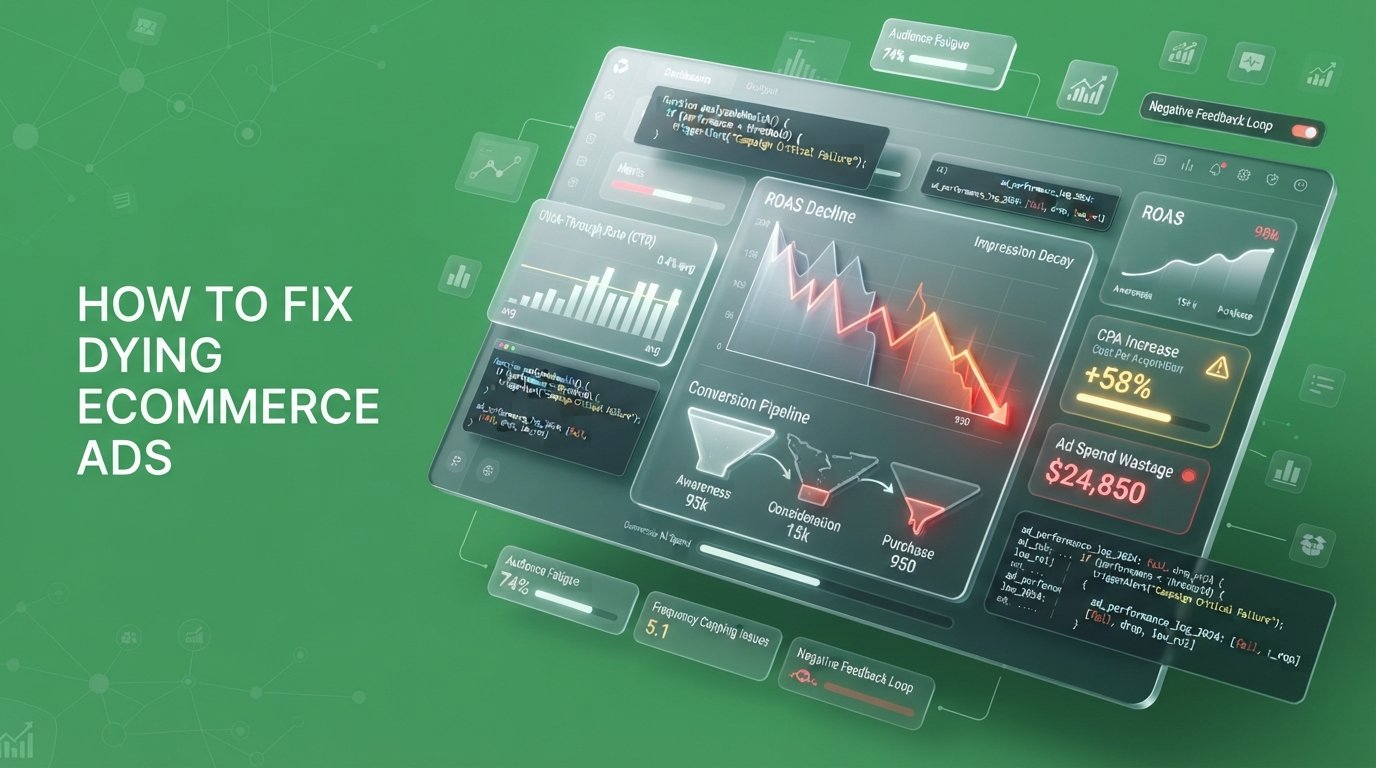
Don’t let your website be a Ghost Town
- Sundus Sohail
- 14
Your ROAS used to be comfortable. Now it’s barely above break-even, and every week brings a new theory. Your agency says give it more time. Your media buyer wants more budget.
If you’re trying to fix dying ecommerce ads, that’s the advice you’ve probably heard. It’s aimed at the wrong target. The ad is rarely the first thing that breaks. It’s what happens after the click.
Here’s how to find the real leak, and the order we’d fix it in.
Optimizing the Post-Click Experience
Fixing underperforming ecommerce ads requires looking beyond creative fatigue and analyzing the full post-click funnel. By prioritizing accurate behavioral tracking, optimizing mobile page speeds, and streamlining checkout forms, you eliminate friction points where shoppers drop off. Following a structured audit enables brands to systematically resolve conversion leaks, maximize overall ROAS, and rebuild sustainable profitability before increasing ad spend.
Your ROAS Dropped and Everyone Has a Different Excuse
The agency blames creative fatigue. The developer blames traffic quality. You blame the market, the algorithm, or the season. Everyone’s right about something, and nobody’s looking at the whole picture.
That’s because each person is staring at their own dashboard. The ad platform shows clicks and platform-reported purchases. The store shows sessions and orders. Analytics shows something slightly different from both.
Meanwhile the budget keeps going out the door every single day. Each week you wait is another week of paying full price for traffic that doesn’t turn into orders.
Nobody owns the gap between those dashboards. That gap is where your money is going.
Three Fixes That Feel Productive and Change Nothing
When ads start slipping, most teams reach for the same three moves:
- Swapping the headline or the background color. Same idea, new paint. The shopper still sees the same offer.
- Rebuilding audiences. You’re rearranging who sees the ad while the page they land on stays untouched.
- Raising the budget. Pouring more money into a leak just makes the leak more expensive.
None of these is wrong in the right situation. They’re wrong as a first move, because you haven’t found the problem yet.
Activity isn’t diagnosis.
Your Ad Is Getting Blamed for a Crime Your Store Committed
Here’s the part most people miss. Your ad gets someone to the door. Your store decides what happens next. And most ecommerce stores quietly lose people at every step after the click.
Start with speed. A Google-commissioned study by Deloitte and 55 found that a 0.1 second improvement in mobile site speed lifted retail conversion rates by 8.4%. That’s one tenth of a second.
Ask your team what your mobile load time was last week. If nobody knows, that’s your first answer.
Now the checkout. Baymard Institute pooled 50 studies and landed on an average cart abandonment rate of 70.22%. Some of that is just window shopping, and Baymard found 42% of US shoppers have abandoned a cart because they were only browsing.
Strip those people out and the leftover reasons are the fixable ones, according to the same Baymard research:
- 40% said extra costs were too high (shipping, tax, fees)
- 19% didn’t trust the site with their card details
- 18% were forced to create an account
- 17% found checkout too long or complicated
- 17% hit errors or crashes
Baymard also estimates the average large ecommerce site could lift its conversion rate by 35.26% through better checkout design alone. That’s not a creative problem. That’s a store problem wearing an ad costume.
Your ad can do its job perfectly and still lose money.
Meta Trims the Field Before Your Ad Even Gets Ranked
Now the ad side, because yes, creative matters. Just not the way most people use that word.
Meta’s own engineering team describes retrieval as the first step in its multi-stage ads system. That stage narrows tens of millions of ad candidates down to a few thousand before anything else happens.
Meta hasn’t published a rulebook for what survives that cut, so treat what follows as our read, not a Meta guarantee.
If your account has eight ads that all make the same promise in slightly different packaging, you don’t have eight shots. You have one idea, repeated eight times. What most people call creative fatigue is often a sameness problem.
Creative fatigue is real. It’s also the easiest diagnosis to hide behind.
Key Takeaway
How We Fix Dying Ecommerce Ads Without Touching the Budget First
Six steps. The order matters, because each one makes the next one cheaper to get right.
1. Check That Your Purchases Are Even Being Counted
Ad platforms optimize toward the purchases they can see. If that data is wrong, every decision built on it is wrong too. We fix tracking before we spend on ads, and you should do the same.
Do this first:
- Place a test order and confirm the purchase event fires once, with the correct value.
- Compare platform-reported purchases against real store orders for the same seven days.
- Check that discounts, shipping, and tax aren’t distorting order value.
If the numbers don’t match, stop there. Get your behavioral tracking and business and website analytics clean before you change a single ad.
Bad tracking turns every other fix into a guess.
2. Find the Exact Step Where Buyers Disappear
Write down five numbers for a good week and the same five for this week: click-through rate, landing page views, add-to-cart rate, checkout starts, and purchases.
The biggest drop tells you where to work:
- Clicks look fine, landing page views are low. The page is usually too slow, or it doesn’t match what the ad promised.
- Landing page is fine, add-to-cart is low. Your product page isn’t doing the selling.
- Add-to-cart is fine, purchases are low. Look at checkout.
- Click-through rate itself is low and everything after it holds up. Now it’s a creative problem.
This is exactly what a sales funnel breakdown is built to show you.
Fix the biggest drop first, not the loudest opinion.
3. Stop Making Mobile Shoppers Wait for Your Product Page
Open your top landing page on a real phone, on mobile data, not office wifi. Count how long it takes before you can tap Add to Cart.
Then clean it up:
- Compress oversized product images and videos.
- Remove scripts and apps nobody’s using.
- Put price, shipping info, and reviews above the fold.
This is where conversion rate optimization earns its keep. For a beverage brand we worked with, a landing page overhaul that cut load time by 42% was part of a rebuild that took ROAS from 2.3 to 5.1 within six weeks.
A faster page is the cheapest ad budget you’ll ever find.
4. Strip Out Whatever Makes Checkout Feel Like Paperwork
Baymard’s testing shows an ideal checkout can run on 12 to 14 form elements. The average US checkout shows 23.48 by default.
Close that gap:
- Show shipping and tax before the last step so nothing surprises anyone.
- Offer guest checkout.
- Remove every field you don’t need to ship the order.
- Run the whole flow on a phone and hunt for errors.
They already said yes to your ad. Don’t make them prove it across 23 form fields.
5. Replace Ads That Say the Same Thing With Ads That Don’t
Now the creative. Lay your last ten ads side by side and group them by the promise they make.
If eight of the ten say “premium quality, free shipping,” you don’t have ten ads. You have two.
Build three or four angles that are genuinely different from each other:
- A problem-first ad. Open on the frustration your product solves.
- A proof-first ad. Real customers, real reviews, real results.
- A product-in-use ad. Show it in someone’s hands or home. 3D product visuals and explainer videos can show what a flat photo can’t.
- An offer-first ad. Lead with the deal and the deadline.
Then build each one for the platform it runs on. We don’t recycle creative across channels in our paid social work, and neither should you.
Ten versions of one idea is still one idea.
6. Set Kill and Scale Rules Before You Spend Another Dollar
Decide the rules while you’re calm:
- What ROAS or cost per acquisition kills an ad?
- How much spend, or how many days, before you judge it?
- How big a budget step are you allowed to take at once?
Change one thing at a time and write it down. Then put ad spend, store revenue, and funnel rates side by side in one marketing dashboard so nobody’s arguing from separate numbers again.
Rules you write before the panic beat opinions you form during it.
This Is the Audit We Run Before We Touch an Ad
Every “TheMayk” engagement opens with a documented audit, not a hunch. We study the market, the funnel, and the tracking first, because that’s where the money usually hides.
Owais Khatri leads paid media here. On fragrance and apparel accounts, his restructures have moved ROAS from 1.8x to 3.4x inside 90 days.
It’s the same logic as the six steps above, just with our hands on your data.
If your ads are dying and nobody can tell you why, let’s find out. Book a free strategy call at www.themayk.com. In 30 minutes we review your brand, funnel, and ad spend, then send you a written summary whether or not you hire us.
Stop guessing. Start growing.
Conclusion
Fixing underperforming ecommerce ads requires looking beyond creative fatigue and analyzing the entire post-click journey. By prioritizing accurate tracking, optimizing landing page speed, and streamlining checkout form design, you address the primary friction points where shoppers drop off. Following a structured, six-step audit process allows brands to systematically eliminate conversion leaks, maximize ROAS, and restore sustainable profitability before attempting to scale ad budgets.
Because in 2026, the difference between a “No” and a “Yes” isn’t your tech stack—it’s the human strategy behind it. Let’s turn your digital ghost town into a conversion machine.