
Blogs > How to Avoid Buying Fake AI Branding Agency Promises
How to Avoid Buying Fake AI Branding Agency Promises
- Sundus Sohail
- 14
Every pitch deck now has “AI-powered” somewhere on slide three. You signed, and three weeks later you’re holding a brand that looks like a template with your logo dropped in. Your agency says the AI needs more time to learn you.
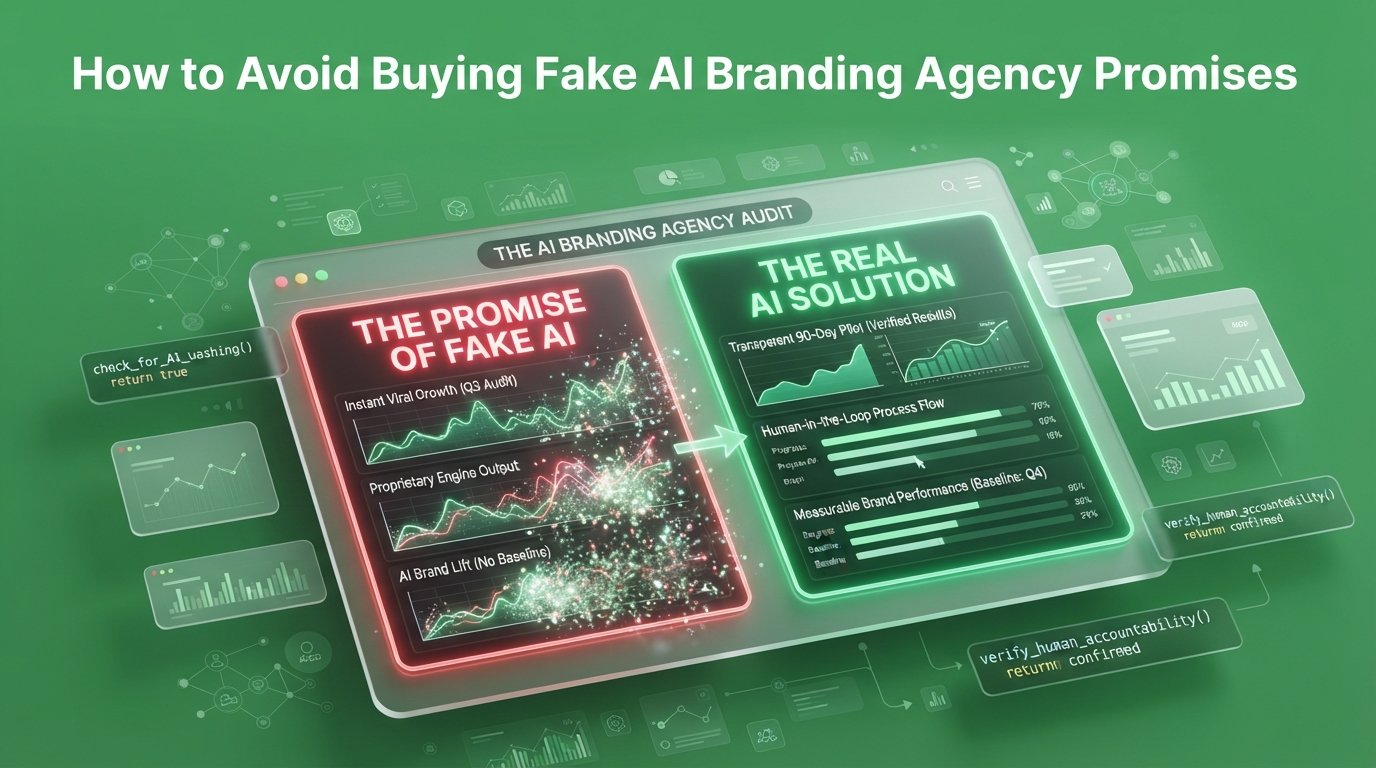
We’ve seen enough of these decks to say it plainly: fake AI branding agency promises almost never fail because of the AI. They fail because nobody can show you the work behind the word.
Protecting Your Brand Investment
Navigating the AI landscape requires looking past buzzwords to evaluate real capability. Spotting red flags like vague processes, untraceable case studies, and missing baselines protects your business from costly mistakes. By enforcing structured vetting checks, demanding transparency, and starting with small pilot projects, you ensure your brand partners deliver verifiable value. Choose agencies that combine AI efficiency with human expertise.
Your Deck Said Proprietary AI, and Your Delivery Said Template
Here’s how it usually goes. The pitch is fast, confident and full of big numbers. The kickoff is a questionnaire. Then the “strategy” arrives, and it could belong to any company in your category.
If you’re not sure what the real version delivers, start with our breakdown of what an AI branding agency actually does. And if you’re already holding something generic, our guide to fixing a weak brand identity shows what to settle first.
The fake isn’t always a lie about the AI. More often it’s a promise nobody can check. These are the ones we’d flag:
- “Our proprietary AI builds your brand in 48 hours.” Ask which tool, which step, and who reviews the output. Silence is an answer.
- Guaranteed results with no baseline. A promised lift means nothing if nobody measured where you started.
- Case studies with no client name, no date and no number. If it can’t be traced, it can’t be trusted.
- The same deck with a different logo. Ask a mutual contact whether last quarter’s pitch read the same.
- Pricing with no scope behind it. “Custom” with no deliverables is how a retainer becomes a subscription to nothing.
This isn’t just a feeling. In September 2024, the FTC announced Operation AI Comply, five enforcement actions against companies it said used AI hype to lure people into bogus schemes.
The FTC alleges one of them, Ascend Ecom, took at least $25 million from consumers after claiming its AI-powered tools would produce thousands of dollars a month. It says another, FBA Machine, cost buyers more than $15.9 million on similar promises.
Those were business-opportunity schemes, not branding agencies, so don’t read them as a verdict on your vendor. Read them as a pattern: when “AI” is the reason to believe the promise, the promise needs more scrutiny, not less.
“AI” in a pitch is a claim. Treat it like one.
The Word AI Is Hiding Three Gaps, and Every Fake Promise Lives in One
Here’s the part most buyers miss. “AI” works as a shield. It explains away a thin process (“it’s proprietary”), a missing result (“it’s still learning”) and a low price (“the machine does the work”).
That’s why asking “do you use AI?” gets you nowhere. Every agency says yes. The better move is to find where the promise has a hole, and in our experience there are only three places it can hide:
- The method gap. They can’t tell you what the AI does, at which step, and what a human decides instead.
- The proof gap. They can’t show a before, an after, a timeframe and what else changed in between.
- The ownership gap. They can’t tell you who is accountable when the work misses.
Regulators have a name for filling those gaps with a buzzword. The SEC calls it AI washing, and in March 2024 it settled charges with two investment advisers, Delphia and Global Predictions, over claims about AI they didn’t actually have. The penalties totaled $400,000.
Gartner uses a cousin of the term. In June 2025 it said “agent washing” is rebranding existing products as agentic AI, and estimated that only about 130 of the thousands of agentic AI vendors are real.
Same caveat applies: investment advisers and software vendors, not agencies. But follow the logic. If companies selling actual code get caught relabeling old products, a service you can’t open and inspect deserves a harder look, not an easier one.
Real AI use in branding is dull and verifiable. Faster research. More concept variants to test. Quicker first drafts. The decisions that make a brand, like positioning and what you refuse to say, still need a strategist who can be wrong on the record.
Real AI saves time on the work. It doesn’t replace the person who decides what your brand stands for.
Key Takeaway
Here's How We'd Vet an AI Branding Agency in Five Checks Before You Sign
Run these in order. Each one takes a call or an email, and each one closes one of the three gaps.
1. Make Them Name the AI, the Step and the Human Who Checks It
Ask for a one-paragraph answer: which tools, at which stage of the project, and who reviews the output before you see it. Good answers are boring and specific.
Something like: “We use AI-powered content creation for first drafts and research, and a senior editor rewrites for voice before anything ships.” You can picture that. You can’t picture “our proprietary engine.”
If the answer is a slogan instead of a process, you’ve found the fake.
2. Ask for a Baseline Before You Ask for a Result
Before anyone promises a lift, ask where today’s number comes from. It should come from your own business and website analytics, not from a slide.
Get the starting metric, the target, the timeframe and the date you’ll both review it. Then ask which stage of the funnel the work is supposed to move. A sales funnel breakdown shows you where that is.
No baseline, no promise worth signing.
3. Check That Every Case Study Has a Name, a Date and a Number
Ask for three recent projects. Each should have a client you can contact, a timeframe, and one metric with context. Then call one and ask what changed besides the branding.
Honest results come with an honest “and also.” Take the 34% add-to-cart lift we report for one fragrance brand. It came from a packaging and visual refresh that shipped alongside a full store migration, so we don’t credit design alone.
A case study you can’t call is a brochure.
4. Get the Scope, the Fixed Price and the Named Owner in Writing
Ask for the deliverables, the number of revision rounds, the price, and the name of the person accountable for the result. Then ask who owns the final files when the project ends.
This is the check that closes the ownership gap. An agency that’s proud of its process will hand you a written scope without a fight. One that hesitates is telling you something.
If nobody’s name is on the work, nobody’s accountable for it.
5. Start With a Paid Pilot Small Enough to Lose
Don’t sign a twelve-month retainer on the strength of a pitch. Buy one scoped piece instead: a positioning sprint, a single landing page, one campaign concept.
Tie it to one metric you can watch. A conversion rate optimization review and behavioral tracking will show you where visitors hesitate and whether the new work moved them. If the pilot’s real, the retainer’s an easy yes. If it’s fake, you’ve lost a month, not a year.
Test the promise on a small bill before you trust it with a big one.
This Is the Test We'd Want You to Run on Us First
Everything above is how we’d want a buyer to vet us. At THEMAYK, every project opens with a documented audit of your brand, funnel and tracking. You get a written scope and a fixed price before any work begins, and you work with named seniors, not a rotating junior pool.
We’re also straight about timing: most clients see their first measurable lift within 60 to 90 days, because we fix tracking before we spend on ads. Ask us the five questions above. We’d rather you did.
If an AI pitch has you second-guessing a signature, bring it to us. Book a free strategy call at www.themayk.com. In 30 minutes we review your brand, funnel and ad spend, then send a written summary whether or not you hire us.
Stop guessing. Start growing.
Conclusion
Navigating the AI landscape requires looking past buzzwords to evaluate real capability. Spotting red flags like vague processes, untraceable case studies, and missing baselines protects your business from costly mistakes. By enforcing structured vetting checks, demanding transparency, and starting with small pilot projects, you ensure your brand partners deliver verifiable value. Choose agencies that combine AI efficiency with strategic human expertise to drive genuine growth.
Because in 2026, the difference between a “No” and a “Yes” isn’t your tech stack—it’s the human strategy behind it. Let’s turn your digital ghost town into a conversion machine.