
Blogs > How to Spot Branding Mistakes That Cost You Sales

How to Spot Branding Mistakes That Cost You Sales

Your traffic is steady, your ads are getting clicks, and sales have been soft for two quarters. Your agency says to give the funnel more time, and your team wants a new logo.

We’ve seen enough of these accounts to say it plainly: the branding mistakes that cost you sales almost never look like mistakes. They look like a perfectly decent website that buyers keep quietly leaving.

Turn Brand Clarity into Revenue

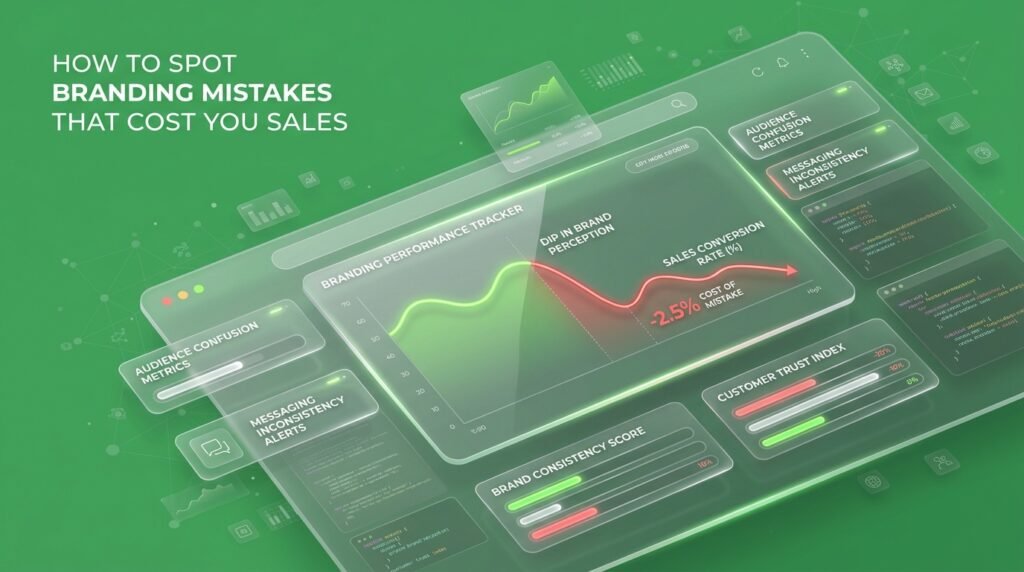
Eliminating silent branding mistakes isn’t just a design exercise it’s a critical strategy for revenue growth. By shifting your focus from aesthetic updates to fixing messaging gaps, inconsistent customer touchpoints, and weak positioning, you rebuild trust where buyers usually hesitate. Aligning your value proposition across all channels ensures prospects immediately recognize your worth, helping you stop losing qualified leads and consistently convert interest into measurable sales success.

Your Traffic Is Fine, Your Pipeline Isn’t, and the Logo Is Taking the Blame

Here’s the usual pattern. Sales slow down, so the business fixes whatever it can see: the logo, the color palette, the homepage banner. A few weeks and a few thousand dollars later, nothing has moved.

That’s because the visible stuff is rarely where the money leaks. Buyers don’t email you to say your messaging felt off. They close the tab.

The same five mistakes show up again and again:

  • A promise nobody can repeat. Ask three people on your team what you do and why you’re different. If you get three answers, your buyers are getting three answers too.
  • Two or three versions of your company. The Instagram feed feels like a boutique, the website reads like a catalog, and the proposal sounds like someone else entirely. We break that one down in our guide to fixing inconsistent branding across platforms.
  • A look that blends in. Cover the logos on your homepage and a competitor’s. If you can’t tell them apart, neither can a buyer, and price becomes the only difference left. We covered that in how to avoid generic branding that gets ignored.
  • Credibility leaks. Dated layouts, mismatched visuals, broken links, and product images that make a premium price look like a bluff.
  • An ad that says one thing and a page that says another. The click felt like a yes. The landing page feels like a different company.

And the cost isn’t only design. It’s trust. Edelman’s 2019 Trust Barometer special report, an eight-country study, found that 81% of consumers treat trusting a brand to do the right thing as a major factor when they buy. Only about one in three said they trust most of the brands they buy and use.

That figure is about values, not visuals. But the mechanism is the same: a brand that contradicts itself hands the buyer a reason to doubt.

Most buyers start from doubt. Your brand either answers it or feeds it.

You Won’t Spot Branding Mistakes by Staring at Your Own Brand

Here’s the part most people miss. Branding mistakes are sales mistakes wearing a design costume.

When you review your brand, you ask designer questions. Is it clean? Is it on-brand? Does it look good? Your buyer asks different questions, and asks them fast.

A Stanford study put numbers on how fast. Researchers had 2,684 people judge the credibility of live websites, and the site’s visual look was the single most-mentioned factor, showing up in 46.1% of comments. It’s old data from 2002, so treat the number as a signal, not a benchmark. But the instinct is hard to argue with: people judge a business by how it looks before they read a word.

Strangers run a gut check in seconds, and it comes down to three questions:

  • Is this a real, trustworthy business? Credibility leaks fail here.
  • Is this the same company that promised me something? Inconsistency and mismatched ads fail here.
  • Is this any different from the other tabs I have open? Blending in fails here.

Every mistake on the list above fails one of those three. So you don’t spot them by judging the design. You spot them by testing for the buyer’s doubt.

Consistency is the one with a price tag attached. Lucidpress’s State of Brand Consistency report, built on responses from more than 450 people, puts the estimated revenue lift from a consistent brand at 10 to 20%. Lucidpress, now Marq, sells brand-management software, and these are estimates rather than measured results. Read it as direction, not a promise.

Audit from the buyer’s chair, not the designer’s.

Stop Leaking Revenue to "Optimized" Mediocrity

Key Takeaway

Here’s How We’d Audit Your Brand for Revenue Leaks in Five Checks

Run these in order. Each one is cheap, and each one tells you whether the next is worth your time.

1. Read Your Homepage Like a Stranger With Ten Seconds to Spare

Open your homepage on your phone. Give it ten seconds, then answer three things: what do you sell, who is it for, and why you?

Now hand your phone to someone outside the business and ask them the same questions. If they stall, your promise is the problem, not your layout. Check your business and website analytics to see which pages get the most traffic, and start there. Pages that fail the test are where conversion rate optimization pays off first.

If a stranger can’t say what you sell in ten seconds, a buyer won’t wait to find out.

Ask three people on your team to describe what you do in one sentence. Then read your website, LinkedIn page, sales deck and marketplace listings. Highlight every place the wording changes.

Write one sentence everyone agrees on and use it everywhere. If you can’t get agreement, you’ve found a positioning gap, and our guide on fixing a weak brand identity covers what to settle first.

One offer, one sentence, the same everywhere.

Screenshot the ad, the page it lands on, the confirmation email and the first follow-up. Put them on one screen.

Ask whether the promise, the voice, the offer and the visuals match at every step. Any break is a leak. A sales funnel breakdown shows which stage loses the most people, and behavioral tracking shows where they hesitate. If the leak is leads rather than sales, how to stop losing leads from poor branding picks up from there.

To a buyer, an ad that doesn’t match its page looks like a bait-and-switch.

Screenshot your homepage and three competitors’ homepages. Cover every logo and show them to three people who don’t work for you. Ask them to pick yours.

If they can’t, you’re blending in. Pick one claim your competitors won’t make and build around it. And if you sell physical products and your visuals undersell the price, 3D product rendering is worth a look before you book another photoshoot.

When price is the only difference a buyer can see, price is what they’ll compare.

5. Match Every Mistake to a Number Before You Spend a Dollar Fixing It

For each red flag, name the metric it should move: landing page bounce rate, ad-to-lead rate, branded search, add-to-cart rate, lead-to-meeting rate. Put them in one dashboard so you see movement monthly instead of guessing quarterly.

Then fix in this order: the promise first, consistency second, differentiation third, polish last.

A branding fix with no number attached is just a redesign.

This Is the Audit We Run Before We Touch a Single Design File

Everything above is a compressed version of how we open an engagement at THEMAYK. Every project starts with a documented audit of your brand, funnel and tracking, because fixing one channel while the rest drift never lasts.

On one fragrance brand, a packaging and product visual refresh shipped alongside a full store migration and lifted add-to-cart rate by 34%. That result came from the refresh and the migration together, so we won’t claim design did it alone. Most clients see their first measurable lift within 60 to 90 days.

If you suspect your brand is costing you sales, let’s find out where. Book a free strategy call at www.themayk.com. In 30 minutes we review your brand, funnel and ad spend, then send you a written summary whether or not you hire us.

Stop guessing. Start growing.

Conclusion

Fixing subtle branding mistakes directly impacts your bottom line. By auditing your brand from the buyer’s perspective focusing on clarity, consistency, and distinctiveness you eliminate the friction quietly draining your sales. Stop relying on quick visual redesigns; align your promise, build trust across every touchpoint, and attach real metrics to your fixes to unlock measurable revenue growth.

See How Our Agency Grow Your Traffic Into Conversions

SEO – unlock sustainable growth with proven search strategies.
Content Strategy – magnetic content that earns links, shares, and brand authority.
Paid Media – precision campaigns built for measurable ROI.

Blogs

How to Fix a Bad Online Personal Brand

How to Fix a Bad Online Personal Brand A buyer you’ve never met just Googled your name before the call. They found a LinkedIn headline from 2019, a podcast clip you’d rather forget, and a personal Instagram that looks like it belongs to a different company. Your team says the pipeline needs more time. We’d […]

How to Spot Branding Mistakes That Cost You Sales

How to Spot Branding Mistakes That Cost You Sales Your traffic is steady, your ads are getting clicks, and sales have been soft for two quarters. Your agency says to give the funnel more time, and your team wants a new logo. We’ve seen enough of these accounts to say it plainly: the branding mistakes […]

How to make a website mobile friendly

How to make a website mobile friendly You’ve tried to make your website mobile friendly. The theme is responsive, the audit tool says you’re fine, and phone sales still trail desktop by a mile. Your developer says it’s handled. Technically, it is. But responsive only means the layout shrinks to fit. It doesn’t mean anyone […]

LET'S TALK GROWTH

Ready to scale your brand?

Tell us a bit about your goals, and we’ll show you how we can help.

How we use your info: Used strictly to review your project, prepare tailored insights, and reach out for a 1-on-1 strategy call. Zero spam, zero shared data.