
Blogs > Is Tesla Losing Its Tech Edge?

Is Tesla Losing Its Tech Edge?

One headline says Tesla delivered 486,532 vehicles in Q3. Another says its operating margin fell to 1.4% in Q2. Both are accurate. Neither tells you whether Tesla still has a tech edge.

That’s the trap with how most people judge a lead. They read the story and skip the receipts.

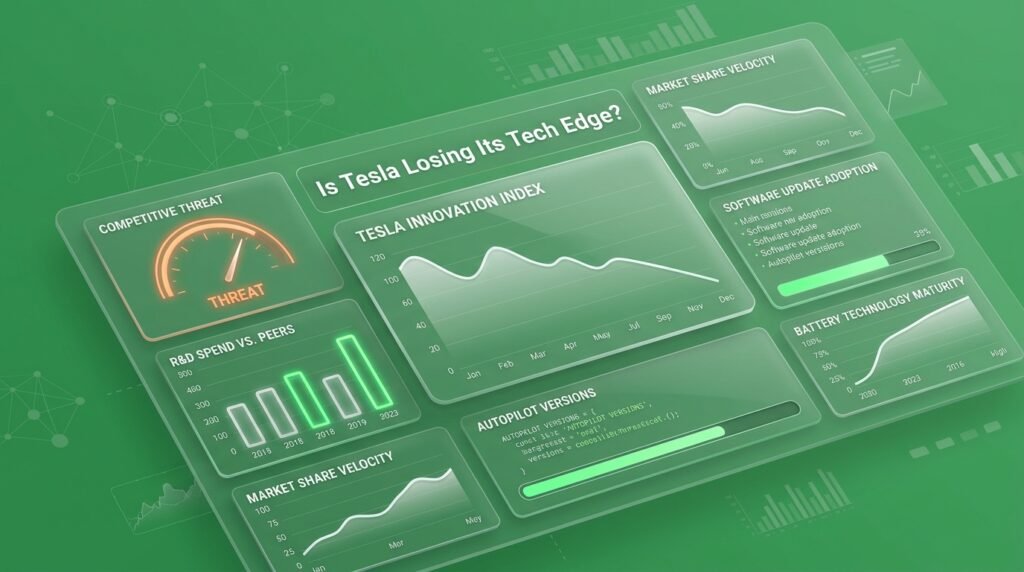
We read the receipts. The Tesla tech edge isn’t gone, but it costs more to hold every quarter, and the proof is thinner than the pitch.

The Reality Behind Tesla’s Competitive Edge

Tesla’s technological advantage remains intact through high Full Self-Driving adoption, but defending that lead requires aggressive capital spending and R&D that directly squeeze operating margins. Unproven bets like Cybercab and Optimus still lack market-wide verification. Ultimately, true innovation is not defined by bold promises, but by measurable profit performance.

Everyone Argues About Tesla. Almost Nobody Opens the Filing

Start with the number everyone quotes. Tesla’s Q3 report shows 486,532 deliveries. A year earlier, Tesla delivered 497,099, so volume slipped about 2%.

That’s not a collapse. Nearly half a million cars a quarter is still a serious machine.

But look one layer down:

  • The Model 3 and Model Y did almost all the work: 478,237 of the 486,532 deliveries.
  • Everything else (Cybertruck, Semi, Model S and X) fell to 8,295, down from 15,933 a year earlier.
  • Tesla has decommissioned the Model S and X lines at Fremont and is installing Optimus lines in their place.

That’s a company trading a flagship car for a robot that hasn’t gone into production yet. It might be a smart trade. It’s definitely a bet.

Selling half a million cars a quarter isn’t the same as widening a lead.

Tesla Is Spending Its Margin on a Future That Hasn't Shipped Yet

Here’s where it gets interesting. The Q2 numbers show where the money went.

  • Operating margin dropped to 1.4%, from 4.1% a year earlier.
  • Operating income fell 57% to $398 million.
  • Operating expenses rose 47% to $4.35 billion, and R&D alone climbed from $1.59 billion to $2.37 billion.
  • Capital spending hit $5.79 billion, against $2.39 billion in Q2 of last year, which pushed free cash flow to negative $1.1 billion.
  • Regulatory credit revenue shrank from $439 million to $146 million.

Every one of those figures comes straight from Tesla’s own Q2 update. Nobody had to dig it out of a rumor.

That last line matters more than it looks. Credits were a cushion. The cushion is getting thinner while the spending gets heavier.

This isn’t an accident. Tesla’s own letter describes its largest period of investment. The question is whether the spend turns into a lead customers can verify.

Tesla is paying for its next edge with the profit from its last one.

Where the Tesla Tech Edge Is Real and Where It's Still a Promise

Now here’s the part most hot takes miss. Tesla’s edge isn’t one thing. It’s three different things moving at three different speeds.

The real one: software people already pay for. Tesla reports 1.48 million active FSD subscriptions, up 56% in a year. Over 55% of new North American deliveries in Q2 included an FSD subscription.

Regulators in the Netherlands, Lithuania, Estonia, Denmark and Belgium have also approved it. All of that is in the same Q2 update.

One catch. Tesla’s own footnote says FSD in this form still needs an attentive driver and doesn’t make the car autonomous. It’s a paid product with real adoption. It’s not yet the driverless business the stock story leans on.

The unproven one: robotaxi. Tesla says Robotaxi is live in seven metros. One of them runs with a safety driver. Six are still ramping unsupervised service, and Phoenix and Las Vegas are listed as preparations underway.

Compare that with Waymo. In March, Waymo said it was giving 500,000 paid rides a week across 10 U.S. cities, up from 50,000 a week in May 2024.

Tesla reports cumulative paid miles rather than weekly rides, so a clean side-by-side isn’t possible yet. That gap in disclosure is itself a signal.

The not-yet-shipped one: Optimus and Cybercab. Cybercab production has started and employees are riding in it on the Giga Texas campus. Optimus lines are being installed. Neither is in customers’ hands.

An Edge Only Counts When Strangers Can Verify It

Here’s the idea we want you to take away, and it applies far beyond cars.

A tech edge isn’t what you build. It’s the gap a customer can verify, at scale, in your margin.

That gives you three tests. Is it shipped? Is it scaled? Does it show up in the profit line?

FSD passes the first two and is still working on the third. Robotaxi is partway through the first. Optimus hasn’t started.

So here’s our read. Tesla hasn’t lost its tech edge. It has a real software lead and a sprawling set of bets that haven’t been proven yet. The market is pricing the bets like they already shipped.

Tesla reports full Q3 financials on October 21. Watch margin and capex first. The delivery number won’t tell you much.

Promises are free. Proof shows up in the margin.

Stop Leaking Revenue to "Optimized" Mediocrity

Key Takeaway

Run This Five-Question Edge Test on Your Own Brand Next

This isn’t just a Tesla problem. Every business owner we talk to has a version of the same gap: a story that sounds ahead and numbers that say “maybe.”

Here’s the test we’d run on any brand. Five questions, in this order.

1. Sort Every Claim Into Shipped, Ramping, or Announced

Write down everything you tell customers you’re better at. Tag each claim as live, rolling out, or still on the roadmap.

Do this to see how much of your pitch is a product and how much is a plan. Most brands find the roadmap column is longer than they thought.

If it’s not live, it’s not an edge yet.

Pull contribution margin by channel and by product line, not just revenue. A real advantage shows up as better margin, or the same margin at higher volume.

A custom marketing dashboard puts spend, revenue and margin side by side in one view. That’s how you stop arguing about feelings.

Revenue is the story. Margin is the receipt.

Pick the one competitor your customers actually compare you to. Match volume, conversion rate and cost per new customer against theirs, using the same time window.

Tesla’s robotaxi miles look big until you set them next to Waymo’s rides. Your “fast growth” might look different next to a rival’s.

Pair it with proper business and website analytics so the comparison uses your real numbers, not platform estimates.

Growth without a benchmark is just a bigger number.

The strongest number in Tesla’s whole report isn’t deliveries. It’s that over half of new buyers in North America took the paid software.

Find your version. What share of customers buy the premium tier, the add-on, the upgrade? Behavioral tracking shows you who engages, who adds to cart and who pays.

Applause is cheap. Attach rate is expensive and honest.

5. Ask What a Skeptic Could Check in Ten Minutes

Imagine a smart, doubtful buyer with a browser and ten minutes. What can they confirm about your claims? Reviews, specs, side-by-side visuals, public numbers.

If the answer is “not much,” fix the proof before you spend more on reach. Clear 3D product visuals and a consistent story across channels are good places to start. Inconsistent branding makes every claim look weaker than it is.

If a skeptic can’t verify it, it doesn’t count.

Here's the Audit We'd Run Before Touching Your Ad Budget

This is the same thinking we apply before a single dollar goes into ads. We map what’s live against what’s promised, then trace where the margin leaks.

Usually that starts with a sales funnel breakdown, because the edge you think you have often disappears between the click and the checkout.

If your growth story is louder than your data, let’s fix that. Book a free strategy call at www.themayk.com. In 30 minutes we review your brand, funnel and ad spend, then send you a written summary whether or not you hire us.

Stop guessing. Start growing.

Conclusion

Tesla has not lost its technological edge, but maintaining it demands record-high capital spending and R&D that heavily squeeze short-term profit margins. While Full Self-Driving shows strong subscription momentum, unproven bets like Cybercab and Optimus remain unverified by the market. Ultimately, a true competitive advantage is defined not by ambitious promises, but by measurable impact on bottom-line margins.

See How Our Agency Grow Your Traffic Into Conversions

SEO – unlock sustainable growth with proven search strategies.
Content Strategy – magnetic content that earns links, shares, and brand authority.
Paid Media – precision campaigns built for measurable ROI.

Blogs

How to Avoid Common Digital Marketing Failures

How to Avoid Common Digital Marketing Failures You’re putting $5,000 a month into Google and Meta ads. Clicks are up and the report looks healthy, but revenue hasn’t moved. Your agency says give it another month. We’ve seen how this ends, and most digital marketing failures aren’t ad failures at all. Securing Your Marketing ROI […]

Is Tesla Losing Its Tech Edge?

Is Tesla Losing Its Tech Edge? One headline says Tesla delivered 486,532 vehicles in Q3. Another says its operating margin fell to 1.4% in Q2. Both are accurate. Neither tells you whether Tesla still has a tech edge. That’s the trap with how most people judge a lead. They read the story and skip the […]

How to Avoid Regret Buying the Xbox Nano Controller

How to Avoid Regret Buying the Xbox Nano Controller The Xbox Nano Controller is $49.99, pocket-sized, and open for pre-order. The headlines make it sound like an easy yes. Here’s what they skip: most people who regret buying the Xbox Nano Controller won’t hate the pad. They’ll hate what nobody told them before checkout. Six […]

LET'S TALK GROWTH

Ready to scale your brand?

Tell us a bit about your goals, and we’ll show you how we can help.

How we use your info: Used strictly to review your project, prepare tailored insights, and reach out for a 1-on-1 strategy call. Zero spam, zero shared data.