
Blogs > How to Fix Slow Website Speed Hurting SEO

How to Fix Slow Website Speed Hurting SEO

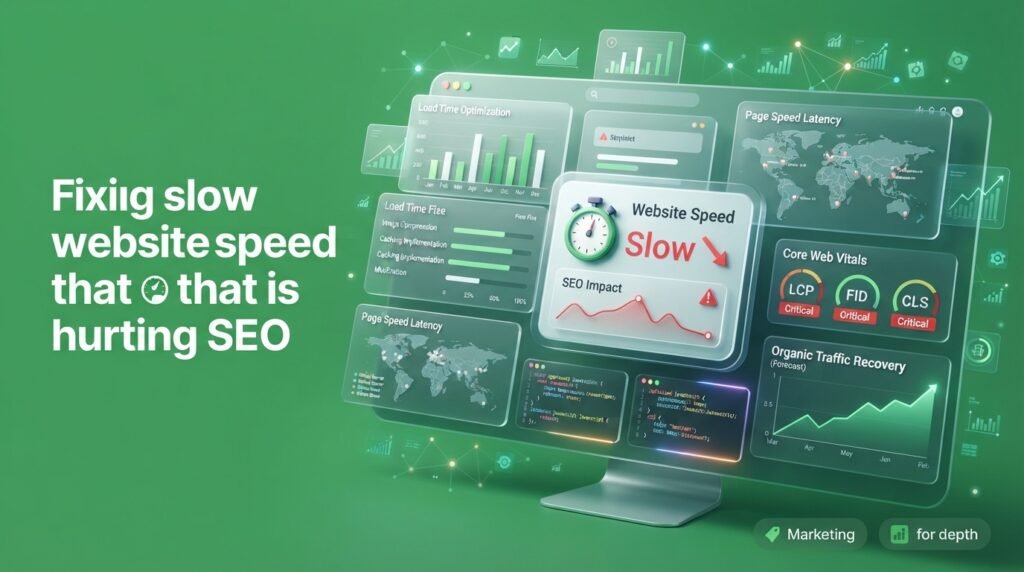
You’re paying for content, ads and an SEO retainer, and your pages still crawl on a phone. Your developer says the site tests fine and your agency says SEO takes time. Both are dodging it. Slow website speed hurting SEO is a visitor problem long before it’s a ranking problem.

Your Slowest Page Is Costing You More Than Your Weakest Keyword

Most brands are burning budgets on a version of the internet that no longer exists. They are optimizing for keywords, w

Open Search Console today and sort your failing pages by how much they earn you. Start with the one that hurts most. Compress its hero image, remove one script nobody can explain, and reserve space for every image. Then test again on a real phone. One fixed page quickly proves the method, and it gives you something concrete to repeat.

hile the world has moved on to Conviction.

Your Rankings Slipped and Your Developer Says the Site Is Fine

Here’s a conversation that goes nowhere. Traffic dips, you ask why, and someone runs a speed test on a fast office connection and says it looks fine.

Your customers aren’t on the office connection. They’re on a phone, on a patchy network, giving your page a few seconds before they decide.

Google’s own research found that the probability of a bounce increases 32% as page load time goes from one second to three seconds. Three seconds isn’t a disaster page. That’s a mildly slow one.

Every visitor who leaves early is a visit you already paid for, through SEO, ads or both. They’re gone before your headline loads.

You don’t have a traffic problem. You have a waiting-room problem.

Your Beautiful Homepage Is Making Visitors Wait for the Good Part

Slow sites rarely come from one big mistake. They come from a pile of reasonable decisions:

  • A hero video nobody compressed
  • Forty images uploaded at camera size
  • Six tracking pixels and two chat widgets, added by three different people
  • A theme full of plugins you installed once and forgot
  • Hosting picked because it was cheap

Each one felt small. Together they’re why your page sits on a blank screen.

We build brand visuals, 3D and motion for a living, so this one’s personal. Heavy visuals aren’t the villain. Uncontrolled visuals are. A stunning hero animation that takes six seconds to show up is a bad ad for a good brand.

Slow doesn’t happen. It accumulates.

Speed Won't Rescue Weak Content, but It Will Sink Strong Content

Here’s the part most SEO posts get wrong. Speed isn’t a magic ranking lever.

Google says its ranking systems use Core Web Vitals and recommends good scores for success in Search. In the same breath it warns that good scores don’t guarantee a top spot, because page experience is more than those numbers.

Read that twice. Speed is a tax, not a trophy. Paying it won’t win you rankings. Skipping it quietly pulls your best content out of the running.

These aren’t vanity numbers either. Google describes Core Web Vitals as metrics that measure real-world user experience across loading, interactivity and visual stability. A perfect score on your developer’s laptop proves nothing. What counts is what your actual visitors feel.

So the cost is double: a ranking system that factors speed in, and a visitor who already left. In our view, the second leak is usually the bigger one.

Speed won’t make you rank. Slowness will make you lose.

Stop Leaking Revenue to "Optimized" Mediocrity

Key Takeaway

Here's How to Fix Slow Website Speed Hurting SEO in Five Moves

Start with the finish line. Google’s targets for a good experience are an LCP within 2.5 seconds, an INP under 200 milliseconds and a CLS under 0.1:

  • LCP (Largest Contentful Paint): how fast the main content shows up
  • INP (Interaction to Next Paint): how fast the page responds to a tap or click
  • CLS (Cumulative Layout Shift): how much the page jumps around while loading

Now work through the list in order.

Measure real visitors, not your own laptop.

Open the Core Web Vitals report in Search Console, which Google points site owners to for seeing how their pages perform. List the pages that fail, and start with the ones that make you money: service pages, product pages and landing pages.

LCP is usually your hero image or video. Compress it, resize it to the size it’s actually shown, and use a modern format like WebP or AVIF. Never lazy-load anything above the fold. For video, show a light poster image first so the page stops waiting on one oversized file.

Old pixels, unused chat widgets, abandoned A/B tools. Delay the rest until after the page loads. Fewer scripts competing for the browser means taps respond faster.

Set width and height on images and embeds so the browser saves their space before they load. Your CLS drops, and visitors stop mis-clicking the button that moved.

Set a speed budget and recheck every month.

Agree on a maximum weight for hero media and a rule that every new script needs a reason. If everything above is clean and the server still responds slowly, look at your hosting and caching next.

Fix the hero, cut the scripts, hold the line.

Case Study

We'd Audit Speed Before You Pay for Another Month of SEO

This is the order we’d work in at “TheMayk”. We find the pages that earn money, find what’s slowing them, fix the heavy media and scripts first, then lock in a budget so it stays fixed. It’s where our web, SEO and 3D and motion work meet, which is exactly where most speed problems start.

Stop guessing. If your pages are slow and your rankings are stuck, let’s find out what’s really holding them back. Explore our services at www.themayk.com.

Conclusion

Slow pages cost you twice. Visitors leave before they see your offer, and Google’s ranking systems factor in the experience they had. Speed won’t win the top spot, but ignoring it will take you out of the race. Fix the hero, cut the scripts, and set a budget. Your best content deserves a page that loads before patience runs out.


See How Our Agency Grow Your Traffic Into Conversions

SEO – unlock sustainable growth with proven search strategies.
Content Strategy – magnetic content that earns links, shares, and brand authority.
Paid Media – precision campaigns built for measurable ROI.

Blogs

How to Fix Slow Website Speed Hurting SEO

How to Fix Slow Website Speed Hurting SEO You’re paying for content, ads and an SEO retainer, and your pages still crawl on a phone. Your developer says the site tests fine and your agency says SEO takes time. Both are dodging it. Slow website speed hurting SEO is a visitor problem long before it’s […]

How to Avoid Blending In With Competitors

How to Avoid Blending In With Competitors A prospect says they’re comparing three vendors and, honestly, you all sound the same. You’ve refreshed the logo and rewritten the homepage twice, and your agency says give it more time. It won’t help. To avoid blending in with competitors, stop treating them like a blueprint. Why Your […]

How to Avoid Common Mistakes in 3D Branding

How to Avoid Common Mistakes in 3D Branding You paid for 3D, the renders look sharp, and your brand still feels like a template. Your studio says the model is perfect, so you’re left guessing. We’d say the model was never the issue: 3D branding mistakes almost always start with a missing brand decision, not […]

LET'S TALK GROWTH

Ready to scale your brand?

Tell us a bit about your goals, and we’ll show you how we can help.

How we use your info: Used strictly to review your project, prepare tailored insights, and reach out for a 1-on-1 strategy call. Zero spam, zero shared data.