Blogs > How to Use 3D Design to Elevate Your Brand

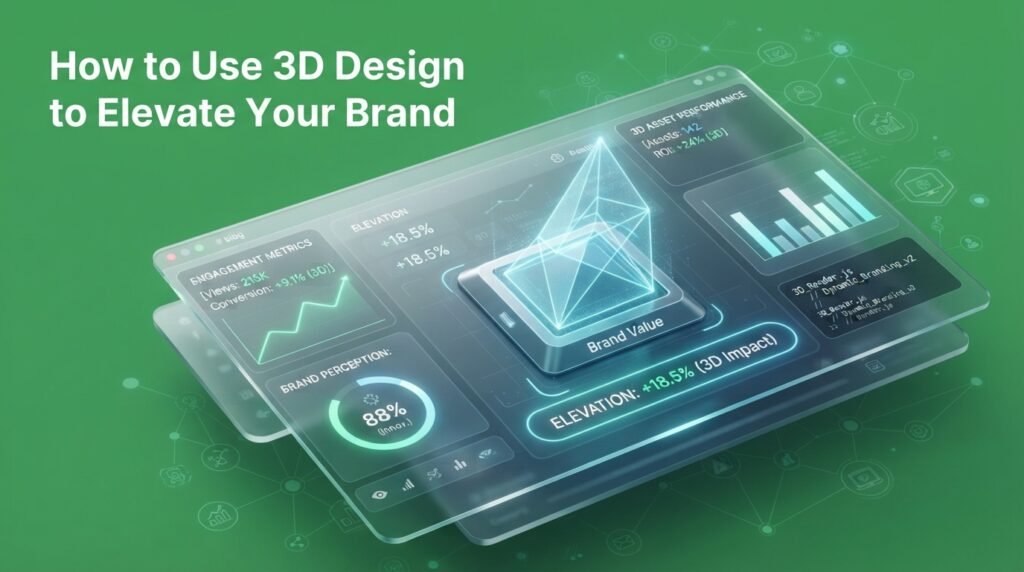
How to Use 3D Design to Elevate Your Brand

You paid for the 3D render. It looks incredible: glossy, cinematic, the kind of thing you’d screenshot for your portfolio. Your conversion rate didn’t move.

Your agency says the brand just needs time. We’d say something different. 3D design doesn’t elevate your brand by looking good. It elevates your brand by removing doubt.

Your Brand Guidelines Go Silent Right Where 3D Begins

Most brand guidelines cover logos, fonts, and colors, then go silent. Few teams document how products should be lit, how fast they should rotate, or what material finish feels like your brand. So every 3D project becomes a fresh interpretation. Add a 3D section to your guidelines and that problem shrinks. Designers, freelancers, and agencies work from the same rules, so your visuals look like they came from one company.

Your 3D Design Looks Great and Nobody Remembers It

Here’s the pattern we see over and over. A brand commissions one hero render, maybe a spinning product on a white background or a launch animation. It looks premium, so it goes on the homepage.

Then the packaging says one thing, the ads say another, and the website looks like a third company built it. The 3D asset sits in the middle like a beautiful stranger.

Sound familiar? Check for these:

  • The renders look great, but the lighting, colors, and camera angles change every time
  • The 3D lives on the homepage and nowhere your buyer actually decides
  • Nobody on your team can say what the 3D is for: sales, awareness, or just “looking premium”

It gets expensive fast. Every new render starts from zero. Every new freelancer reinterprets your brand. Six months in, you’ve spent real money and your look is less consistent than when you started.

A render is a file. A brand is a pattern people recognize.

You're Treating 3D Like Decoration When It Should Be Answering Questions

Think about what your buyer is doing on a product page. They can’t touch the product. They can’t turn it over. They’re guessing about size, finish, and whether it’ll look like the photo.

A photo gives them one angle under one lighting setup. 3D answers the question they showed up with.

In a survey The Harris Poll ran for 3D platform Threekit, 60% of 1,869 U.S. online shoppers said they’re more likely to buy a product shown in 3D or AR. That survey was commissioned by a 3D vendor and it’s a few years old. Read it as direction, not gospel. GlobeNewswire

The retail numbers point the same way. Shopify’s write-up on 3D ecommerce reports that Rebecca Minkoff shoppers who viewed a product as a 3D model were 44% more likely to add it to their cart, and shoppers who viewed it in AR were 65% more likely to buy. Shopify

Shopify has also said products with AR or 3D content have seen conversion rates up to 94% higher than comparable listings without them. Shopify

Notice the phrase “up to.” Numbers like these are ceilings, not promises. Products where size, material, or fit is the hesitation tend to benefit most. A basic tee with no fit anxiety won’t.

Now here’s the part most people miss.

3D is the one medium where every variable is a decision. Lighting, material, camera angle, motion speed: you choose all of it. Photography inherits the conditions of the shoot. 3D inherits the decisions of your brand.

That makes it the most ownable visual language you can build. Set those decisions once and every asset that follows looks like you. That repetition is what makes a brand stick, and we’ve broken down the psychology in our guide to brand recall and consumer psychology.

3D doesn’t make your brand look expensive. It makes your brand look certain.

The “On Paper” View: You can generate 100 landing pages in an afternoon. Your “cost per output” is at an all-time low. On paper, you are winning.

The “Insider Truth”: You are suffering from the Empathy Gap. Automation scales reach but dilutes conviction. When you optimize for bots, you shave off the “edges” of your brand voice to fit a template. You become a “grey-label” brand. Strategy > Tool because a tool can tell you how to say something, but only strategy tells you why it matters.
Some Brands Should Fix the Offer Before Buying a Single Render

We’ll say the quiet part out loud. 3D can’t rescue a brand that hasn’t decided what it stands for. It’ll just make the confusion look beautiful.

Hold off if any of these are true:

  • You can’t explain in one sentence who the product is for
  • Your returns come from quality, shipping, or pricing problems that a better image won’t fix
  • You don’t track conversion by product page, so you couldn’t tell whether 3D worked

Fix those first, then come back. 3D multiplies what’s already there, good or bad.

Stop Leaking Revenue to "Optimized" Mediocrity

Key Takeaway

Here's the Order We'd Put 3D Into Your Brand

Five steps. The sequence matters more than the software.

1. Find the Doubt That's Stopping the Sale

Pull 30 to 50 recent reviews, support tickets, and return reasons for your top three products. Highlight every question about size, color accuracy, material, or how the thing works.

Rank them by how often they show up. The top two become the brief for your 3D work. Typical doubts look like this:

  • Scale: “Is it as big as it looks?”
  • Finish: “Is that matte or glossy in real life?”
  • Function: “How does it actually fit together?”

You’re not commissioning a pretty render. You’re commissioning an answer.

Write a one-page 3D style sheet before a single model gets built. It should define:

  • Materials and finishes: how your surfaces are supposed to look
  • Lighting mood: soft studio, moody, natural daylight
  • Camera language: angles, distance, how close you get
  • Color and backgrounds: the exact palette, every time
  • Motion timing: slow reveals or fast cuts

That page is what stops the third freelancer from reinterpreting your brand.

If it isn’t written down, it isn’t a brand decision. It’s a mood.

Build the product model once, at high quality. Then reuse it instead of paying for new visuals every time you need them:

  • Product page viewer and hero images
  • Ad cutdowns for Meta, TikTok, and Google
  • Short social loops
  • Email headers and marketplace listings
  • Packaging and launch previews before production

Every reuse lowers your cost per asset. Every reuse also repeats your look, which is the whole point.

One model, ten placements, one recognizable brand.

Don’t park your 3D on the homepage and call it done. Put it on the product pages, where the doubt lives.

Start with your best sellers and the products with the most returns or pre-sale questions. Add an AR view on mobile wherever scale is the objection. If you’re on Shopify, Shopify’s guide covers how to add 3D models and AR to your store. Shopify

Then use short branded 3D animation in your ads to pull people toward those pages.

Build the 3D where the buyer hesitates, not where the brand gets admired.

5. Judge It by Sales, Not by How It Looks in Your Portfolio

Pick your metrics before launch: add-to-cart rate, conversion rate, return rate, and time on the product page.

Compare products with 3D against similar products without it, over the same period. Kill what doesn’t move a number. Put more into what does.

If a render can’t defend itself in a dashboard, it’s decoration.

Your Next Render Should Earn Its Keep

This is the order we work in at “TheMayk”: buyer doubt first, brand system second, renders third. Our 3D and motion team builds the visuals. The rest of the team makes sure they’re wired into your site, your ads, and your analytics. A render that’s disconnected from your funnel is just an expensive screensaver.

If your 3D work looks incredible and sells nothing, let’s find out why. Stop guessing. Book a strategy call at www.themayk.com.

Conclusion

3D design isn’t a visual upgrade. It’s a decision system. Find the doubt, lock the look, build one model, place it where buyers hesitate, and measure the result. Do that and every render you commission adds to the same recognizable brand instead of starting over. If your 3D work can’t defend itself in a dashboard, rebuild it before spending more.

See How Our Agency Grow Your Traffic Into Conversions

SEO – unlock sustainable growth with proven search strategies.
Content Strategy – magnetic content that earns links, shares, and brand authority.
Paid Media – precision campaigns built for measurable ROI.

Blogs

How to Use 3D Design to Elevate Your Brand

How to Use 3D Design to Elevate Your Brand You paid for the 3D render. It looks incredible: glossy, cinematic, the kind of thing you’d screenshot for your portfolio. Your conversion rate didn’t move. Your agency says the brand just needs time. We’d say something different. 3D design doesn’t elevate your brand by looking good. […]

How to Create a Strong Brand Identity

How to Create a Strong Brand Identity You paid a designer $3,000 for a new logo, a color palette, and a forty-page brand guideline PDF. Nothing changed. Customers still can’t tell you apart from the business down the street, and your own team still argues about what the brand is supposed to stand for. Here’s […]

How to Stand Out in a Crowded Market

How to Stand Out in a Crowded Market You’ve spent real money this year. A rebrand, maybe. New ads. A website refresh. And somehow, your business still reads like a copy of the company down the street. Most agencies will tell you to post more, try a new platform, or “refresh the branding” again. None […]

LET'S TALK GROWTH

Ready to scale your brand?

Tell us a bit about your goals, and we’ll show you how we can help.

How we use your info: Used strictly to review your project, prepare tailored insights, and reach out for a 1-on-1 strategy call. Zero spam, zero shared data.