How to Use 3D Visuals to Boost Brand Identity
how to Use 3D Visuals to Boost Brand Identity You paid for a set of 3D renders, and they’re gorgeous, but your brand still looks like…
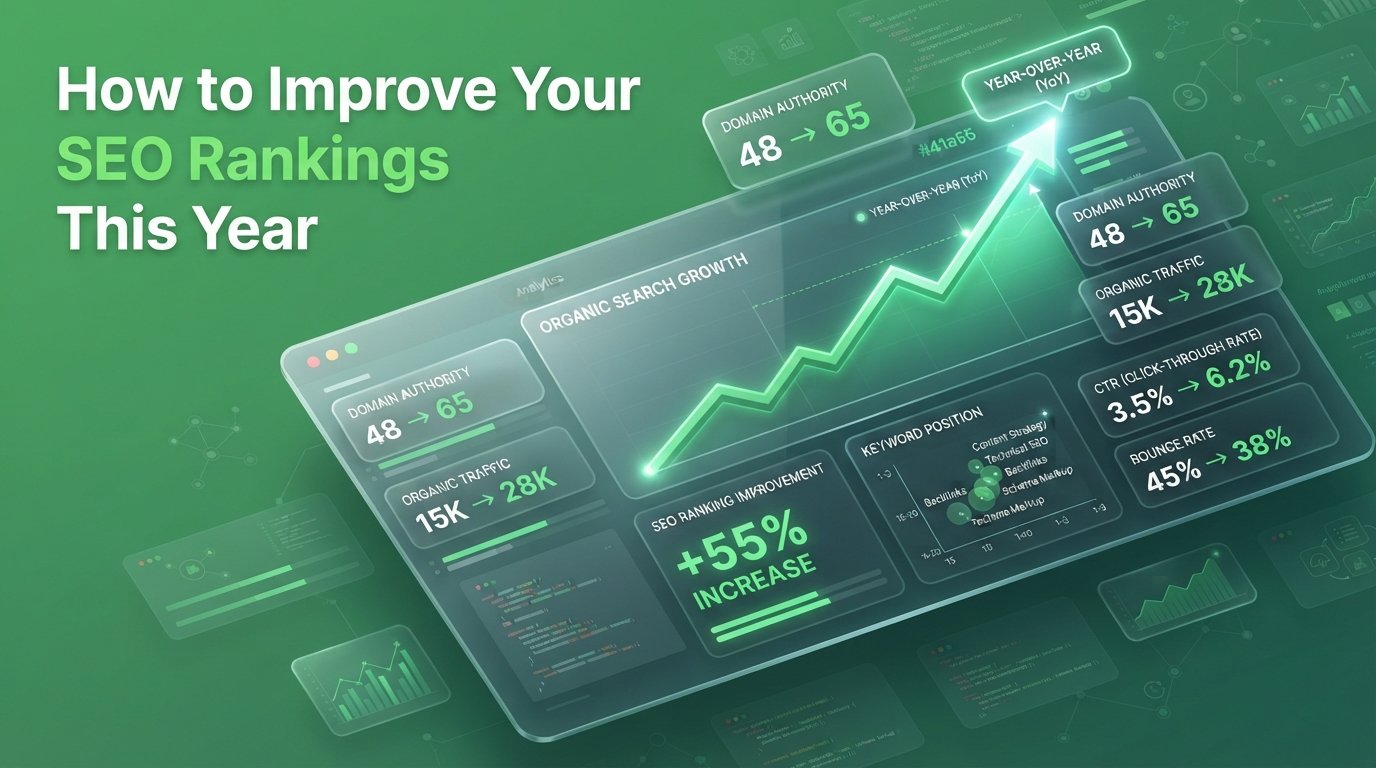
You’re publishing every week, paying for SEO every month, and your rankings haven’t moved. Your agency says give it time, your freelancer says publish more, and neither will tell you what’s actually broken.
If you want to improve your SEO rankings in 2026, the problem is almost never volume. It’s whether Google, and now an AI answer engine, has any reason to pick you over the next result.
Stop burying a broken foundation under an endless stream of low-impact content. True growth in 2026 demands strategic precision, not endless volume. By auditing technical indexes, cutting dead weight, refining unique insights, and building authentic trust, you transform stagnant traffic into predictable revenue. Fix your core pages first, prove your genuine expertise, and watch your rankings finally move forward.
Some SEO really does take time. But there’s a difference between slow and stuck, and most business owners can’t tell which one they’re paying for.
Here’s how it usually plays out from the inside. A blog launches with energy. Ten posts become fifty. Someone buys a keyword tool, someone else writes briefs, and every month a report arrives with a green arrow next to “content published.”
Slow shows movement:
Stuck shows a flat line:
If that second list sounds like your dashboard, waiting isn’t a strategy. You’re covering a foundation problem with content budget, and that bill only grows.
Slow is a timeline. Stuck is a diagnosis.
The instinct makes sense. Rankings stall, so you add more pages. More posts, more keywords, more of everything.
Google has a name for the extreme version. Its spam policies define scaled content abuse as many pages generated mainly to manipulate rankings instead of helping people, and it doesn’t matter whether humans, automation or both produced them. google
You’re probably nowhere near that line. But the logic underneath it should still worry you. Pages built to hit a publishing calendar, not to answer a real question, are dead weight. We treat every page as a liability until it proves otherwise.
Meanwhile the usual fixes pile on: another tool, another plugin, another round of keyword research. None of them ask whether the page deserves to rank.
And the results page has changed under your feet. Pew Research Center tracked the browsing of 900 U.S. adults in March 2025 and found people clicked a traditional result in 8% of visits when an AI summary appeared, versus 15% when one didn’t. pewresearch
So even when you rank, you’re splitting a smaller pie.
More pages, fewer clicks. That’s not a growth plan.
None of this is an argument to stop publishing. It’s an argument to stop publishing into a broken foundation. Good content on a broken foundation is a letter with no address.

Here’s the part most SEO advice skips. Google’s own guidance says there are no extra requirements or special optimizations for showing up in AI Overviews or AI Mode. The foundations stay the same: technical requirements, spam policies, and helpful, reliable, people-first content. google
Read that twice. There’s no secret 2026 tactic. The fundamentals just stopped being forgiving.
So we stop thinking in posts and start thinking in gates. Every page you own has to clear three, in this order:
Each gate fails differently.
Gate one fails quietly. A noindex tag, a blocked folder, a redirect chain. No error, no alert, just a page that never shows up.
Gate two fails politely. The post is fine. Well-written, on-topic, forgettable. It repeats what the top ten results already say, so Google has no reason to choose it.
Gate three fails expensively. The page ranks, the visitor lands, and nothing on it earns the scroll, the click or the form fill.
In our audits, the money almost always gets spent on gate three while the leak sits at gate one or two. Buying more content only touches one gate, and it’s usually the wrong one.
Fix the gates in order and the content finally gets a fair shot.
Five moves. Start at the top. Skipping ahead is how budgets disappear.
Open the page indexing report in Google Search Console. Pull up the ten pages that should be making you money: service pages, product pages, your strongest guides. Run each through the URL Inspection tool, which shows what Google actually sees, not what you see in your browser.
Then hunt for the usual suspects:
Do this and you’ll win back pages you’ve already paid for, without writing a single new word.
Check the gate before you decorate the room.
Export a year of clicks and impressions by URL from Search Console. Sort by clicks. Every post that earns nothing goes into one of three buckets:
Before you delete anything, check it for backlinks and conversions. A post with no traffic can still be the one your best partner links to.
The result is fewer, stronger pages for Google to judge, and a site that reads like you meant it.
A smaller site that’s all signal beats a bigger one that’s mostly noise.
Look at what triggers those summaries. In Pew’s data, six in ten searches beginning with who, what, when or why produced one, and so did more than half of searches ten words or longer. That’s a snapshot of U.S. searches from March 2025, but the direction is hard to miss. pewresearch
“What is X” and “how to do Y” posts are the first thing a summary swallows. Judgment is the last.
So build pages around decisions:
Take “What is a Shopify migration?” That’s a summary magnet. Now take “Shopify migration: what breaks, what it costs, and when it isn’t worth it.” The second one needs someone who’s actually done it.
Before you rewrite anything, search your ten most valuable queries yourself. Note which ones show an AI summary above your listing. Those pages go first.
Then add what a summary can’t invent: your data, your process, your screenshots, your mistakes. Rewrite your top pages so they lead with the answer only you can give.
If a summary can finish your post, your post was never the point.
A ranking only counts if the page holds up once someone lands. Google recommends good Core Web Vitals: main content loading within 2.5 seconds, an interaction delay under 200 milliseconds, and a layout-shift score under 0.1. google
Start with the Core Web Vitals report in Search Console, which shows which URLs are failing and on which metric. Then test the same ten pages from step one and fix in this order:
Speed only gets the visitor through the door. What happens next is conversion, which is why we run SEO and conversion rate optimization as one job. Better UX, stronger engagement and faster load times can lift both organic rankings and paid ad efficiency. THEMAYK
Track scroll depth, button clicks and form starts alongside sessions. If people arrive and don’t act, ranking higher just sends more of them to the same dead end.
Traffic you can’t convert is just a more expensive way to be ignored.
Google’s guidance keeps circling back to helpful, reliable, people-first content. Reliable means provable. Your About page saying you’re great is a claim. A named strategist with a track record is evidence.
So prove it on the page:
One more clue. Pew found that Wikipedia, YouTube and Reddit were the most commonly cited sources in both AI summaries and standard results. Our read: Google leans on places where real people talk, not only on brand blogs. pewresearch
We’ve written before about trust as a ranking lever, and 2026 only made the case stronger.
Your blog can say you’re an authority. Only other people can prove it.
Here’s how you’ll know it’s working. Judge each fix on the pages you touched, using clicks, impressions and conversions, not your sitewide average position. An average hides everything you need to see.
We’d run the five checks above against your ten most valuable pages, then rank the fixes by how fast they pay back. Technical audit first, then entity mapping and behavioral data, then content. Never the reverse.
That order is the backbone of our SEO frameworks, and it’s why the strategists on our team read your data before they touch a keyword.
Google rewards systems, not guesswork. Ask your current team what their system is.
If your SEO rankings are stuck, let’s find out why. Book a free audit call at www.themayk.com. Stop guessing. Start growing.
Stop chasing content volume and fix your foundation instead. Prioritize technical health, prune dead weight, and focus on unique expertise that AI summaries can’t replicate. Audit your core pages today, ensure you earn real trust, and turn your traffic into actual business growth.
Stop letting high-intent traffic slip away. In 2026, real growth doesn’t come from endless content it takes a human strategy that turns your digital ghost town into a conversion machine. Let us fix your foundation and align your traffic with actual revenue. Book your free audit call today and start winning.
how to Use 3D Visuals to Boost Brand Identity You paid for a set of 3D renders, and they’re gorgeous, but your brand still looks like…
How to Improve Your SEO Rankings This Year You’re publishing every week, paying for SEO every month, and your rankings haven’t moved. Your agency says give…
How to subscribe to a service for building an online store? You found the platform. You’re about to hand over your card details and hit subscribe.…
How we use your info: Used strictly to review your project, prepare tailored insights, and reach out for a 1-on-1 strategy call. Zero spam, zero shared data.