How to Build a Strong Brand Identity From Scratch
How to Build a Strong Brand Identity From Scratch You’ve got a name, a rough sense of what you sell, and a designer quoting you $4,000…
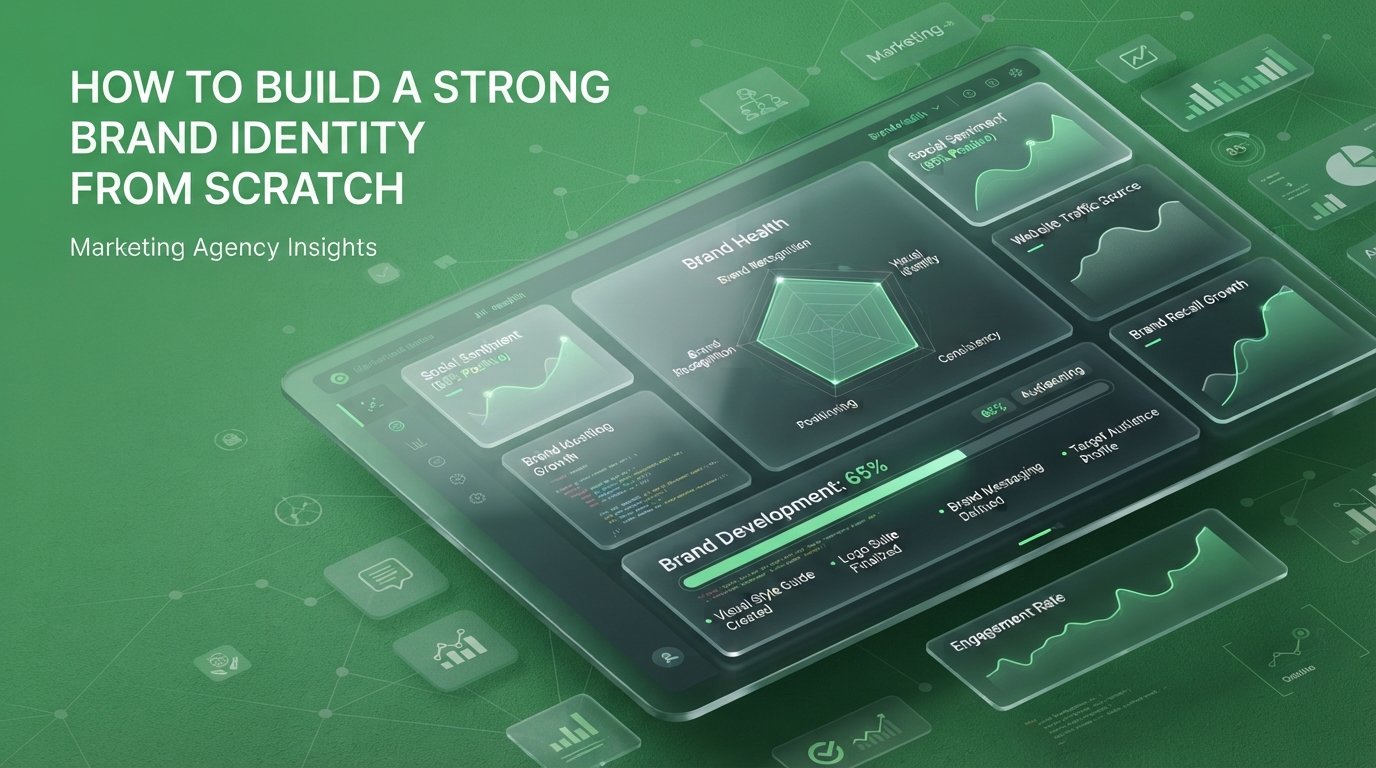
You’ve got a name, a rough sense of what you sell, and a designer quoting you $4,000 for a logo package. Everyone tells you that’s step one.
We’ve built brand identities for fragrance brands, apparel manufacturers, and DTC founders on their second attempt. The logo has never once been the thing that made the brand work.
What makes it work is a decision you make before anyone opens Illustrator. Most founders skip it, pay for the logo, and wonder six months later why nothing changed.
A successful brand identity should work beyond a presentation or mood board. It needs to remain recognizable across websites, social media, ads, packaging, and every other customer touchpoint. The strongest brands create distinctive cues that people can remember even without seeing the name. When your identity is built around clear positioning and consistently enforced, it becomes easier to recognize, trust, and recall when customers are finally ready to buy.
Open a new tab. Pull up your five closest competitors and read their homepage headlines back to back.
You’ll find some version of the same three claims every time: premium quality, customer-first service, and innovation. Different fonts, same sentence.
Now look at your own site. Be honest about whether a stranger could tell the difference with the logos removed.
This is the actual problem, and it isn’t aesthetic. When five companies make identical claims, the buyer has exactly one variable left to compare: price. You’ve just been entered into a race you didn’t sign up for.
The cost shows up everywhere downstream. Your ads need higher spend to hit the same ROAS because nothing in the creative is memorable. Your sales calls open with education instead of preference. Your best customers can’t explain to a friend why they chose you.
And the judgment happens faster than most founders want to believe. In a study published in Behaviour & Information Technology, researchers found that people form a reliable opinion of a web page’s visual appeal in roughly 50 milliseconds and that snap rating stays consistent when they’re given more time to look.
Fifty milliseconds is faster than reading your headline. Your positioning never gets a turn.
We’ve written before about the specific branding mistakes that make a business look cheap, and almost all of them trace back to this same root: the business skipped the thinking and bought the artwork.
Sameness doesn’t just look bad. It quietly sets your ceiling on margin.
Here’s the part most branding advice gets wrong, and it changes everything about how you should build.
Research from Professor John Dawes at the Ehrenberg-Bass Institute, produced with the LinkedIn B2B Institute, found that only about 5% of buyers in a category are in the market at any given moment. The other 95% aren’t shopping. They’ll buy in nine months, or two years, or never.
So when someone encounters your brand today, a purchase almost certainly isn’t on the table. Something else is happening instead.
They’re deciding whether you’re worth remembering.
That reframes the entire job. A brand identity isn’t decoration for the 5% who are ready to buy. It’s a retrieval system for the 95% who aren’t a set of cues designed to survive months of silence and fire back into memory at the exact moment the need appears.
Which means the question you ask about every design decision changes. Not “is this beautiful?” The real question is: will someone recognize this at thumbnail size, in a crowded feed, eight months from now, with the name cropped off?
Most identities fail that test badly. They’re built to look good in a presentation deck, viewed at full size, with the founder explaining the rationale out loud. That environment does not exist in the wild.
The 2026 Edelman Trust Barometer Special Report on brand growth points the same direction consumers are fragmenting into narrower circles of identity and belonging, and brands are falling short on relevance across every dimension that matters. Being pleasant to look at isn’t a strategy for that. Being unmistakable is.
Your identity’s job is not to impress people. It’s to be retrievable by them.
This is the sequence we run on new brand work. It’s deliberately backwards from how most agencies scope a project, because most agencies scope the deliverable they know how to sell.
Before you define your audience, define your exclusions. List three types of customer you’d turn down, and write the reason next to each.
This is faster than positioning and it does more work. A brand that serves everyone is legible to no one, and exclusions force the trade-offs that every later decision depends on.
Take the competitor headlines you pulled earlier. Cross out every claim that two or more of them could copy-paste onto their site without lying.
Whatever survives is the beginning of real brand positioning. If nothing survives, you don’t have a design problem you have a product or an operations problem, and no identity system will paper over it.
Pick the three specific moments when a buyer should think of you first. Not demographics. Situations.
“When a shipment gets rejected at customs.” “When the expo booth needs to pull a crowd.” “When the rebrand can’t cost us our rankings.” Write them as sentences a real person would say, then build every message to attach to one of them.
Distinctive assets are the cues that identify you without your name attached: a colour, a shape, a layout rule, a recurring character, a sound, a photographic treatment.
Pick two or three and commit hard. Then run them through the only test that counts print them at thumbnail size, convert to greyscale, and show them to someone outside your company. If they can’t tell it’s you, it’s decoration, not an asset.
Skip the adjective soup. “Confident, friendly, approachable” has never helped a single person write a single sentence.
Build a table instead: “We say” on the left, “We don’t say” on the right, with real examples from your own site in both columns. Ten rows is enough to make a freelancer sound like you on their first draft.
At this point the logo is the easy part, because every constraint has already been decided. It’s also just one asset among many arguably not even the most important one.
Build the full kit in one pass: logo lockups, colour with exact hex values, type hierarchy, photography or 3D product rendering direction, motion rules, and the templates your team will actually reach for on a Tuesday afternoon.
Don’t roll out across eight channels at once. Put the identity live on your highest-traffic page and watch real behaviour against it.
Set up behavioural tracking before launch, not after, so you have a clean before-and-after on scroll depth, time to first action, and add-to-cart or inquiry rate. This is the same instrumentation we run for conversion rate optimization work, and it turns a subjective debate about taste into a number you can argue with.
While you’re there, check whether the new identity passes the 5-second trust test. Plenty of beautiful rebrands quietly fail it.
Seven steps. The logo is step six. That ordering is the whole point.
You’ll build the system. You’ll be proud of it. Then, about eleven weeks later, a rush campaign goes out with the wrong blue and a headline nobody approved.
That’s how identities die. Not in one bad decision in forty small ones nobody thought were worth escalating.
You’ve probably seen the statistic that consistent branding lifts revenue by 33%. It’s worth reading the source before you quote it in a board deck. Marq’s own write-up of its brand consistency research frames the figure as what surveyed brand managers expected consistency would deliver around 10 to 20% and the company explicitly notes the work is directional rather than hard fact.
We’d rather give you the honest version: consistency is almost certainly worth real money, and nobody has cleanly measured how much. That’s still a better bet than the alternative, because inconsistency has an obvious mechanism. Every off-brand asset resets the recognition you paid to build.
So enforce it structurally, not culturally. Templates people can’t easily break. One named owner with veto power. A five-item pre-publish check. Guidelines that live in the tool, not in a PDF nobody has opened since onboarding.
And if you’re doing this to an identity that already has customers attached to it, the sequencing matters even more we’ve broken down how to rebrand without losing the customers you have separately, because that’s a different job with different risks.
A brand system you don’t enforce is just an expensive opinion.
Every brand project we take on opens with a documented audit, not a mood board. We map the competitor claim set, pull the exclusions, test distinctive assets at thumbnail size, and only then put a designer on the logo. Most of that first phase ships in two to four weeks.
We also wire the tracking before anything goes live, because a brand refresh you can’t measure is a brand refresh you’ll be defending on vibes in six months. That’s the difference between looking more professional and actually converting better.
If you’re building an identity from scratch, or rebuilding one that never earned its keep, let’s map it properly. Stop guessing. Book a free strategy call at themayk.com and we’ll tell you what we’d fix first whether or not you hire us.
Building a strong brand identity starts long before the logo. The real work is defining who you serve, what makes you different, what you want people to remember, and how your brand should sound and look consistently. When those decisions come first, the logo becomes one piece of a larger system rather than the entire strategy. Build the thinking first, then design the identity around it.
Because in 2026, the difference between a “No” and a “Yes” isn’t your tech stack—it’s the human strategy behind it. Let’s turn your digital ghost town into a conversion machine.
How to Build a Strong Brand Identity From Scratch You’ve got a name, a rough sense of what you sell, and a designer quoting you $4,000…
How to Make Your Brand Look More Professional You’ve paid for a logo. Maybe a color palette, a font pairing, a “brand board” a designer sent…
How Do You Improve SaaS Conversion Rates? You’re running a healthy trial signup number. Your ad spend is working. Your landing page looks clean. And your…
How we use your info: Used strictly to review your project, prepare tailored insights, and reach out for a 1-on-1 strategy call. Zero spam, zero shared data.