Landing Page or Product Page: Where Should You Send Meta Ads Traffic?
Landing Page or Product Page: Where Should You Send Meta Ads Traffic? You’re spending $4,000 a month on Meta ads and every single click lands on…
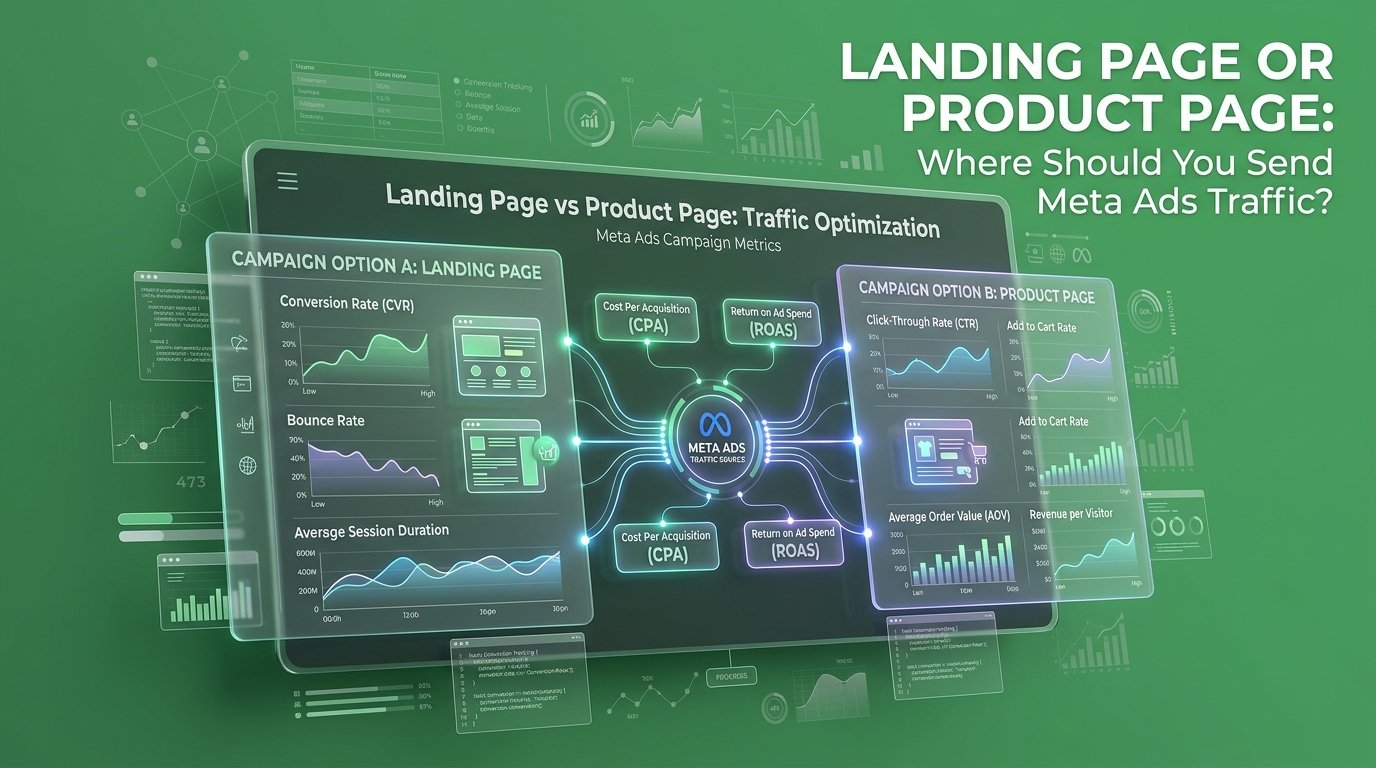
You’re spending $4,000 a month on Meta ads and every single click lands on the same product page your organic customers browse. Your agency says the creative needs work. It doesn’t.
We’ve audited hundreds of ad accounts, and the leak is almost never the ad. It’s the page absorbing the click without ever being built for it.
Where you send Meta ads traffic matters more than what the ad says to get them there. Get that wrong, and you’re paying full price for clicks that were never going to convert.
Fixing your ad-to-page mismatch is the fastest way to squeeze more profit out of your existing advertising budget without spending a single extra dollar. When you give cold traffic a clear, frictionless path to purchase, your return on ad spend naturally improves. Take a close look at your top-performing campaigns today, fix the destination gap, and turn those expensive clicks into consistent, scalable revenue.
A product page has a job, and it’s not the job you’re asking it to do.
It exists to answer every possible question a shopper might have: sizing, materials, shipping, reviews, related items, the six other colors it comes in. That’s the right job for someone who already knows your brand and is close to buying.
The problem is that most Meta traffic isn’t that person. A cold visitor who just scroll-stopped on your ad isn’t ready for a wall of options. They’re ready for one message, the one your ad promised them.
Send them to a page built for browsing, and you’re asking someone mid-scroll to do the work of a returning customer. Most won’t. They’ll bounce, and your ad account will quietly absorb the cost.
This is not a creative problem. It’s a mismatch between the promise and the page.
Here’s what most people get wrong about this decision: they treat it as a design question. Cleaner page, better photos, punchier headline. None of that fixes the actual issue.
A conversion rate optimization problem like this isn’t about polish. It’s about whether the page matches the mental state of the person who just clicked.
Cold Meta traffic is mid-scroll, low-commitment, and one distraction away from leaving. A product page, by design, is full of distractions: navigation, related products, a dozen tabs to explore. A landing page strips all of that out and leaves exactly one path forward.
That’s why the data backs this up so consistently. Across all industries, Unbounce’s 2024 Conversion Benchmark Report found Instagram and Facebook are the two highest-converting paid social channels, averaging 17.9% and 13% respectively but that’s on landing pages built for the click, not general-purpose product pages.
Zoom into ecommerce specifically and the gap tightens, which tells its own story. Unbounce’s ecommerce breakdown puts the median paid social conversion rate at 4.8%, while top-performing Facebook landing pages climb as high as 15.3%. That spread between median and top performer is the page, not the platform.
Here’s where it gets interesting: this isn’t just a Meta quirk. Google runs the same logic into its own ad system. Their Ads Help Center is explicit that landing page relevance how well the page matches what the ad promised directly shapes ad ranking and cost. Platforms reward the match. Visitors reward it more.
The ad gets the click. The page decides if the click was worth anything.
This isn’t a “landing pages always win” argument. Product pages have a place. You just need to know which traffic belongs where.
Send traffic to a product page when:
Send traffic to a dedicated landing page when:
Match the page to the promise, and the traffic does the rest.

This is the exact check we run on every new Meta account before we adjust a single campaign. We pull the top five spending ad sets, look at where each one is sending traffic, and ask one question: does this page make the same promise the ad just made?
More often than not, the answer is no. The ad says “40% off your first order.” The page says nothing about the offer until the third scroll. That gap is where the budget goes to die.
It takes us about a week to run this audit properly, cross-referenced against funnel and drop-off data and behavioral tracking on the page itself, so we’re not guessing where the mismatch is happening we’re watching it happen.
If your product page is also carrying your website’s trust signals, that’s worth checking too. A landing page can convert brilliantly and still lose the sale if the visitor doesn’t trust what they’re looking at.
Stop guessing where your ad spend is leaking. Book a free strategy call and we’ll show you exactly which of your campaigns are sending traffic to the wrong page.
Your Meta ads are doing their job by driving clicks, but sending cold traffic straight to a standard product page is quietly killing your conversion rate. By matching the landing page directly to your ad’s unique promise, you eliminate unnecessary distractions and guide visitors toward a single action. Re-evaluate your traffic destinations today, align your messaging, and stop letting your valuable, high-intent clicks go to waste.
Because in 2026, the difference between a “No” and a “Yes” isn’t your tech stack—it’s the human strategy behind it. Let’s turn your digital ghost town into a conversion machine.
Landing Page or Product Page: Where Should You Send Meta Ads Traffic? You’re spending $4,000 a month on Meta ads and every single click lands on…
Should You Include Duties in Your Prices or Charge Them at Checkout? You price the product at $60, add shipping, and your checkout shows $71 flat.…
Why Can’t I Exclude Placements in Meta Ads Anymore? You go to uncheck Audience Network like you’ve done for three years. The checkbox isn’t there. In…
How we use your info: Used strictly to review your project, prepare tailored insights, and reach out for a 1-on-1 strategy call. Zero spam, zero shared data.