How to Check If Your Website Is Blocking AI Crawlers
How to Check If Your Website Is Blocking AI Crawlers You wrote a genuinely useful answer to a question your buyers actually ask. Somewhere in an…
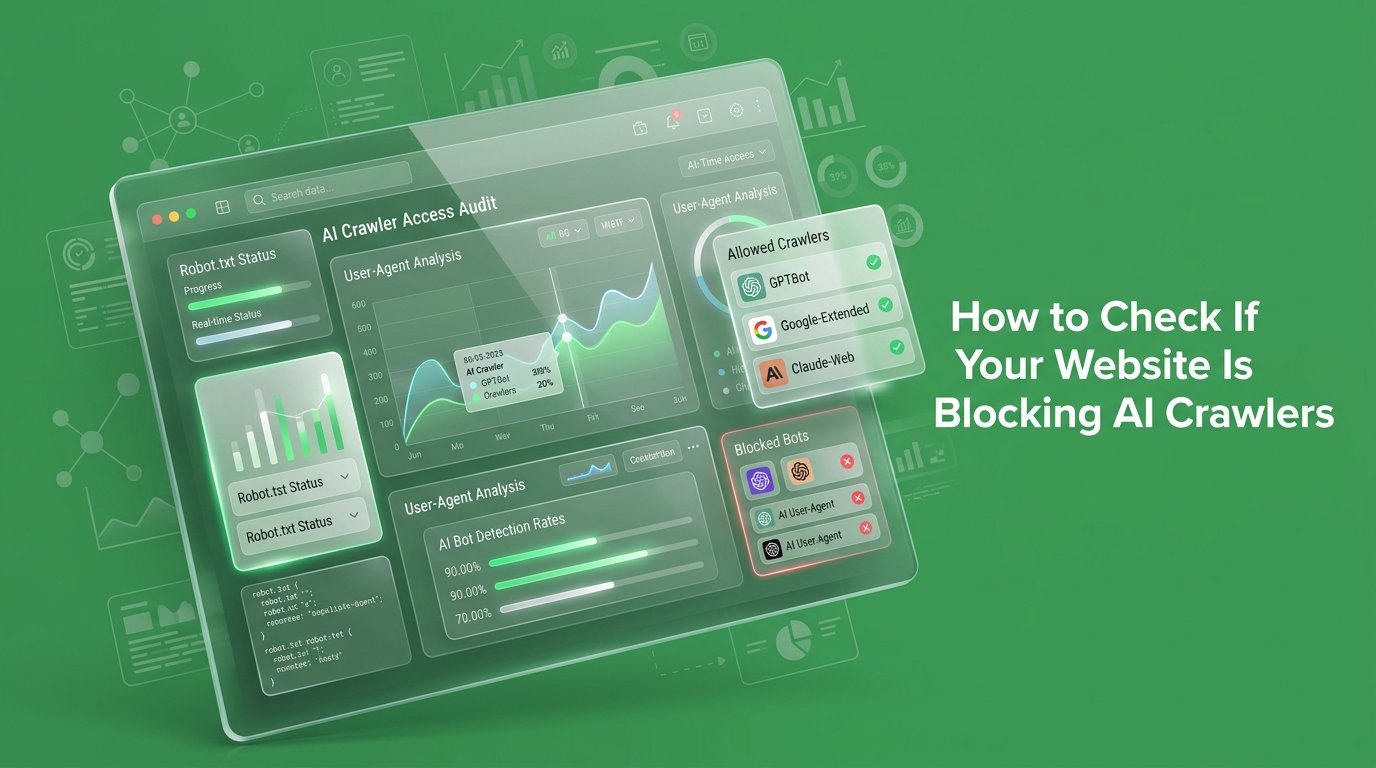
You wrote a genuinely useful answer to a question your buyers actually ask. Somewhere in an SEO checklist, someone told you AI visibility just means publishing more content. But if your server is quietly telling GPTBot and ClaudeBot to turn around at the door, none of that content ever gets read.
Here’s the real insight: the problem usually isn’t your content. It’s one line in a file you’ve probably never opened.
Most site owners spend thousands optimizing content while ignoring the invisible technical barriers blocking AI crawlers. By explicitly updating your server permissions to welcome bots like GPTBot and ClaudeBot, you instantly put your brand back in the running for AI-driven search results. Fix the friction at the door, and let your existing content finally do the heavy lifting.
Robots.txt is the file that tells crawlers what they’re allowed to touch. It sits at yoursite.com/robots.txt, and almost nobody checks it after launch. That’s the whole issue.
A quarterly crawl of nearly 1,750 sites by AI Visibility found that 84.2% of them have no AI crawler policy at all no deliberate allow, no deliberate block. Roughly one in ten blocks GPTBot by name without anyone signing off on that decision.
Most blocking isn’t a stance. It’s a default nobody reviewed.
And robots.txt is only the visible layer. Research firm HasData tested how sites actually respond to AI bot traffic and found that 5.5% of sites block GPTBot at the firewall or CDN level even while their published robots.txt says it’s welcome. The policy says yes. The server says no. Nobody’s lying the two systems just aren’t talking to each other.
That gap is exactly where brands lose visibility without ever making a choice.
Here’s where most guides stop short. They tell you to check robots.txt and move on. But robots.txt is just the paperwork. The actual blocking happens in three different places, and they rarely agree with each other.
Security plugins fingerprint unfamiliar bots as threats and quietly drop their requests. Hosting providers and CDNs ship with AI-bot filtering turned on by default for new accounts. And a huge share of AI crawlers never execute JavaScript at all, so if your key content loads client-side, it’s invisible to them whether or not you’ve blocked anyone.
Think of your content as the storefront and your server configuration as the door. It doesn’t matter how good the storefront looks if the door is locked and nobody told the person standing in it.
This isn’t a fringe concern anymore. A peer-reviewed analysis published on arXiv tracked reputable news sites over 18 months and found active AI-blocking climbed from 23% to nearly 60% most of it added quietly, one policy update at a time, as security teams and hosting defaults shifted underneath the marketing team.
The sites losing AI visibility usually didn’t choose to. They just never checked.

This takes about five minutes if you know where to look. Don’t skip a step each one catches a different kind of block.
Go to yoursite.com/robots.txt and scan for Disallow rules under User-agent: GPTBot, ClaudeBot, Google-Extended, PerplexityBot, or CCBot. A blanket Disallow: / under any of these names means that crawler gets nothing.
Fetch a key page while spoofing one of those user-agent strings, or run it through a free AI-crawler checker. This is the step that catches the gap HasData documented a permissive robots.txt with a firewall quietly blocking behind it.
If you’re on Cloudflare, look for AI Bots settings under the security tab many accounts opted into blocking by default. Same goes for any WAF or bot-management tool your host runs.
View the page source, not the rendered browser view. If your pricing, specs, or core copy only shows up after a script runs, most AI crawlers never see it.
A hybrid policy open your public pages, block /account/, /checkout/, and internal tools is the approach most enterprise sites now run, and it’s the one we recommend to clients.
Once you know where the blocks actually are, fixing them is the easy part.
This is the exact audit we run before touching a single word of content for a new client: robots.txt, CDN rules, JavaScript rendering, all three checked against each other, not just one. It’s the same generative engine optimization process behind our own search visibility structuring and clearing the path so the content actually gets read, by people and by the AI systems increasingly standing in for that first search.
If you’ve never pulled the data on who’s actually reaching your site, that’s worth fixing too our website and analytics audits will show you exactly what’s landing and what’s getting turned away before it ever reaches a page.
Stop guessing whether AI can see you. Book a free strategy call and we’ll tell you in one conversation.
A site’s AI visibility is only as strong as its weakest server setting. You can publish world-class content, but hidden firewall blocks, outdated plugins, and missing crawler policies will quietly lock out major AI engines. Run the five-minute check across your robots.txt, CDN rules, and rendering setup today. Stop letting default configurations dictate your reach clear the path so your content actually gets read.
Because in 2026, the difference between a “No” and a “Yes” isn’t your tech stack—it’s the human strategy behind it. Let’s turn your digital ghost town into a conversion machine.
How to Check If Your Website Is Blocking AI Crawlers You wrote a genuinely useful answer to a question your buyers actually ask. Somewhere in an…
Why Do Google Ads Say Limited Ad Serving? Your account manager logged into Google Ads this morning and saw a banner that wasn’t there yesterday: limited…
How to Create a Digital Marketing Plan for a Small Buisness You’ve got a website, an Instagram account you post to when you remember, and a…
How we use your info: Used strictly to review your project, prepare tailored insights, and reach out for a 1-on-1 strategy call. Zero spam, zero shared data.