
Blogs > My Rankings Haven’t Changed but Traffic Is Down. Here’s What To Check

My Rankings Haven't Changed but Traffic Is Down. Here's What To Check

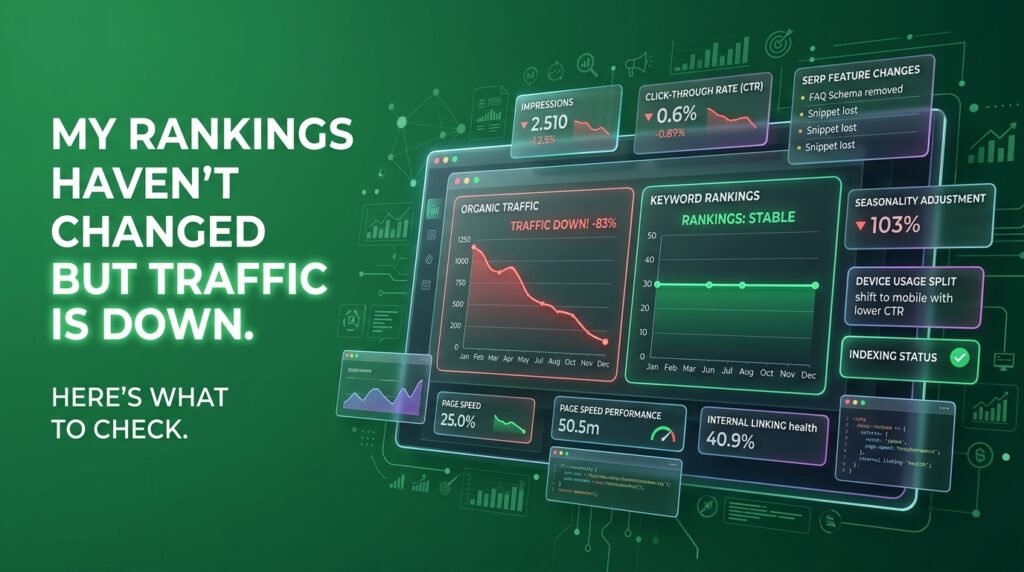
You pulled up your rank tracker expecting bad news. There wasn’t any. Position three, same as last month. Position one, still yours.

And yet your traffic dashboard tells a completely different story. Sessions are down. Leads are down. Somebody on your team has already asked what happened, and “nothing” isn’t an answer they’re going to accept.

Here’s the truth most SEO reporting won’t say out loud: rankings and traffic stopped being the same metric a while ago. You can hold position one and still lose the click. We’ve audited enough accounts to know exactly where to look first and it’s rarely the keyword.

Fixing the Gap Between Ranks and Clicks

A traffic drop with stable rankings isn’t a mystery it’s a sign the SERP has evolved beyond traditional blue links. Whether AI Overviews, shifting searcher intent, or internal page cannibalization are absorbing your audience, identifying the specific diagnostic leak is your first priority. Stop making blind changes to working content. Run this six-point audit today to pinpoint the issue, update your reporting stack, and start recapturing lost search traffic.

You Checked Rankings First. That Wasn't the Problem to Check.

Most people troubleshoot a traffic drop backwards. They open the rank tracker, see green numbers, and conclude the SEO is “working” so the drop must be something else. A seasonal blip. A bad month. Bad luck.

That instinct makes sense. For over a decade, rank position and click volume moved together almost one-to-one. If you held position one, you got the traffic that came with position one. The relationship was reliable enough that “rankings” became shorthand for “how the SEO is doing.”

That shorthand is now misleading you.

A rank tracker tells you where your blue link sits among the other blue links. It says nothing about what’s sitting above the blue links, how much of the page an AI-generated answer is now occupying, or whether the searcher even scrolled past the fold. Your position on the page and your share of the clicks on that page are two different numbers, and they’re drifting apart.

Rankings Measure Position. They Don't Measure What Happens Next.

Here’s the part most audits skip: the SERP itself has changed shape underneath your ranking, and Google never told you.

Zero-click search a query that gets answered without anyone clicking through to a website now accounts for roughly 27% of U.S. search traffic, up from 24.4% in early 2024, according to Semrush. AI Overviews, featured snippets, and knowledge panels are absorbing the click before it ever reaches your listing.

The uncomfortable stat inside that shift: when a searcher does encounter an AI-generated summary, Pew Research Center found only about 1% of them go on to click any link at all.

Your position hasn’t moved. The page around your position has. That’s the insight most reports never surface, because a rank tracker was built to measure a search results page that doesn’t fully exist anymore.

So what does this mean for you? It means “check rankings” is no longer a complete diagnostic. It’s step one of six.

Stop Leaking Revenue to "Optimized" Mediocrity

Key Takeaway

The Six-Point Audit We Run Before We Touch a Single Keyword

This is the same sequence we walk through for every client who comes to us saying “the rankings look fine, but the numbers don’t.” Work it in order  each check rules out one cause before you spend time on the next.

Check whether an AI Overview or featured snippet is now sitting above you.

Search your top 10-15 keywords manually, on both desktop and mobile. If a summary box now occupies the space your listing used to own, that’s very likely where your click went even though your position never changed. Semrush’s own analysis of over 200,000 keywords found this effect is strongest on informational queries, and noticeably lighter on commercial or transactional ones.

Pull up your Search Console query report and check whether two of your own URLs are now ranking for the same term. When that happens, Google often splits impressions between them, and neither page gets the full click volume the keyword used to send to one page. This is a self-inflicted traffic leak, and it’s one of the most common ones we find during onboarding audits.

Month-over-month comparisons hide seasonality. A B2B topic that always dips in August, or an e-commerce category that always slows after a holiday spike, will look like a crisis in a monthly view and look completely normal year over year.

Google logs its confirmed updates on its Search Status Dashboard. If your traffic decline started weeks before or after a listed update, the update probably isn’t your cause and you’ve just saved yourself from chasing the wrong fix.

Check your tracking setup before you trust the dashboard at all.

GA4 configuration changes, a new consent banner quietly blocking analytics tags, or a filtered view in Search Console can all make traffic look like it fell off a cliff when it didn’t. We walk through exactly how to isolate this in our guide to tracking AI and organic traffic properly in GA4 and Search Console it’s worth ten minutes before you touch anything else on this list.

Google reads searcher behavior constantly. If people searching your keyword have started preferring video results, local packs, or a completely different type of page than yours, Google will keep your ranking stable for the term while sending fewer of the clicks your page used to get. Your content hasn’t changed. What the searcher wants when they type that phrase has.

Run through all six before you rewrite a single page. Most traffic drops trace back to one of these not to your rankings.

The Response That Actually Moves the Number

Once you know which of the six it is, the fix looks completely different depending on the cause. Here’s the short version of what we do for each.

  • If a SERP feature is eating the click: don’t fight it for informational queries where it’s already winning. Redirect the content investment toward commercial and bottom-funnel pages where buyers still need to compare, price, and decide pages a summary box can’t fully replace.
  • If it’s cannibalization: consolidate the competing pages into one, and 301-redirect the weaker URL so Google stops having to choose between your own content.
  • If it’s seasonal: stop reacting. Build the seasonal pattern into your reporting so next year’s dip doesn’t trigger a false alarm.
  • If it’s an algorithm update: wait for the dust to settle before making structural changes. Overcorrecting mid-update is how sites end up chasing their own tail for a quarter.
  • If it’s tracking: fix the measurement first. You can’t diagnose a problem you’re measuring wrong.
  • If it’s intent drift: rebuild the page format to match what’s actually winning the SERP now, not what won it eighteen months ago.

This is the same audit sequence we run on our own site, and it’s part of the broader system we cover in how we approach ranking strategy heading into 2026 because ranking well and capturing the click are becoming two separate jobs, and most SEO plans are only built for one of them.

Position tells you where you stand. It doesn’t tell you if anyone showed up.

This Is the Exact Audit We Run for Every New Client

Before we touch a single ad, page, or keyword for a new account, we run this six-point sequence usually inside the first 48 hours. It’s rarely one dramatic cause. It’s almost always a specific, findable leak, and once you can name it, the fix is usually smaller than people expect.

If your rankings look fine but your traffic doesn’t, let’s find out why. Book a free audit call at www.themayk.com and we’ll walk your account together.

Conclusion

A traffic drop with stable rankings isn’t a myster it’s a sign the SERP moved past your traditional blue link. Whether AI features, shifting search intent, or internal page competition are absorbing your clicks, identifying the specific leak is step one. Run this six-point audit today, stop guessing, and adapt your strategy to start capturing real search traffic again.

See How Our Agency Grow Your Traffic Into Conversions

SEO – unlock sustainable growth with proven search strategies.
Content Strategy – magnetic content that earns links, shares, and brand authority.
Paid Media – precision campaigns built for measurable ROI.

Blogs

Should You Move Your Shopify Store to the Horizon Theme?

should you move your shopify store to the horizon theme? You just read that Shopify’s new Horizon theme has AI-generated blocks, better Core Web Vitals, and a design system that makes Dawn look a decade old. Your dev is already asking if you should switch. Here’s the part nobody selling you on Horizon mentions: there’s […]

Why Is My Shopify Traffic Up but Sales Down?

why is my shopify traffic up but sales down? Your Shopify dashboard says sessions are up 40% this month. Your payout report says something else entirely. Someone on your team already blamed a slow week, or the economy, or “it’ll even out.” It won’t. We’ve pulled the analytics on dozens of Shopify stores stuck in […]

My Rankings Haven’t Changed but Traffic Is Down. Here’s What To Check

My Rankings Haven’t Changed but Traffic Is Down. Here’s What To Check You pulled up your rank tracker expecting bad news. There wasn’t any. Position three, same as last month. Position one, still yours. And yet your traffic dashboard tells a completely different story. Sessions are down. Leads are down. Somebody on your team has […]

LET'S TALK GROWTH

Ready to scale your brand?

Tell us a bit about your goals, and we’ll show you how we can help.

How we use your info: Used strictly to review your project, prepare tailored insights, and reach out for a 1-on-1 strategy call. Zero spam, zero shared data.