
Blogs > How to Rank on Google Page 1 Step-by-Step

How to Rank on Google Page 1 Step-by-Step

Are you tired of publishing endless blog posts only to stay stuck on page three while inferior competitors steal your organic traffic? If you want to break through the noise, you need an actionable Google page 1 ranking strategy that modern search algorithms actually reward. Google doesn’t care about sheer content volume anymore it rewards trust, user experience, and proven relevance.

In this comprehensive guide, we’re pulling back the curtain on the exact framework we use to turn invisible sites into top-ranking search powerhouses. You’ll discover how to optimize for E-E-A-T, master intent-driven content, dial in your technical SEO, and build a high-impact backlink profile that commands authority. Ready to stop burning your marketing budget and start dominating the search results? Let’s dive in.

The Page 1 Blueprint: From Invisible to Irresistible

Breaking onto Google’s first page isn’t about churning out endless content it’s about building undeniable trust. By executing a structured playbook grounded in real authority, sharp technical performance, and strategic link building, you transform your site from an ignored blog into an industry leader. Stop letting competitors steal your traffic simply because they played the credibility game better. Apply this sequence, fix your quiet performance leaks, and own position one.

Page 3 Isn't a Traffic Problem. It's a Trust Problem.

Most businesses treat SEO like a content quota. Write enough blogs, hit enough keywords, and rankings will follow. That’s the advice you’ve been given. It’s also why you’re stuck.

Here’s what’s actually happening: Google isn’t short on content about your topic. It’s flooded with it. What it’s short on is content it can verify, structure, and confidently hand to a searcher without looking bad.

Your page isn’t losing because it’s thin. It’s losing because Google can’t tell if it’s trustworthy.

We see this constantly. A client comes to us with a blog that hits every technical box keyword in the title, decent word count, a handful of subheadings and it still sits at position 14. The content isn’t broken. It’s just unconvincing.

That distinction changes everything about how you should be spending your time.

Google Isn't Ranking Your Content It's Ranking Your Reputation

Most agencies will tell you SEO is about keywords and backlinks. That’s half the story, and it’s the easy half.

Google’s own documentation on ranking systems lays out what it’s actually checking for: experience, expertise, authoritativeness, and trustworthiness E-E-A-T, for short. Of those four, Google is explicit that trust matters most. A page can be well-written and still rank behind a rougher page from a source Google already believes.

This is the layer most blogs skip. They jump straight from “here’s the problem” to “here’s a checklist,” and they never explain why the checklist works.

Ranking isn’t a content exercise. It’s a credibility exercise that happens to be written in words.

Once you see it that way, every step below makes a lot more sense.

Here’s where it gets practical.

Key Takeaway

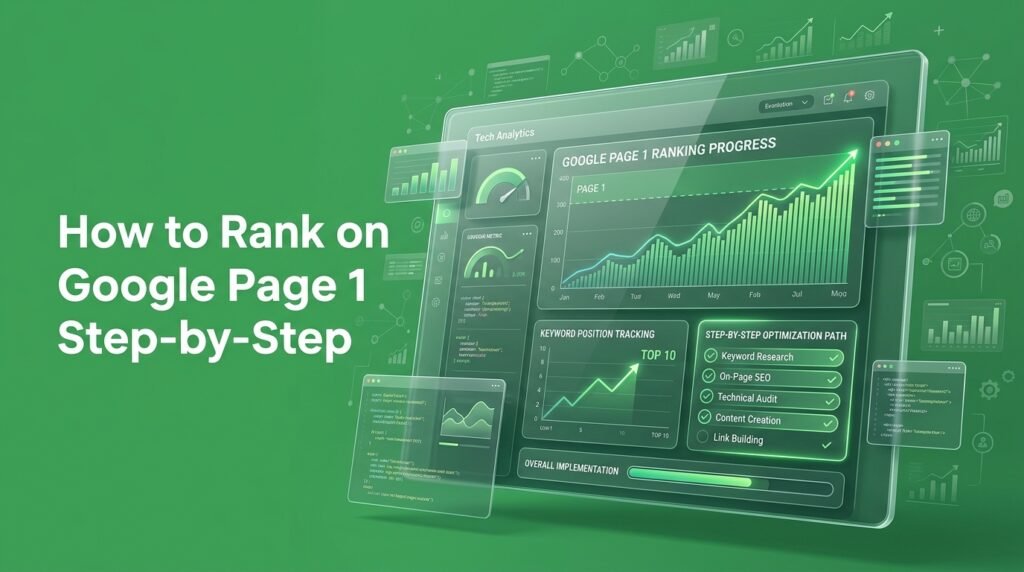
The Seven-Step Path to Google's Page 1

This is the exact sequence we run for clients before we touch a single blog post. No shortcuts, no guessing.

Step 1: Find the Search Your Buyer Is Actually Typing

Skip broad terms like “marketing tips.” Nobody with a credit card searches that. Go after the specific, frustrated version of the question the one someone types at 11 p.m. when something’s already broken.

  • Pull the actual queries bringing traffic to your site using your analytics and search data, not guesswork
  • Check monthly search volume aim for terms with real demand and a realistic shot at ranking, not the impossible ones
  • Match the term to intent: someone searching “how to rank on Google” wants a guide, not a sales page

Get this step wrong and nothing after it matters.

This is where most content fails before it’s even published. Generic advice, no specifics, nothing that proves you’ve actually done the work.

Show your receipts. Cite real numbers. Name the mistake you’ve personally watched clients make. Google’s helpful content guidance is built around one core idea: content should demonstrate it was made by someone who genuinely knows the subject, not assembled to catch a keyword.

Write like you’ve done the thing. Because if you haven’t, it shows.

One quick test: if you deleted your brand name from the page, could a reader tell it came from someone who’s actually run this playbook or could it have come from any agency’s blog? If it’s the second one, it needs another pass.

Your primary keyword needs to show up in three places: the title, the first hundred words, and at least one subheading. That’s not stuffing  that’s telling Google, in the first three seconds, what this page is actually about.

  • One H1 per page your title, nothing else
  • H2s for main sections, H3s for the steps underneath
  • A meta description under 160 characters that includes your primary keyword and gives someone a reason to click

Skip this and you’re asking Google to guess what your page is for. It won’t bother.

A brilliant page that takes six seconds to load is a page nobody finishes reading. Google’s own page experience documentation confirms that Core Web Vitals feed directly into its ranking systems loading speed, visual stability, and how fast the page responds when someone taps something.

This won’t rescue weak content. But it will quietly sink strong content that never gets the chance to prove itself.

Step 5: Link Your Own Site Together Like You Mean It

Every blog you publish should point somewhere toward a related guide, a service page, a case study. This isn’t decoration. It’s how Google understands which pages on your site matter most, and it’s how a reader who’s already interested moves one step closer to actually working with you.

If your blog talks about conversion problems, it should point to your funnel breakdown. If it talks about content production at scale, it should mention how AI-assisted content workflows fit into the picture. Every link should earn its place in the sentence never “click here.”

This is the step everyone wants to skip because it’s the hardest. It’s also the one that separates page one from page three.

Backlinko’s large-scale study of over 11 million search results found a clear correlation between the number of referring domains a page has and where it ranks. Not the number of links total the number of different sites vouching for you.

You earn those links the same way you earn trust anywhere else: original data, a genuinely useful tool, or an opinion worth citing. Guest posts and directory submissions won’t cut it anymore.

Nobody links to a page that says what everyone else already said.

Ranking isn’t a finish line. It’s a position you defend. Pull your dashboard monthly, track which pages are climbing, and check where searchers are dropping off before they act.

Small, consistent adjustments beat one big rewrite every time.

This Is the Audit We Run Before We Touch a Single Page

Here’s why this matters: position 1 on Google gets roughly 27.6% of all organic clicks, while page two gets scraps. There’s no partial credit for “close to page one.” You’re either found or you’re invisible.

This seven-step framework is the exact audit we run for every new client before we write a word of content. It usually takes us about a week and it almost always uncovers three or four leaks nobody had noticed.

If you’re doing everything “right” and still stuck on page three, the problem probably isn’t effort. It’s sequence.

Stop guessing. Let’s find out what’s actually holding your rankings back. Book a free audit call at www.themayk.com.

Conclusion

Breaking onto Google’s first page isn’t about working harder or churning out endless content it’s about working in the right sequence and giving Google the verified trust it demands. By moving away from generic keyword-stuffing and executing a structured playbook grounded in real E-E-A-T, technical performance, and strategic link building, you transform your site from an ignored blog into an undeniable industry authority. Stop letting low-quality competitors steal the top spot simply because they played the credibility game better. Implement these seven steps today, fix the quiet performance leaks on your site, and turn your hidden content into your most reliable driver of real, high-intent revenue.

See How Our Agency Grow Your Traffic Into Conversions

SEO unlock sustainable growth with proven search strategies.
Content Strategy magnetic content that earns links, shares, and brand authority.
Paid Media precision campaigns built for measurable ROI.

Blogs

How to Do Keyword Research Like a Pro

How to Do Keyword Research Like a Pro You’ve opened a keyword tool, typed in a broad term, and stared at a giant spreadsheet with no idea which phrases actually drive sales. Building a high-converting SEO content strategy isn’t about toggling filter settings for high volume it’s about mapping content directly to what your ideal […]

How to Rank on Google Page 1 Step-by-Step

How to Rank on Google Page 1 Step-by-Step Are you tired of publishing endless blog posts only to stay stuck on page three while inferior competitors steal your organic traffic? If you want to break through the noise, you need an actionable Google page 1 ranking strategy that modern search algorithms actually reward. Google doesn’t […]

How to Enhance Your Conversations Using AI

How to Enhance Your Conversations Using AI Deploying an AI assistant to scale your business is only half the equation the real key is transforming those interactions into high-value customer experiences. When brands treat AI like a cheap replacement for a call center rep, they end up driving potential clients straight to competitors with circular, […]

LET'S TALK GROWTH

Ready to scale your brand?

Tell us a bit about your goals, and we’ll show you how we can help.

How we use your info: Used strictly to review your project, prepare tailored insights, and reach out for a 1-on-1 strategy call. Zero spam, zero shared data.