
Blogs > What Are the Hidden Reasons Behind Low Conversion Rates?

What Are the Hidden Reasons Behind Low Conversion Rates?

You’re getting clicks. The ad account looks healthy. CPC is reasonable, impressions are up, and yet sales barely move. So you do what every dashboard tells you to do: you blame the ad.

That’s almost never where the problem actually lives.

We’ve opened up accounts for founders convinced their creative was the issue, only to find the real leak three steps deeper somewhere most people never think to look, because it’s not the part anyone’s watching closely.

Low conversion rates rarely have one obvious cause. They have a handful of quiet ones, stacked on top of each other, each one small enough to ignore and large enough, together, to sink the whole funnel.

The Data Blindspot: Blindly Trusting Averages

Averages lie because they flatten the real user experience into a comfortable, misleading metric. Your overall conversion rate might look decent, but it completely masks the fact that your premium audience segment is abandoning ship due to a broken localized payment gateway. When you stop looking at global totals and start deeply segmenting your data by device, location, and user behavior, the hidden fractures in your funnel finally become painfully clear.

You're optimizing the part nobody actually abandons on

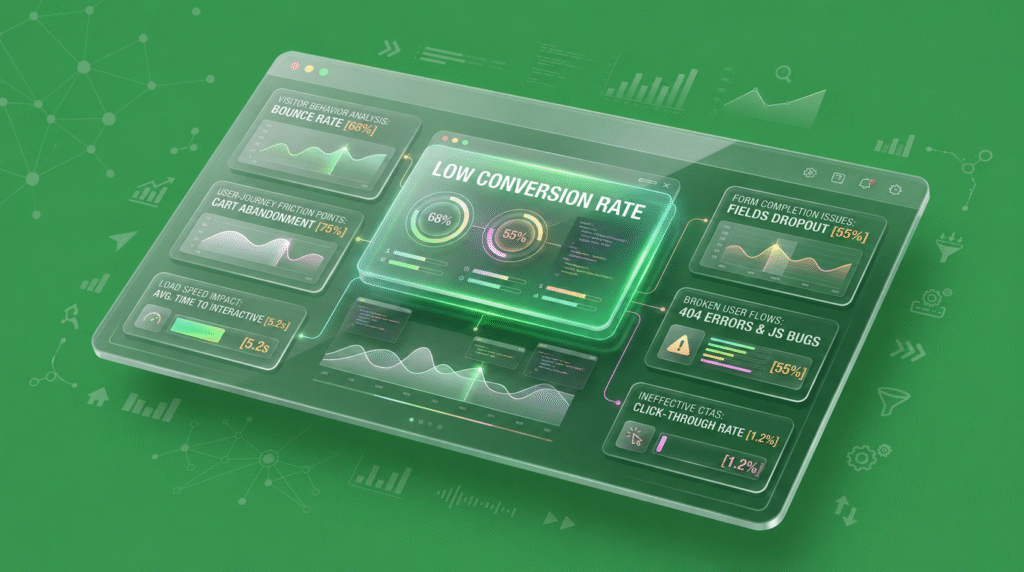
Most teams spend their energy on the headline and the hero image. Meanwhile, the actual point of collapse is usually somewhere boring: a slow-loading page, a form with too many fields, a shipping cost that shows up out of nowhere at the last step.

Here’s the uncomfortable math: speed alone can decide whether someone ever sees your offer. Google’s own research found that as mobile page load time stretches from one second to ten, the chance a visitor bounces jumps by 123 percent and that’s before they’ve read a single word of your copy.

That’s not a creative problem. That’s an engineering problem wearing a marketing costume.

The checkout page is where most of the money actually disappears

Here’s where it gets interesting. Everyone obsesses over the top of the funnel  the ad, the click, the landing page. Almost nobody audits the part where the money actually changes hands. According to the Baymard Institute’s research across dozens of studies, the leading reasons shoppers abandon checkout, once you remove people who were just browsing, are extra costs that show up too late, a checkout that demands an account before it’ll let someone pay, and a process that simply has too many steps. None of these are mysteries. They’re just unmonitored.

A checkout with too many form fields isn’t “thorough.” It’s a wall. Baymard’s research shows that the average checkout displays nearly twice the number of form elements that an ideal flow actually needs and every extra field is a fresh chance for someone to quit.

The trust gap nobody's tracking in their dashboard

Most conversion dashboards measure clicks, scroll depth, and time on page. None of them measure the thing that’s actually killing your numbers: whether the visitor trusts you enough to type in their card number.

People don’t abandon because they changed their mind about wanting your product. They abandon mid-decision, because something  an unclear return policy, a missing security badge, a checkout that looks slightly off-brand from the ad that brought them there made them hesitate at the exact moment they needed to feel safe. This is the layer most agencies skip, because it doesn’t show up cleanly in a heatmap. It shows up in the gap between “added to cart” and “completed purchase,” and that gap is where a huge share of your revenue is quietly leaking out.

If your add-to-cart numbers look healthy and your sales don’t, the problem was never your product. It was the five seconds of doubt right before checkout.

The version of your site that's losing money is the one on mobile

Here’s a pattern we see constantly: a brand fixes desktop, declares victory, and never looks at what’s actually happening on the device most of their traffic comes from.

Mobile conversion rates consistently lag desktop, and the reason isn’t a mystery it’s friction. Tiny tap targets, checkout forms that weren’t built for a thumb, autofill that doesn’t trigger correctly, pages bloated with images that were never compressed for a phone screen. Fixing this isn’t glamorous work. It’s also where some of the fastest, cheapest wins in the entire funnel are sitting untouched.

What to actually do about it, in the order that matters

Stop guessing which piece is broken. Here’s the sequence we run when a client comes to us with healthy traffic and a flat conversion rate.

  1. Map the real funnel, not the assumed one. Most businesses have a mental model of “landing page → signup → purchase” that doesn’t match how people actually move through the site, including the loops, back-clicks, and abandoned-and-returned sessions that never show up in a simple chart.
  2. Audit load speed on mobile first. If your mobile pages take more than a few seconds to load, fix that before touching a single word of copy. No headline is strong enough to survive a visitor who already left.
  3. Count every field in your checkout. If it’s north of 14 form elements, you’re asking for more than people are willing to give. Cut anything that isn’t strictly necessary to complete the order.
  4. Surface costs early, not at the end. Shipping, taxes, and fees should appear before the final step, not as a surprise right when someone’s ready to pay.
  5. Put trust signals where the hesitation actually happens. Security badges, clear return policies, and real reviews belong near the moment of payment, not buried on an About page nobody visits.

Do this in order, and you’ll usually find the leak before you’ve spent another dollar on traffic.

Key Takeaway

Conclusion

This is the exact audit we run before touching a single ad Before we recommend a bigger budget, we map where your funnel is actually bleeding using behavioral tracking and a full funnel breakdown to see what your dashboard isn’t showing you. Most of the time, the fix isn’t more spend. It’s removing whatever’s quietly making people hesitate.

If your traffic looks good but your numbers don’t move, we should talk. See how our CRO process finds the leak before we touch a single campaign, or book a free audit call at www.themayk.com.

Stop guessing where the money’s going. Start finding out.

See How Our Agency Grow Your Traffic Into Conversions

SEO   unlock sustainable growth with proven search strategies.
Content Strategy   magnetic content that earns links, shares, and brand authority.
Paid Media   precision campaigns built for measurable ROI.

Blogs

What Are the Hidden Reasons Behind Low Conversion Rates?

What Are the Hidden Reasons Behind Low Conversion Rates? You’re getting clicks. The ad account looks healthy. CPC is reasonable, impressions are up, and yet sales barely move. So you do what every dashboard tells you to do: you blame the ad. That’s almost never where the problem actually lives. We’ve opened up accounts for […]

When Should Brands Focus on Creating Lasting Impressions?

When Should Brands Focus on Creating Lasting Impressions? You redesigned the logo last quarter. You refreshed the website. You ran the ad campaign, got the clicks, and watched the traffic roll in. Three weeks later, a prospect who visited your site can’t remember your name. That’s not a marketing problem. That’s a memory problem, and […]

How to Use Storytelling to Create Lasting Impressions for Your Brand

How to Use Storytelling to Create Lasting Impressions for Your Brand You’re pouring money into visuals, ads, and websites that look sharp. Yet customers scroll past, forget you by tomorrow, and pick the competitor whose name they actually remember. The difference isn’t your product. It’s that you’re throwing facts at people instead of giving them […]

Contact Us