
How to Avoid Regret Buying the Xbox Nano Controller
How to Avoid Regret Buying the Xbox Nano Controller The Xbox Nano Controller is $49.99, pocket-sized, and open for pre-order. The headlines make it sound like…
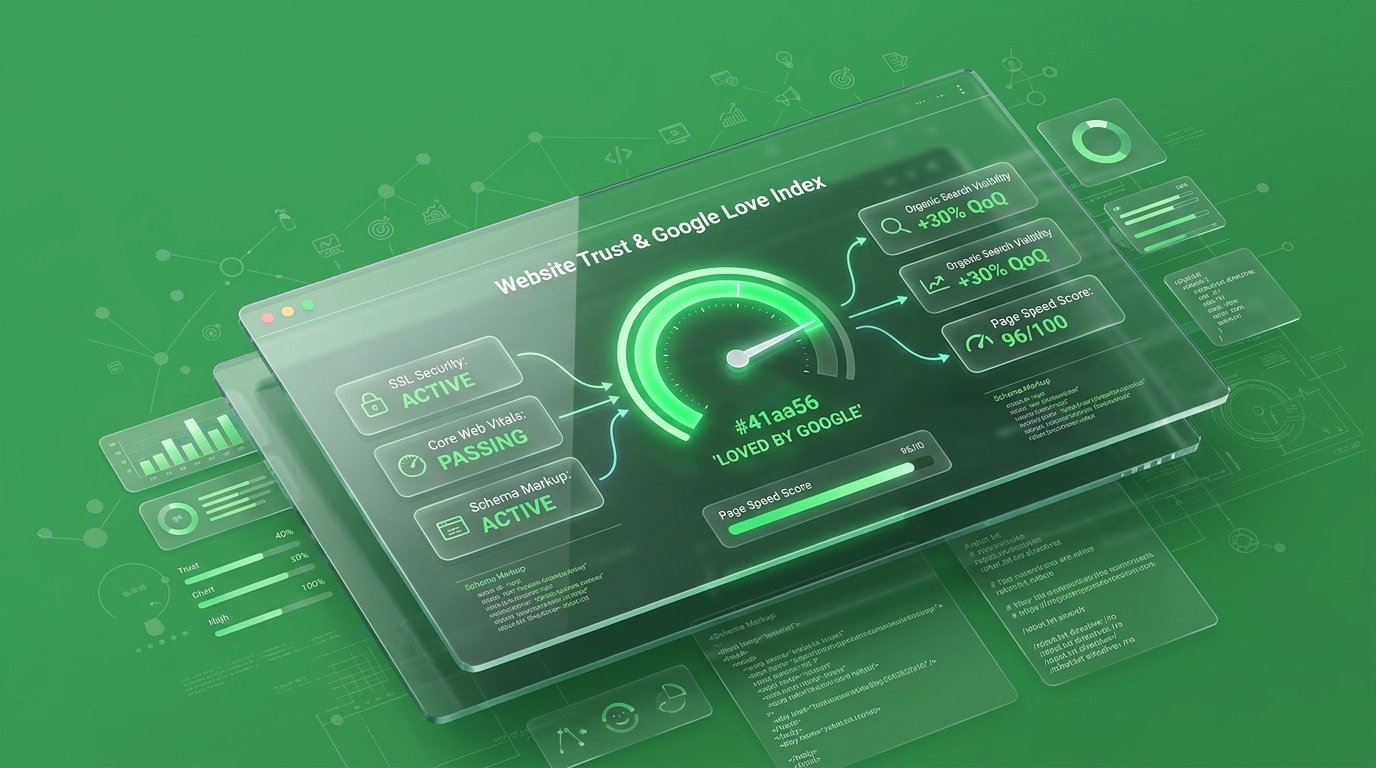
You spent real money on the website. The design is clean. The copy isn’t terrible. You’ve got a contact page and a blog section with three posts from eight months ago. And yet Google doesn’t rank you. Visitors land and leave in 12 seconds. Your bounce rate looks like a bad joke.
Here’s what no one told you: Google doesn’t just index websites. It audits them. And a site that looks professional to a human often fails every credibility test Google runs behind the scenes. The problem isn’t your design. It’s what your design doesn’t say.
Your polished website may impress humans, but Google demands verifiable E-E-A-T SEO signals. Without strong website trust signals like named authors, Core Web Vitals, and entity proof, rankings suffer despite clean design. Build credibility through deep topical content, genuine testimonials, internal linking, and off-site validation. This transforms visitor trust and boosts Google ranking factors for sustainable organic growth.
There’s a difference between a website that looks trustworthy and one that is trustworthy at least in the eyes of a search algorithm.
Most web design briefs sound like this: “Make it modern. Make it clean. Make us look like a serious company.” Fair enough. But Google’s trust assessment doesn’t care about your font choice or your hero image. It’s running a completely different checklist.
Google wants to know one thing: should I send my users here?
That’s it. Every ranking decision Google makes is, at its core, a bet on your reliability. If your site doesn’t demonstrate credibility through measurable signals technical, structural, and content-based Google won’t take that bet. It’ll send the traffic to someone it can verify.
And the businesses that get this wrong are losing ranking positions, losing organic leads, and spending money on ads to compensate for a problem they don’t even know they have.
Here’s the deeper issue most people miss.
In a landmark study, the Stanford Web Credibility Project found that nearly half of all consumers 46.1% assess a website’s credibility based primarily on its visual design. That’s the human judgment. But Google isn’t a human. It can’t feel impressed by your colour palette.
Google runs what’s known as the E-E-A-T framework Experience, Expertise, Authoritativeness, and Trustworthiness. Google’s own Search Quality Rater Guidelines use this framework to train the systems that evaluate your content and your domain. And trust, specifically, sits at the centre of it. As Google’s documentation on helpful content makes clear: experience, expertise, and authority are all in service of one goal building verifiable trust.
The websites that rank consistently well aren’t always the flashiest ones. They’re the ones that signal credibility across every dimension Google can measure.
That’s a design problem, a content problem, and a technical problem all at once.
Before we get into the fix, you need to understand the full picture of what’s being measured.
1. Technical credibility signals
These are the signals Google reads before a human ever reads your headline.
2. Content and authority signals
This is where most businesses have the biggest gap between what they think they’re doing and what Google actually sees.
3. Off-site credibility signals
You can’t fully control these but you can influence them.
There’s a layer beneath all of this that almost no one talks about clearly.
Google doesn’t trust your website. It trusts your entity.
The website is just one piece of evidence. Google is trying to build a complete picture of whether your business is real, established, and reliable. Your website is cross-referenced against your social profiles, your Google Business listing, your mentions in the press, the authors of your content, and the quality of the sites linking back to you.
This is why a fresh website with great design and perfect Core Web Vitals can still rank below a slower, uglier site that’s been around for years, has genuine reviews, has press mentions, and has a handful of quality backlinks.
Trust isn’t built on your website. It’s built across your entire digital presence and your website is where it comes together.
This is the distinction that separates businesses doing organic growth correctly from those who wonder why their SEO “isn’t working.” The SEO strategy isn’t just about keywords and metadata. It’s about building a presence that Google can verify from multiple angles.
This is the framework. It’s not a quick fix. It’s a system. But each step compounds.
Run your site through Google’s PageSpeed Insights and Google Search Console. Fix what’s flagged. Prioritise:
This isn’t optional. It’s the floor. You can’t build credibility on a broken technical foundation.
Every page on your site that contains expertise especially blog posts, case studies, and service pages needs a named author. That author needs a bio. That bio needs to link to something Google can cross-reference: a LinkedIn profile, a byline on an external publication, a speaker profile.
Don’t hide behind your brand. Show Google there are real, qualified people behind it.
Pick the two or three topics that sit at the core of your business. Build a content ecosystem around them. Go deep. Answer the questions your customers actually search for, at every stage of their decision-making process.
A business running business and website analytics services, for example, shouldn’t have one broad post about “marketing analytics.” It should have a cluster of interconnected content covering tracking setup, dashboard interpretation, behavioural data, and funnel analysis each piece reinforcing the others.
Real trust signals aren’t subtle. They need to be visible:
You need Google to find evidence of you beyond your own website.
These aren’t “nice to have” items. They’re the signals that tell Google your entity is real and established not a website that appeared last month.
Every piece of content you publish should connect to other relevant pages on your site. This does two things: it helps Google understand the structure and depth of your expertise, and it passes authority from your stronger pages to your newer ones.
A site with no internal link structure is a pile of disconnected documents. A site with deliberate internal linking is a content ecosystem and Google rewards the latter.
If you’ve built out services like behavioural tracking, predictive analytics, and conversion rate optimisation as separate offerings, your content should connect them. Show Google and your visitor that these capabilities form a coherent system, not a random menu.
Trust isn’t a switch you flip. It’s a score that accumulates.
Every authoritative backlink you earn adds to it. Every named author bio you publish adds to it. Every Core Web Vitals improvement adds to it. Every verified review, every press mention, every piece of genuinely useful content adds to it.
The businesses that dominate organic search in competitive markets aren’t doing anything exotic. They’ve been consistent about building their entity authority for two, three, sometimes five years. The compound effect of that consistency is almost impossible to beat with a short-term sprint.
The good news: most of your competitors haven’t started yet. They’re still treating their website like a brochure. You can treat yours like an asset.
When a new client comes to us and their organic traffic is flat or declining, the first thing we do isn’t write new content or run ads. We audit the full trust picture technical health, content depth, entity signals, and off-site presence.
We use a combination of business analytics, behavioural tracking, and technical SEO audit to map exactly where the trust gaps are. The patterns we see repeat across almost every site: credible-looking on the surface, broken underneath.
Once we know where the gaps are, we build the fix systematically. Not a blog post here and a backlink there a full system that accumulates authority over time. It’s not fast. But it works. And it compounds.
If your website looks good but Google still doesn’t seem to care, that’s not a mystery. It’s a solvable problem. Let’s find where your trust gaps are and fix them properly.
Book a strategy session at www.themayk.com.
Because in 2026, the difference between a “No” and a “Yes” isn’t your tech stack it’s the human strategy behind it. Let’s turn your digital ghost town into a conversion machine.
How to Avoid Regret Buying the Xbox Nano Controller The Xbox Nano Controller is $49.99, pocket-sized, and open for pre-order. The headlines make it sound like…
Is the Xbox Nano Controller Actually Comfortable? You’ve read the headlines: five inches, 3.5 ounces, $49.99, all 18 inputs. Everyone’s calling it cute. Nobody’s answered the…
How to Master Social Media Marketing Fast You are posting three times a week on Instagram and LinkedIn. Your designer makes pristine templates, and your team…
How we use your info: Used strictly to review your project, prepare tailored insights, and reach out for a 1-on-1 strategy call. Zero spam, zero shared data.