How to Avoid Regret Buying the Xbox Nano Controller
How to Avoid Regret Buying the Xbox Nano Controller The Xbox Nano Controller is $49.99, pocket-sized, and open for pre-order. The headlines make it sound like…
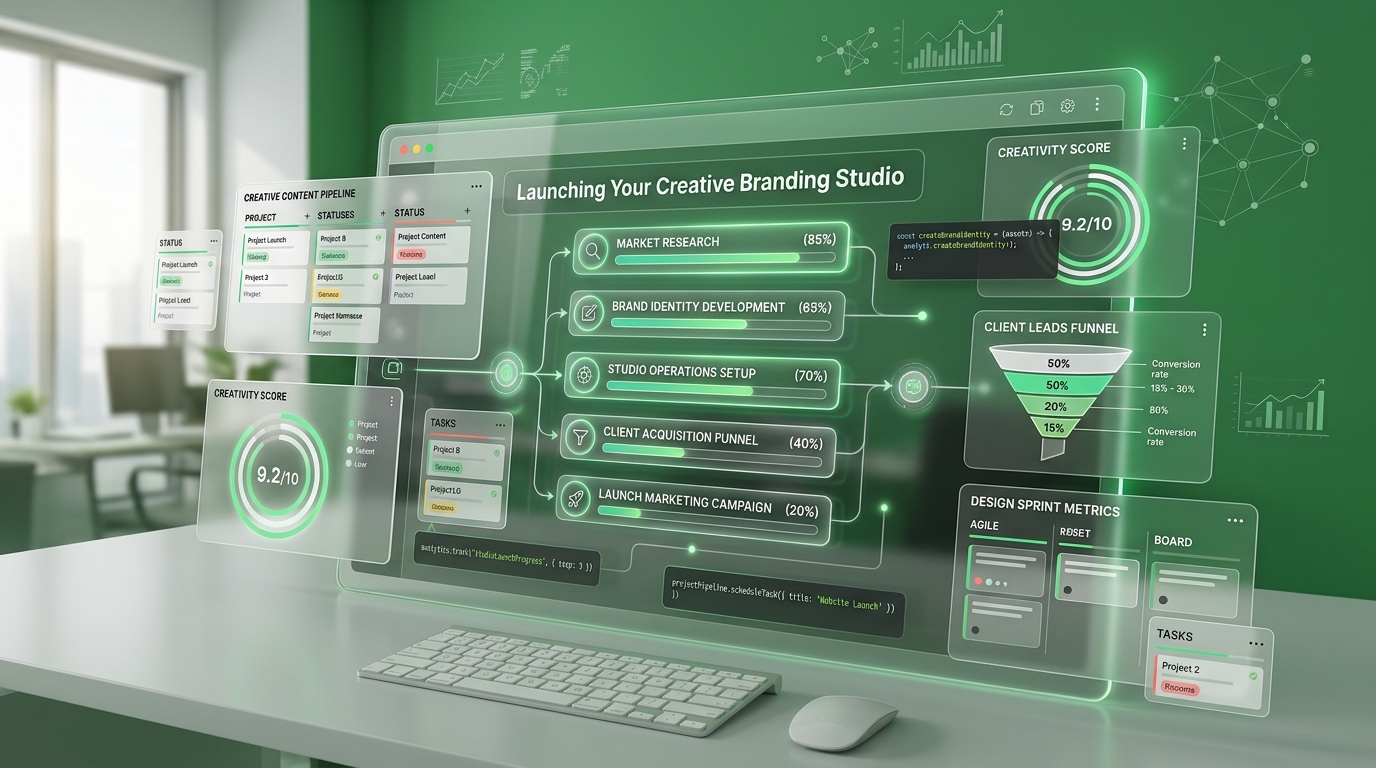
Most creative studios fail inside the first two years. Not because the work is bad. Because nobody treated it like a business from day one. Here’s the step-by-step breakdown of how to build one that actually lasts. You’ve got the skills. Maybe a portfolio. Probably a name picked out and a color palette you’re already attached to. And you’re about to make the same mistake most creative founders make: you’re thinking about the studio, not the system behind it.
We’ve watched talented designers, brand strategists, and creative directors launch studios with real promise and then spend the next 18 months scrambling for clients, undercharging, and wondering why referrals dried up after the first three projects.
The launch isn’t the hard part. The structure is.
The branding agencies market is already worth $59.89 billion in 2026 and is on track to hit $101 billion by 2035. The opportunity is real. But so is the competition. What separates the studios that grow from the ones that grind is not raw talent it’s how they’re built.
Here’s the exact framework we’d use if we were launching a creative branding studio from scratch.
The difference between a studio that barely survives and one that scales isn’t talent or luck it’s treating your creative practice like a real business from day one. Most founders obsess over perfecting logos and moodboards while ignoring cash flow, client acquisition systems, and positioning. They launch with passion but no infrastructure. Two years later, they’re burned out, underpaid, and wondering why their “dream studio” feels like an expensive hobby.
Most studios make their first critical mistake before they ever take a client call. They position themselves as generalists. “We do branding, design, social, and content.” That sentence sounds thorough. To a potential client, it sounds like everyone.
The studios that fill their pipeline fastest are the ones that solve a specific problem for a specific type of client. Not because they can’t do more but because being known for something specific is what makes you referable.
Ask yourself these three questions before you write a single line of your website:
The test: Read your positioning out loud. If it could belong to any other creative studio on the internet it’s not positioning. It’s a description. Rewrite it until it could only be yours.
Your niche doesn’t permanently box you in. It gets you in the room. Once you’re in the room, the work sells the rest.
Pricing is the thing creative founders get wrong more consistently than anything else. And it’s not because they don’t know their worth it’s because they price based on their own financial anxiety, not on the value they deliver to the client.
Here’s the framework that actually works: anchor your price to the outcome, not the deliverable.
A logo is a deliverable. It might cost $500 or it might cost $50,000 depending on who’s making it. But a brand identity system that reduces a founder’s customer acquisition cost by 30% over 12 months? That’s a business result. And business results command business budgets.
Before you set a number, define three things:
Build three packages. Not a menu of services three distinct business outcomes at three price points. The middle one is where most clients will land. Price it accordingly. The reason most creative studios can’t raise their rates isn’t that their work isn’t worth it. It’s that they’ve never made the case for why it is.
There’s a version of every studio’s early days where they take any client who shows up. The startup with no real budget. The friend’s cousin’s bakery. The three-revision-limit project that turns into fourteen rounds.
It’s understandable. Revenue is revenue, especially early. But it compounds in the wrong direction fast.
The clients you take in your first six months shape the kind of studio you become. They fill your portfolio. They define your referral network. They set the ceiling for what people assume you’re worth.
So be deliberate. Before you go looking for clients, define your ideal client profile with uncomfortable specificity:
And then before you send a single cold email or post in a single Facebook group make sure your online presence already speaks directly to that client. Your website, your social, your case studies. If a $30,000 budget founder lands on your portfolio and it looks like you work with $1,500 clients, you’ve already lost the conversation.
Nearly 69% of creative studios still rely primarily on referrals for new business. Which means every client you take is a future referral or a future liability. Choose accordingly.
Most creative founders assume they’re bad at marketing because they’re ‘not a marketer.’ That’s not the real issue. The real issue is that they don’t have a repeatable system for being seen by the right people.
Posting your work on Instagram three times a week and hoping the algorithm does the rest is not a strategy. It’s a ritual. And rituals without outcomes are just habits.
Here’s the visibility system worth building:
A compounding SEO strategy paired with consistent content is how studios that don’t have big ad budgets still build full pipelines. The studios that figured this out in year one are the ones with waitlists in year three.
This is the part that nobody wants to hear. Creative founders are usually the best creative person in the room and that becomes the ceiling.
When every deliverable has to go through you, when every client decision requires your judgment, when the quality depends on your energy on that specific day you don’t have a studio. You have a freelance operation with a name attached to it. Scaling a creative studio means building systems that don’t depend on you. That’s not a size thing it’s a structure thing.
Start with three systems before you hire your first person:
Every project from brief to delivery should follow a defined sequence. Not as a rigid cage, but as a repeatable framework that anyone on your team can follow. If the process only exists in your head, you’re the bottleneck.
What gets sent when. How revisions are scoped. How feedback is collected. How timelines are managed. Every hour you spend on back-and-forth email is an hour you’re not billing for creative work. Systematize it.
Not every inquiry deserves a full discovery call. Build a qualification process that filters out wrong-fit clients before they consume your time. A short intake form with the right three questions saves more hours per month than any tool you’ll ever buy.
These three systems aren’t glamorous. Nobody posts about them on Instagram. But they’re what separate the studios that double their revenue in year two from the ones still working 70-hour weeks for the same number.
Most studio websites are portfolios. Beautiful, often impressive and almost useless for converting clients.
The problem isn’t the design. It’s the logic. A portfolio answers the question “what have you made?” But the question a serious client is asking is “what will you do for me?”
These are not the same question. And the gap between them is where most studios lose deals.
A website that converts doesn’t just show work it demonstrates expertise. It names the client’s problem in the headline. It shows what it looks like to work with you. It makes the next step obvious and low-friction.
Four things that move a studio website from portfolio to pipeline:
The principles of conversion rate optimization apply to studio websites just as much as they apply to e-commerce. Every element should have a job. If it doesn’t convert, inform, or build trust it’s decoration.
Every few months there’s a new platform promising to make running a studio easier. A new project management tool. A new proposal software. A new AI content system.
None of them matter if your positioning is muddy, your pricing is wrong, and your onboarding process is an email thread.
That said the right tools in the right order genuinely do compound your output. Here’s a lean stack that actually matters at launch:
Add tools as you hit real friction not to solve problems you don’t have yet.
The studios that survive year two all have one thing in common: they treated the business as seriously as they treated the creative work. They got specific about who they served, built systems before they needed them, priced on value, and made their expertise visible where their ideal clients actually look.
This is exactly how we approach brand strategy at “TheMayk” not as an aesthetic exercise, but as a high-performing business system. Positioning, messaging, visual identity, and content strategy all work together, engineered for results. Whether you’re building a studio from scratch or repositioning one that’s already running, the fundamentals don’t change.
Stop guessing about what’s holding you back. Find out.
Book a free 20-minute strategy call. We’ll look at where you are, where you’re stuck, and what actually needs to change.
How to Avoid Regret Buying the Xbox Nano Controller The Xbox Nano Controller is $49.99, pocket-sized, and open for pre-order. The headlines make it sound like…
Is the Xbox Nano Controller Actually Comfortable? You’ve read the headlines: five inches, 3.5 ounces, $49.99, all 18 inputs. Everyone’s calling it cute. Nobody’s answered the…
How to Master Social Media Marketing Fast You are posting three times a week on Instagram and LinkedIn. Your designer makes pristine templates, and your team…
How we use your info: Used strictly to review your project, prepare tailored insights, and reach out for a 1-on-1 strategy call. Zero spam, zero shared data.