How to Avoid Regret Buying the Xbox Nano Controller
How to Avoid Regret Buying the Xbox Nano Controller The Xbox Nano Controller is $49.99, pocket-sized, and open for pre-order. The headlines make it sound like…
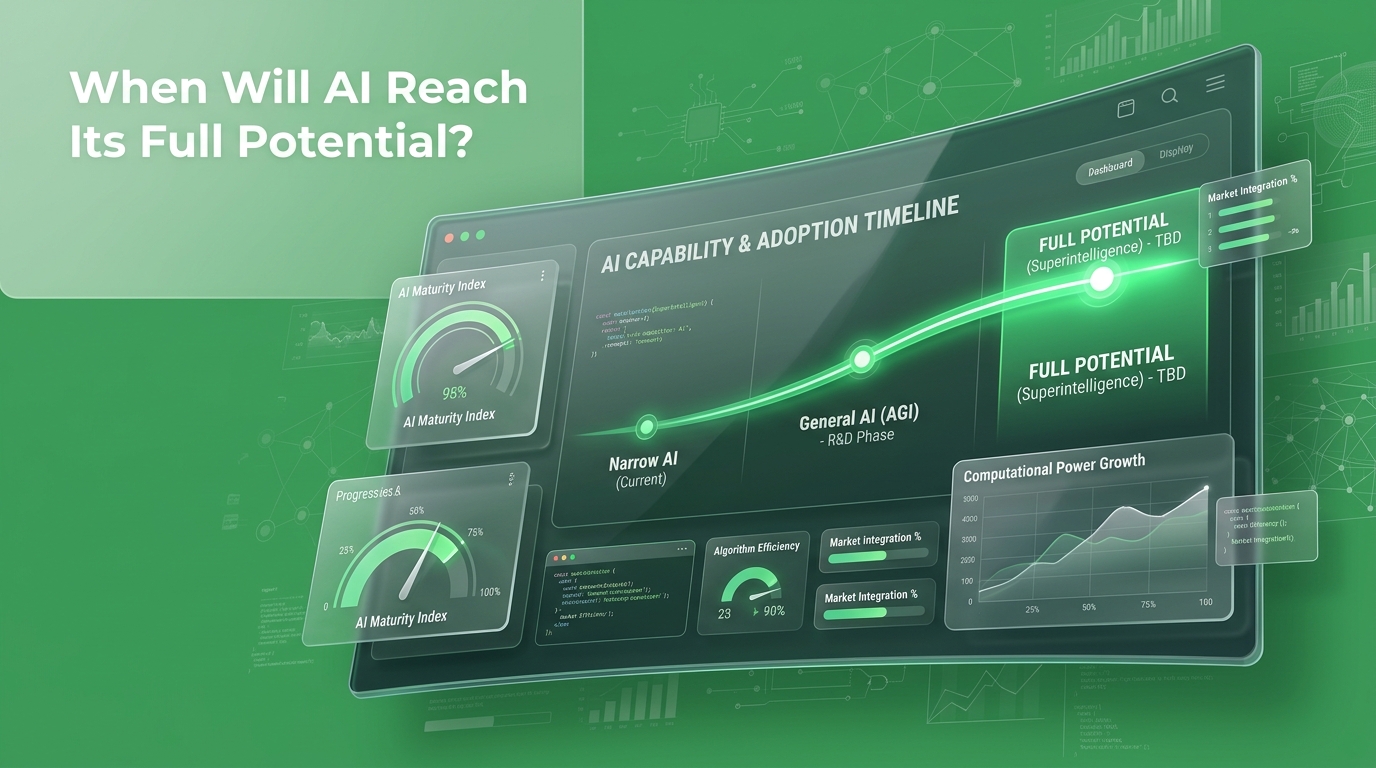
Everyone keeps asking when AI will reach its “full potential.” Tech analysts have timelines. VCs have spreadsheets. Consultants have frameworks with names like “The AI Maturity Curve.”
And meanwhile, most business owners are sitting on the sidelines treating AI like a weather forecast watching, waiting, and doing very little about it.
Here’s the uncomfortable truth: the window to move early is closing faster than anyone predicted. The companies that will dominate the next decade aren’t waiting for “full potential.” They’re already building the systems, the workflows, and the competitive moats. Right now. This isn’t a think piece about the singularity. It’s a reality check about where AI actually is, where it’s going, and what that means for the way you run your business.
The uncomfortable truth in 2026 is this: AI has already reached enough potential to completely reshape your business. The only thing still missing is your decision to use it. While competitors quietly build AI-powered systems that run 24/7, many business owners are still “watching the space.” Stop waiting for perfection. The gap between early movers and late adopters is widening fast and it won’t close. The real question isn’t when AI will be ready. It’s whether you are.
The “full potential” framing is broken. It implies a single finish line some future moment where everything clicks and AI finally delivers. That’s not how this works.
AI has already crossed milestones that would have seemed impossible five years ago. GPT-4-class models now perform in the top 10% on bar exam simulations. They answer roughly 90% of U.S. medical licensing questions correctly. On SWE-Bench a standardized coding benchmark AI systems went from solving 4.4% of problems in 2023 to 71.7% in 2024.
That’s not incremental. That’s a step change.
And the adoption numbers back this up. According to McKinsey’s 2025 State of AI survey, 78% of organizations now report using AI in at least one business function up from 55% just two years ago. In 2025, 27% of white-collar workers say they use AI tools frequently in their daily work, a 12-point jump from 2024. We’re not in the “early adopter” phase anymore. We’re in the phase where not using AI is the strategic risk. The mistake most businesses are making isn’t moving too fast. It’s confusing “I haven’t implemented this yet” with “it hasn’t arrived yet.” It has arrived. The question is whether you’re in it.
Here’s what nobody in the AI conversation admits loudly enough: the technology is ahead of the deployment.
McKinsey research estimates that today’s AI not future versions, what exists right now could theoretically automate approximately 57% of current U.S. work hours. But only 1% of company leaders describe their organizations as “mature” on the AI deployment spectrum.
Read that again. The capability is there for more than half of work to be AI-assisted. The deployment hasn’t happened. This is the gap that most conversations about “AI potential” completely miss. When people ask when AI will reach its full potential, they’re usually asking about capability. But capability isn’t the constraint. Deployment is. The bottleneck is organizational. It’s the business owner who sees a demo and says “that’s impressive” and then goes back to doing things the way they’ve always been done. It’s the marketing team running the same manual reporting process that AI could handle in seconds. It’s the operations leader still doing by hand what a predictive analytics system could surface automatically.
AI’s “full potential” will never arrive for businesses that are still waiting for permission to implement it.
Let’s get specific about where we’re going, because the forecasts are not gentle.
Forecasters on Metaculus a platform that aggregates hundreds of expert predictions put a 25% probability on AGI arriving by 2029 and a 50% probability by 2033. These aren’t fringe estimates. They reflect a broad consensus that has been consistently moving earlier over the last three years.
Stanford HAI data shows generative AI reached 53% adoption within three years of the first widely available product a pace that outstrips both the PC and the internet.
Meanwhile, investment is accelerating in lockstep. Goldman Sachs forecasts that AI could boost global labor productivity by more than 1 percentage point per year in the decade following widespread usage. McKinsey sizes the total long-term opportunity at $4.4 trillion in added productivity value from corporate use cases alone. But here’s the part that should make you sit up: 92% of companies say they plan to increase AI investment over the next three years, yet only 1% call themselves mature at it. That means nearly every company in your competitive landscape is pouring money into AI and still figuring out how to make it work. The advantage goes to whoever gets the implementation right, not just the investment.
The question for your business isn’t “when will AI be powerful enough?” It’s already powerful enough. The question is: what does your AI-powered operation actually look like?
This is where the data stops being theoretical and starts being about market share.
Industries with high AI exposure are already seeing labor productivity grow 4.8 times faster than the global average. Revenue per employee in AI-exposed sectors is running at 3x higher growth compared to sectors that are slower to adopt.
For businesses using AI in marketing specifically: 37% reduction in costs and a 39% increase in revenue. Sales teams using AI are reporting 78% shorter deal cycles. That’s not marginal improvement. That’s structural advantage. The gap between companies that have integrated AI-powered workflows into their operations and those that haven’t isn’t going to close it’s going to widen. The longer you wait, the bigger the ground you’re giving up.
We see this pattern in almost every audit we run at “TheMayk”. A business comes to us with a marketing operation that relies on guesswork manual content, reactive campaigns, analytics that get checked monthly. Meanwhile, their sharpest competitors have already built systems where behavioral data drives targeting in real time, content is personalized at scale, and the sales funnel surfaces opportunities before a human would even think to look.
The difference isn’t budget. It’s that one side made a decision.
Most businesses experience AI in the same three phases. Understanding them helps you skip the expensive middle one.
Experimentation: This is where most businesses are right now. Individual employees are using AI tools. Some teams have adopted a tool or two. There’s no unified strategy, no measurement, and no compounding. It feels like progress. It isn’t, not yet.
Reactive Integration: Something breaks. A competitor out-executes you. A client asks why you’re not using AI for conversion rate optimization or content. You scramble to bolt AI onto existing processes. The results are uneven because the foundation was built for a pre-AI workflow.
Systems Thinking: This is where the advantage lives. You’re not adding AI to how you work you’ve redesigned how you work around what AI makes possible. Every process has a feedback loop. Your marketing analytics are live, not lagging. Your personalization engines are doing work your human team couldn’t do manually if they tried.
The companies in Phase 3 right now aren’t smarter. They just committed to the transition earlier and did it with a system.

Here’s the reframe: stop thinking about AI’s full potential. Start thinking about your organization’s full potential with AI.
AI doesn’t have a single ceiling. It compounds. Every workflow you automate frees up human capacity for higher-order work. Every data system you build gives you better inputs for every subsequent decision. Every predictive model you deploy reduces guesswork and improves ROI. That compounding effect is already in motion for businesses that started early. And it doesn’t sto it accelerates.
The businesses asking “when will AI be ready?” are going to look back on this period the same way businesses that waited on the internet looked back on the 1990s. The moment was obvious in hindsight. It was just uncomfortable to act on in real time.
AI is ready. The only question worth asking now is whether your business is.
If your business is still in Phase 1, here’s a concrete starting framework.
List every repeatable task your team does weekly. Anything that’s routine, data-dependent, or involves pulling and compiling information is a candidate for AI replacement or assistance.
Don’t try to implement AI everywhere at once. Pick the highest-leverage workflow usually the one that’s draining the most team time or producing the most inconsistent results and build there first.
The businesses that get stuck in Phase 2 are the ones that treat AI as a content generator or task completer. Build your AI integrations so they feed data back into your systems. Every interaction should be making your next decision smarter.
The only way to know what AI is doing for your business is to have a baseline. Set your metrics before you implement. Volume, speed, cost, conversion whichever matters most to that workflow.
An AI tool that one team member uses occasionally isn’t a competitive advantage. An AI workflow that runs automatically and informs your sales funnel decisions every day is.
This is the exact audit process we run with every new client before recommending a single tool or system. What’s broken, what’s slow, and where is the data either not being captured or not being used? The answers to those three questions tell you exactly where AI has the most immediate impact.
AI’s full potential isn’t a future event. It’s an ongoing process, and the businesses writing the success stories of the next decade are the ones in it right now. The window isn’t closed. But it’s not as wide as it was two years ago and it’ll be narrower in two years more.
If you’re ready to stop treating AI as a future consideration and start building the systems that compound, let’s talk. We’ll show you exactly where your operation is leaking potential and what an AI-powered workflow looks like for your specific business.
Because in 2026, the difference between “stuck at impressive demo” and “truly transformative” isn’t your model or tech stack it’s the human strategy behind it. Let’s turn your collection of AI experiments and digital ghost towns into a genuine intelligence-powered growth machine.
How to Avoid Regret Buying the Xbox Nano Controller The Xbox Nano Controller is $49.99, pocket-sized, and open for pre-order. The headlines make it sound like…
Is the Xbox Nano Controller Actually Comfortable? You’ve read the headlines: five inches, 3.5 ounces, $49.99, all 18 inputs. Everyone’s calling it cute. Nobody’s answered the…
How to Master Social Media Marketing Fast You are posting three times a week on Instagram and LinkedIn. Your designer makes pristine templates, and your team…
How we use your info: Used strictly to review your project, prepare tailored insights, and reach out for a 1-on-1 strategy call. Zero spam, zero shared data.