
How to Avoid Regret Buying the Xbox Nano Controller
How to Avoid Regret Buying the Xbox Nano Controller The Xbox Nano Controller is $49.99, pocket-sized, and open for pre-order. The headlines make it sound like…
Every brand has AI now. They’re scheduling posts with it. Writing ad copy with it. Generating email sequences with it. The tools are practically the same. The prompts are basically the same. And the output? You already know it’s starting to feel the same.
Here’s what nobody wants to say out loud in a marketing meeting: when everyone uses the same AI, the content converges. And when content converges, your audience stops seeing you.
That’s the real crisis in AI marketing right now. Not whether AI works it does. The crisis is brands letting AI swallow their voice whole, and wondering why engagement is declining when posting frequency has never been higher.
This is exactly the problem we solve at THEMAYK. And the solution isn’t less AI. It’s building what AI can’t fake.
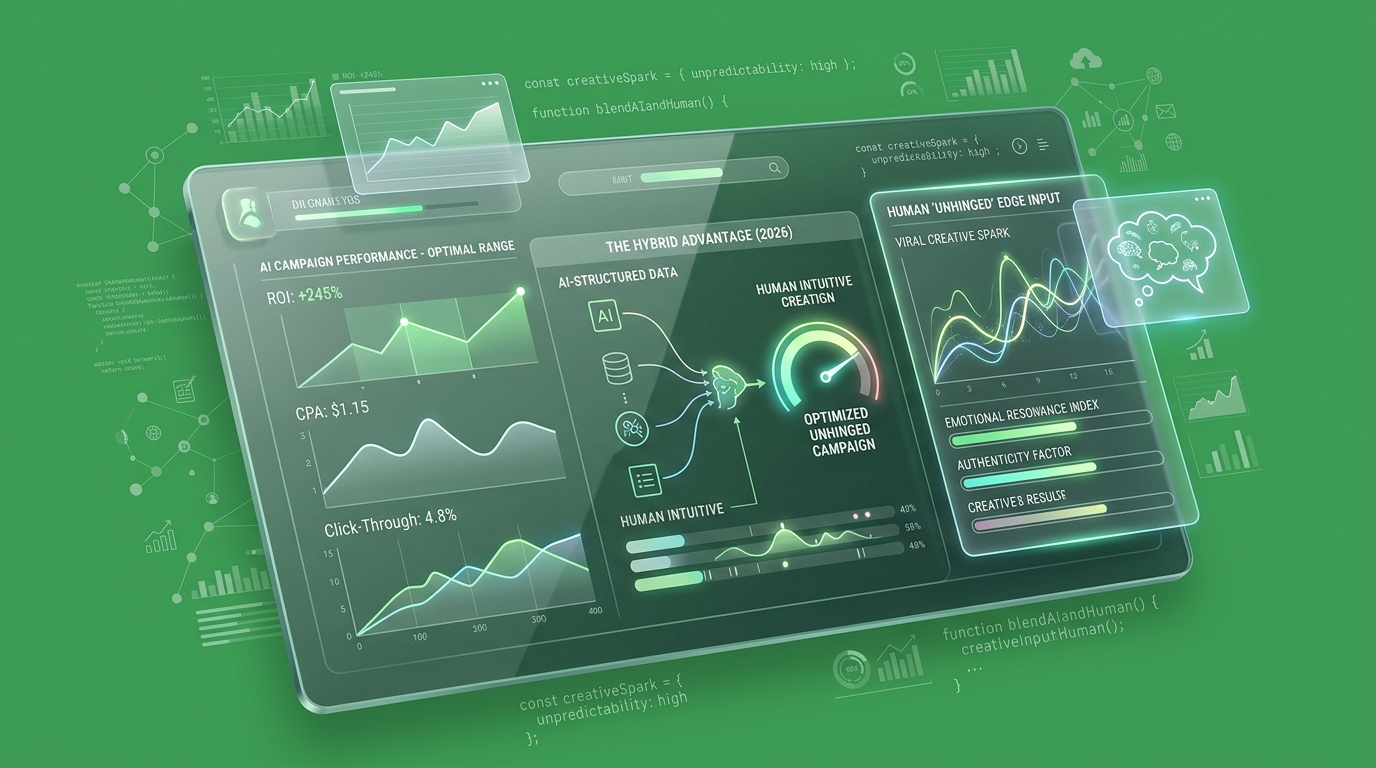
In 2026, AI has become table stakes. Every brand is pumping out content at record speed. Yet most of it blends into the noise. The real differentiator isn’t who uses AI better it’s who refuses to let AI dilute their personality. While your competitors sound like polished robots, the memorable brands sound dangerously human. That edge isn’t generated. It’s guarded. And it’s becoming the rarest advantage in marketing today.
In 2025, AI-generated articles surpassed human-written content online for the first time, according to Hootsuite’s Social Trends 2026 report. Let that land for a second. More AI content than human content. Not slightly more more, across every platform, every category, every niche your customer is scrolling through.
Your audience is swimming in it. Every feed. Every inbox. Every ad break. Every Google result.
And here’s what that’s doing to trust: a Meltwater and YouGov study of nearly 10,000 people across seven global markets found that 51% of consumers feel uncertain or skeptical about a future shaped by generative AI, while only 39% are genuinely excited. That’s not a fringe reaction. That’s your customer’s baseline emotional state when they encounter your content.
They’re not scared of AI existing. They’re exhausted by AI content that feels like it was made for nobody in particular.
And most of it was. That’s the honest truth. When an AI writes without a defined human personality behind it, it does exactly what it’s trained to do: it produces content that’s grammatically correct, structurally sound, and completely forgettable. There’s no edge. No opinion. No moment where a reader thinks, “okay, that’s actually a take.” Just well-formatted words that perform the idea of marketing without actually doing any.
Most brands in 2026 are moving fast and producing nothing that sticks.
Here’s the tension most marketing teams are actively avoiding.
AI helps you post more. More posts means more reach. More reach should mean more results. The logic tracks until you realize your audience has gotten extraordinarily fast at detecting content that wasn’t written by someone who actually cares.
Research from the Nuremberg Institute for Market Decisions confirmed what many marketers are starting to feel in practice: when content is perceived as AI-generated, consumers rate it as less natural, less useful, and significantly less worth engaging with even when the content itself is identical to human-written material. The perception of automation alone changes the outcome.
But here’s the sharper problem: your audience doesn’t need a label. They can feel it.
The passive scroll. The skim without a comment. The follow without fervor. Generic AI content doesn’t lose it just never wins. It’s consistent. Predictable. Safe. And it’s quietly teaching your audience that your brand has nothing new to say. Volume without voice is just noise with a posting schedule. And right now, brands are losing ground not because their AI is bad but because nobody in the workflow is asking the human questions. What would make our audience feel something? What would make a competitor uncomfortable? What’s the one angle in this piece that nobody else would dare take?
Those questions can’t be prompted. They have to be lived.
Let’s talk about Brita for a moment.
A water filter brand. Not exactly a category you’d associate with obsession or cultural cachet. But in 2025, Brita’s social team made a ruthless, deliberate decision: go full “unhinged.” They built a chaotic, serialized persona that had almost nothing to do with hydration and everything to do with a distinct human sensibility.
The result: a single post drove 3 million views and over 500,000 engagements. Users were commenting “would love a Brita for Christmas.” AdAge wrote about the social team by name. The brand went from commodity to character.
That’s not an accident. That’s a human being with deep brand knowledge making a call that an AI, optimizing for format and precedent, would never make.
Duolingo did it. Aldi UK does it consistently. And here’s what every one of these brands has in common: the “unhinged” element was not outsourced to an AI it was a human obsession about audience, voice, and timing that AI then helped distribute at scale.
That’s the distinction most brands miss. They see the viral result and try to replicate the format. They miss the foundational human judgment that made the format work and they end up with AI-generated “quirky” content that’s painful to read. AI can help you scale the unhinged content. It can’t decide what “unhinged” means for your brand. That is a human call. And it’s the most important call you make in 2026.
At THEMAYK, we’ve run enough AI-powered growth systems to know one thing with certainty: the brands that win aren’t the ones who automate the most. They’re the ones who automate strategically and protect the human layer with obsessive precision.
Here’s the exact framework we use to make sure our clients’ AI marketing still hits like it was written by someone who genuinely gives a damn.
Before we open a single AI platform, we establish what we call the brand’s Unhinged Frequency the specific emotional register, vocabulary, cultural references, and fault lines that belong only to that brand. This isn’t a tone-of-voice doc. It’s a personality map. What would this brand say about a competitor’s campaign? What would it never say? What would make its audience snort-laugh at 11pm? What would make them stop scrolling mid-bite?
AI can generate content within a frequency you define for it. It absolutely cannot define the frequency for you.
Most teams give AI a brief. We give it a voice document a curated archive of the brand’s best-performing human content, specific vocabulary choices, unpublished internal references, and tone examples that could not have been default-generated.
When you feed AI your voice rather than a category prompt, the output sounds like you. Not like every other DTC brand using the same free template.
The edge line is the one sentence in every piece of content that makes it worth sharing. The line someone screenshots. The sentence that makes a competitor wince.
We write this manually. No exceptions, no shortcuts. AI builds the content architecture around the edge line. The edge line itself is human work.
There’s a version of AI that’s extraordinary: scheduling, A/B testing subject lines, analysing optimal posting windows, repurposing long-form into short-form across six platforms in thirty minutes. We use AI for exactly this.
What we don’t use it for: deciding the angle, the opinion, or the first sentence of anything that represents the brand publicly.
Before AI-produced content goes live, it runs through our human filter. Not for grammar. For soul.
The question isn’t whether the content is correct it’s whether a real person at this company would actually say it out loud. If the answer is “technically, yes” it fails. It needs to be “obviously, yes.”
Generic AI content references generic results. Our content references specific CPL improvements, actual audience responses, real campaign numbers, and the kind of granular detail that signals unmistakably that a human who knows this business wrote this.
We build content around real data from inside the client’s world. Not invented specificity. Not marketing fiction. Real numbers, real moments, real stakes.
We build what we call a Feral Day into every client’s content calendar. One day per month where the format breaks. The content does something unexpected. A human with brand context makes a call fast and puts something out that the algorithm didn’t predict and couldn’t have generated.
No AI brief. No committee approval. A real person making a real bet on what their audience will feel.
The brands that become obsessions have a Feral Day. The brands that become furniture don’t.
Here’s where this lands commercially.
When everyone runs the same tools same prompts, same scheduling systems, same output formats the only thing left that can’t be replicated is the genuine human signature inside the work. The opinion nobody else would take. The reference only your audience would get. The tone that sounds like someone actually wrote it.
That human signature is now, without exaggeration, the scarcest asset in digital marketing.
Accenture’s Life Trends research found that 62% of consumers now name trust as a key factor in brand engagement up from 56% in 2023. Trust is trending up as a requirement precisely because AI content has made authentic, human-feeling content rarer.
The brands that protect their human voice inside AI-powered systems don’t just perform better on engagement metrics. They build the kind of brand equity that shows up months later in conversion rates, referral rates, and customers who lead sales conversations with “I’ve been following you for a while.” Nobody says that about a brand that sounds like a content machine.
They say it about a brand that made them feel something.
This is exactly the system we build at THEMAYK AI-powered growth infrastructure where the scale is automated and the soul is protected.
We’ve built these systems for DTC brands, scaling e-commerce operators, and Series A founders who’ve already burned budget on agencies that handed them a content calendar and called it a strategy. We know the difference between posting and positioning. We know what “unhinged” looks like when it’s built on brand intelligence versus when it’s just chaos with a caption.
If your brand is producing content consistently and wondering why nothing sticks, the problem isn’t your tools. It’s that nobody in the workflow is asking the human questions and there’s no system protecting the answer. We build that system. The results show up in the comments, the DMs, and eventually, the revenue.
Stop guessing. Start growing. Let’s talk at www.themayk.com/contact.
In 2026, AI will handle your marketing volume, but only human judgment can give your brand the unhinged edge that makes it unforgettable. The brands that win won’t be the ones using the most AI they’ll be the ones who protect their distinct human voice inside it.
At “TheMayk”, we build exactly that system: scalable AI infrastructure with an obsessive human core.
Stop blending in. Start building a brand people can’t ignore.
Let’s talk: www.themayk.com/contact
Because in 2026, the difference between a “No” and a “Yes” isn’t your tech stack it’s the human strategy behind it. Let’s turn your digital ghost town into a conversion machine.
How to Avoid Regret Buying the Xbox Nano Controller The Xbox Nano Controller is $49.99, pocket-sized, and open for pre-order. The headlines make it sound like…
Is the Xbox Nano Controller Actually Comfortable? You’ve read the headlines: five inches, 3.5 ounces, $49.99, all 18 inputs. Everyone’s calling it cute. Nobody’s answered the…
How to Master Social Media Marketing Fast You are posting three times a week on Instagram and LinkedIn. Your designer makes pristine templates, and your team…
How we use your info: Used strictly to review your project, prepare tailored insights, and reach out for a 1-on-1 strategy call. Zero spam, zero shared data.