
How to Avoid Regret Buying the Xbox Nano Controller
How to Avoid Regret Buying the Xbox Nano Controller The Xbox Nano Controller is $49.99, pocket-sized, and open for pre-order. The headlines make it sound like…
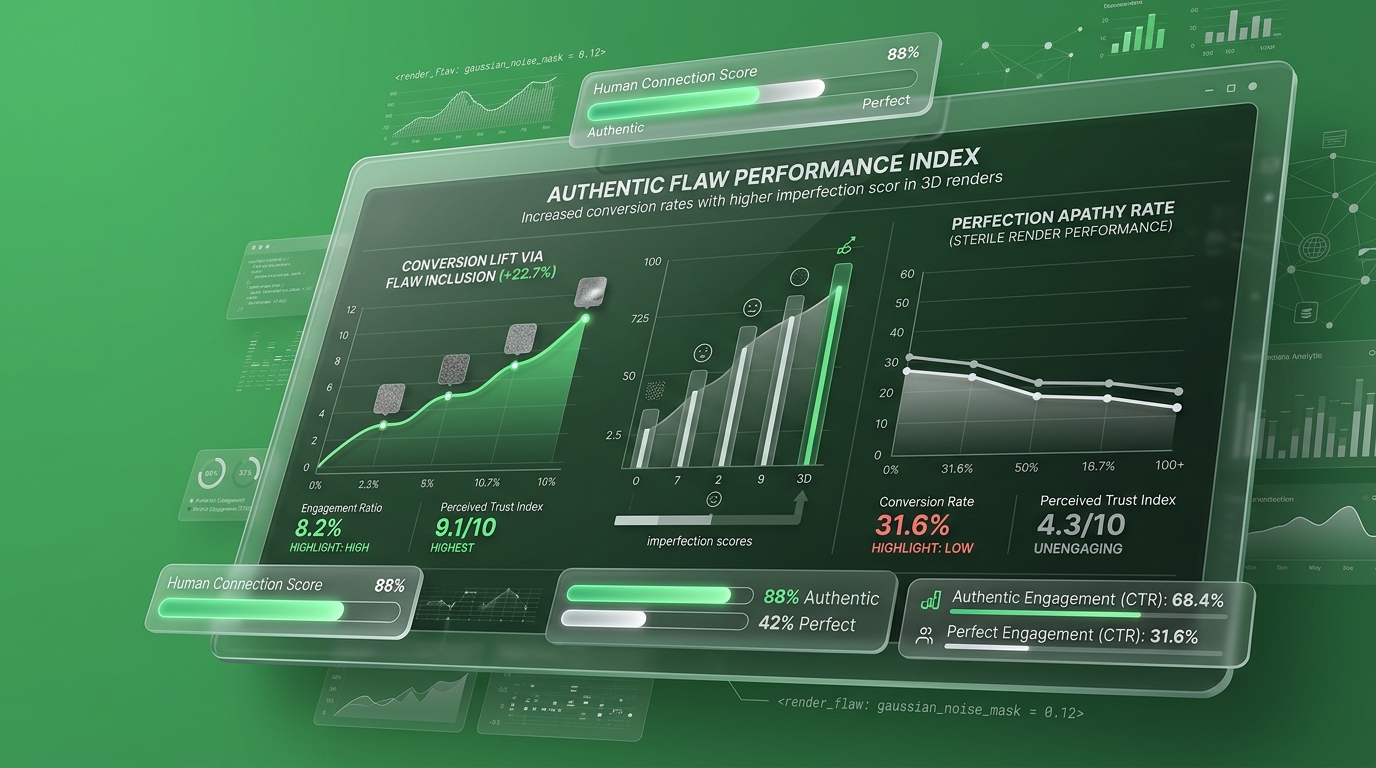
The 3D product visualization industry has a dirty secret: it’s too good. We’ve reached a point where software can render a perfume bottle or a watch with such mathematical precision that the human eye starts to reject it. Your brain sees a surface without a single microscopic scratch or a light reflection that is physically impossible in the real world, and it quietly labels the product as “fake.” Most e-commerce founders think “better” 3D means “smoother” 3D. They want every edge sharp, every texture uniform, and every shadow perfectly calculated. But in the pursuit of digital perfection, they are accidentally triggering the “Uncanny Valley” of product marketing a space where something looks so close to real, but is just “off” enough to feel untrustworthy.
Here is the counter-intuitive truth: The most effective 3D renders are the ones that include “authentic flaws.” When we deliberately introduce microscopic dust, subtle surface imperfections, or “unbalanced” lighting into a render, conversion rates actually climb.
Most e-commerce founders believe digital perfection signals quality, but the human brain is hardwired to detect and distrust anything that looks too sterile. When a 3D render lacks natural friction, microscopic dust, or lighting inconsistencies, it triggers a “fake” alert in the viewer’s subconscious. These subtle, authentic flaws are the primary trust signals that drive conversion.
Humans evolved in a world of friction, wear, and organic chaos. Our survival once depended on recognizing natural patterns, and as a result, the human brain is an elite-level “fake” detector. When you present a product in a 3D environment that is digitally sterile, you aren’t showing quality you’re showing a lack of reality.
Research into the Uncanny Valley effect, a term coined by roboticist Masahiro Mori and further explored by researchers at the University of California, San Francisco, shows that as an object becomes nearly indistinguishable from a human or real-world object, our emotional response shifts from empathy to revulsion. In 3D product visualization, this manifests as a “gut feeling” that the product isn’t quite right.
If a customer feels, even subconsciously, that the image they are looking at is a fabrication, that skepticism bleeds into the product itself. They don’t just doubt the image; they doubt the material, the durability, and the brand behind it.
In the world of 3D and motion design, we see brands spending thousands on “perfect” renders that underperform compared to raw, unpolished UGC. The reason isn’t that people prefer low quality it’s that they prefer credibility. A 2025 study on consumer psychology and perceived authenticity suggests that “imperfection” signals that a product exists in physical space. It’s the difference between a render that looks like a CAD file and one that looks like a photograph. When we work on brand and design strategy for e-commerce, we look for the “tactile signal.” If you’re selling a leather bag, the render shouldn’t show a uniform surface; it should show the slight pull of the stitching and the natural variation in the grain. Those aren’t “errors” they are the trust signals that confirm the product is real.
How do you fix a render that looks too digital? You break it. At “TheMayk”, our AI and innovation workflows often include a “de-perfection” phase where we add layers of reality back into the digital file.
Here is how we use “flaws” to drive conversion rate optimization (CRO):
No glass or metal surface is perfectly smooth. Adding subtle “surface noise” or microscopic scuffing makes the light hit the product in a way that feels familiar to the eye.
Studio lighting in the real world is messy. If your 3D lighting is mathematically “even,” it looks like a video game from 2010. We use HDRI environments that mimic real rooms with real, imperfect light bounces.
Fabric should have “fuzz” or stray fibers. Metal should have faint fingerprint smudges. These tiny details tell the brain, “This is a physical object I can touch.”
In photography, not everything is in sharp focus. Using a shallow depth of field in 3D renders mimics the way a real camera lens works, immediately elevating the “pro-photography” feel of the image.
A render that looks “too clean” looks like a lie.
Most agencies will give you a render that is technically perfect but emotionally empty. They focus on the software output rather than the human intake. But your marketing intel will eventually show you that “perfect” isn’t what sells presence is. When a product has “presence,” it feels heavy. It feels like it’s sitting on a desk, not floating in a vacuum. That sense of weight and reality is what bridges the gap between “just browsing” and “adding to cart.”
This is the exact philosophy we apply to product commercials and promos. We aren’t just making things look pretty; we’re making them look inevitable. If your current 3D assets feel like they’re missing that “something,” they probably are: they’re missing the flaws.
Stop Guessing. Start Growing.
If you’re ready to trade digital perfection for real-world results, let’s talk. Explore our 3D and motion services or book a strategy call today.
Perfection is a conversion killer because it looks like a lie. When your 3D renders are too clean, the brain triggers a “fake” alert, stalling the sale before it even begins. The most successful brands today are the ones brave enough to let their digital products look real scratches, dust, and all.
At “TheMayk”, we design for human psychology, not software benchmarks. We build strategic website experiences that use authentic imperfections to bridge the trust gap. If you want your products to move, stop making them look perfect and start making them look physical.
Reality sells. Precision just looks expensive.
Stop guessing. Let’s build a 3D system that actually converts. Book your strategy call at www.themayk.com.
Because in 2026, the difference between a “No” and a “Yes” isn’t your tech stack it’s the human strategy behind it. Let’s turn your digital ghost town into a conversion machine.
How to Avoid Regret Buying the Xbox Nano Controller The Xbox Nano Controller is $49.99, pocket-sized, and open for pre-order. The headlines make it sound like…
Is the Xbox Nano Controller Actually Comfortable? You’ve read the headlines: five inches, 3.5 ounces, $49.99, all 18 inputs. Everyone’s calling it cute. Nobody’s answered the…
How to Master Social Media Marketing Fast You are posting three times a week on Instagram and LinkedIn. Your designer makes pristine templates, and your team…
How we use your info: Used strictly to review your project, prepare tailored insights, and reach out for a 1-on-1 strategy call. Zero spam, zero shared data.