
Blogs > Great CTR, zero sales? The Meta ads disconnect nobody talks about

Great CTR, zero sales? The Meta ads disconnect nobody talks about

You invested in AI tools. You’re producing more content, faster. More ads, more emails, more posts than you could manage twelve months ago. And yet the results feel thinner. Your ads are getting clicks but not converting the way they used to. Your content is showing up but not earning the attention it deserves. Your brand is technically everywhere, and nothing is actually landing.

Here’s the uncomfortable truth: AI didn’t just speed up your marketing. It sped up everyone else’s, too. And when the entire industry is running on the same tools, the same templates, and the same output logic, your marketing doesn’t stand out. It disappears into a wall of stuff that all looks, sounds, and reads the same.

This isn’t a tools problem. It’s a sameness problem. And it’s getting worse.

The Paradox of High Engagement and Low Conversion

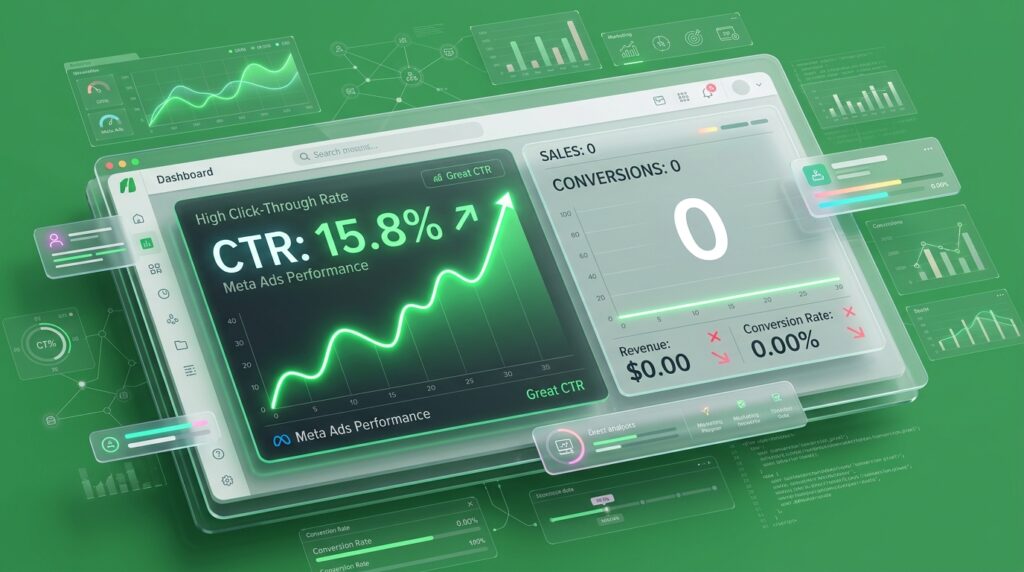
A soaring Click-Through Rate often masks a fundamental breakdown in the customer journey where creative appeal fails to translate into commercial intent. This disconnect suggests your ads are successfully harvesting attention but failing to qualify the buyer, attracting curious clickers instead of committed customers. Without aligning your ad’s promise with a seamless, high-trust landing page, you are simply paying for traffic that has no intention of ever reaching the checkout.

Everyone got the same tool and nobody noticed the trap

When AI writing and creative tools went mainstream, something shifted fast. Businesses that couldn’t afford content teams started publishing daily. Brands with no creative infrastructure suddenly had ad copy, email sequences, and blog posts at scale.

It looked like democratisation. In some ways, it was.

But research published on SSRN examining the ChatGPT ban in Italy in April 2023 found something marketers weren’t expecting. When small businesses lost access to AI, their Instagram marketing content became measurably more distinct lexical, syntactic, and semantic similarity all dropped. Consumer engagement went up by approximately 3.5% despite those businesses posting less frequently and at shorter length.

Read that again. Less content. More distinct content. Higher engagement.

AI didn’t just speed up output. It introduced a homogenisation effect that’s quietly eroding brand differentiation across every channel.

Your ad creative is blending in before anyone even reads it

This is where the sameness problem turns into a revenue problem.

When users can identify an ad as AI-generated, premium perception drops 17%, inspiration falls 19%, and purchase intent declines 14%. That’s not a minor dip. That’s nearly a fifth of your conversion potential disappearing because the creative felt machine-made.

The irony is that AI-generated ads can sometimes outperform human ads on click-through rate by as much as 12% in certain categories. But CTR isn’t revenue. What happens after the click is what matters. And when brand trust is already eroded by generic creative, that post-click journey gets harder to complete every time.

There’s also a platform-level pressure building beneath all of this. Meta and TikTok have been quietly down-ranking obvious AI creative in their 2026 ranking updates a pattern confirmed across multiple agency performance studies. The platforms themselves are responding to the sameness problem before most brands have even named it.

Your competitors aren’t just running the same ads as you. The algorithm is starting to notice and penalise it.

The real reason your content is losing traction isn't what you think

Most teams look at flattening traffic, falling engagement, or email open rates that won’t move. They respond by producing more. More headlines tested, more sends, more posts, more variations.

That’s solving the wrong problem.

According to eMarketer, 75% of content professionals say AI has increased the volume they produce and only 4% of marketers aren’t using AI for content at all. Think about what that means: nearly every brand, in nearly every industry, is producing higher volumes of AI-assisted content simultaneously, targeting the same audiences, on the same platforms.

The result isn’t a content-rich landscape. It’s a saturated one where the primary constraint has shifted from production capacity to differentiation. You don’t have a quantity problem. You have a distinctiveness problem.

Content saturation doesn’t mean people have more to read. It means they’ve trained themselves to ignore more of what they see.

Why your brand voice is the one thing AI actually can't copy

Here’s what most agencies won’t tell you because addressing it requires more than running the same prompts everyone else is running.

The brands cutting through AI saturation in 2026 aren’t abandoning the tools. They’re feeding AI with things those tools can’t generate on their own: proprietary data, specific client outcomes, real decisions made in real contexts, and a brand voice that doesn’t sound like it was assembled from a template.

AI generates the average of what it was trained on. Your brand’s advantage lives entirely in the specifics. The result you got for a client that no case study template can replicate. The opinion your team actually holds that pushes against industry consensus. The tone your customers recognise because it sounds like a human being with a point of view not a content system with a character count.

This is why content strategy and AI-powered content creation aren’t competing approaches. They only work together when the strategy is doing its job first. Without a clear, differentiated brand foundation, AI gives you a faster way to sound like everyone else.

The brands winning right now gave AI something specific to work with. The ones losing gave it a blank prompt.

What the data says about where attention is actually going

The attention problem isn’t evenly distributed. Some brands are holding or growing engagement. They’re not immune to AI saturation they’re solving it differently.

Q1 2026 generative AI adoption data shows 87% of marketers now use generative AI in at least one recurring workflow. But the teams maintaining performance aren’t the ones producing the most they’re the ones running human-led, AI-assisted workflows where AI handles speed and humans handle distinctiveness.

The metric shift that matters right now: stop tracking volume as a success signal. Brands producing fifty AI-generated pieces a month with flat engagement aren’t ahead. Brands producing fifteen pieces that carry original insight, specific data, and a recognisable voice are pulling away from them quietly.

The same logic applies to paid social advertising. Your audience has now seen thousands of AI-generated ads. They’ve developed pattern recognition for what those ads look and feel like. The creative that stops the scroll in 2026 is the one that breaks the pattern not the one that’s technically optimised to fit it.

Here's what breaking out of the sameness loop actually looks like

This isn’t about rejecting AI. It’s about using it with intention rather than as a substitute for thinking. Here’s the framework we use at THEMAYK when a brand’s marketing has started to blur into the background:

  1. Audit your brand’s distinct territory first. What specific perspective, result, or story does your brand own that no AI tool has access to? This is your raw material. If you can’t name it in a single sentence, your content has nothing specific to build from and AI will fill that gap with averages.
  2. Inject proprietary signals into every piece. Real client numbers. Actual test results. Decisions that didn’t work and why. This kind of content can’t be replicated by a competitor running the same prompts it requires access to your specific business and your specific outcomes.
  3. Use behavioural tracking to measure what’s actually landing. Not just page views or click-through rates scroll depth, attention time, on-site behaviour. Most teams are optimising for the wrong signal and calling it success. The data usually tells a different story.
  4. Tighten your creative brief before AI touches it. Generic inputs produce generic outputs. The brands extracting the most value from AI are the ones investing more time in the brief the specific angle, the audience’s specific frustration, the one thing the piece should make them feel. That level of specificity is what separates AI-assisted content from AI-automated content.
  5. Build differentiation into your conversion rate optimisation process. The funnel isn’t just a technical problem. If your landing pages sound like everyone else’s, your conversion rate will reflect that. Distinctiveness isn’t just a brand exercise it’s a direct performance driver.

Volume isn’t the answer. Specificity is. And specificity requires a human making decisions, not just a tool producing outputs. 

Your competitors are already noticing this most of them won't actually fix it

The brands that break through AI saturation over the next twelve months won’t be the ones that stop using AI. They’ll be the ones that stop using it as a replacement for strategic thinking.

There’s a real window right now. Most of your competitors are still producing more, faster. They’re watching engagement flatten and responding with higher volume. That feedback loop doesn’t end well and the ones still in it won’t realise it until it’s measurably expensive to fix.

The businesses pulling ahead are using predictive analytics and personalisation systems to understand what their specific audience responds to  not what performs on average and building creative that reflects that. They have a brand voice clear enough that AI enhances it rather than replaces it.

This is what we build at “TheMayk”. Not just content systems differentiated growth systems that don’t dissolve into the background when every competitor picks up the same tools.

If your marketing has started to sound like everyone else’s, let’s find out why and fix it. Book a free strategy call at www.themayk.com.

Stop guessing. Start growing.

Conclusion

Ultimately, a high CTR is a vanity metric if it doesn’t fuel your bottom line. To fix the disconnect, move beyond mere attention-grabbing and focus on qualifying your audience through transparent, high-intent creative. When you align your ad’s promise with a frictionless, high-trust post-click experience, you stop paying for empty curiosity and start driving the scalable growth your brand deserves.

See How Our Agency Grow Your Traffic Into Conversions

SEO – unlock sustainable growth with proven search strategies.
Content Strategy – magnetic content that earns links, shares, and brand authority.
Paid Media – precision campaigns built for measurable ROI.

Blogs

Great CTR, zero sales? The Meta ads disconnect nobody talks about

Great CTR, zero sales? The Meta ads disconnect nobody talks about You invested in AI tools. You’re producing more content, faster. More ads, more emails, more posts than you could manage twelve months ago. And yet the results feel thinner. Your ads are getting clicks but not converting the way they used to. Your content […]

How to rank in 2026 when everyone’s blog is AI-generated

How to rank in 2026 when everyone’s blog is AI-generated You hired a writer. Or maybe you just started using AI. Either way, you’ve been publishing. Regularly. And your traffic is… fine. Not growing. Not tanking. Just sitting there, doing nothing. Your content team keeps saying you need more blogs. Your agency keeps delivering them. […]

How to build a premium brand on a startup budget in 2026

How to build a premium brand on a startup budget in 2026 You’re pouring money into product development and customer acquisition, yet sales feel stuck. Prospects hit your site or see your ads and bounce without converting. They don’t complain out loud, but the signal is loud: this doesn’t feel premium. It feels like every […]

Contact Us