
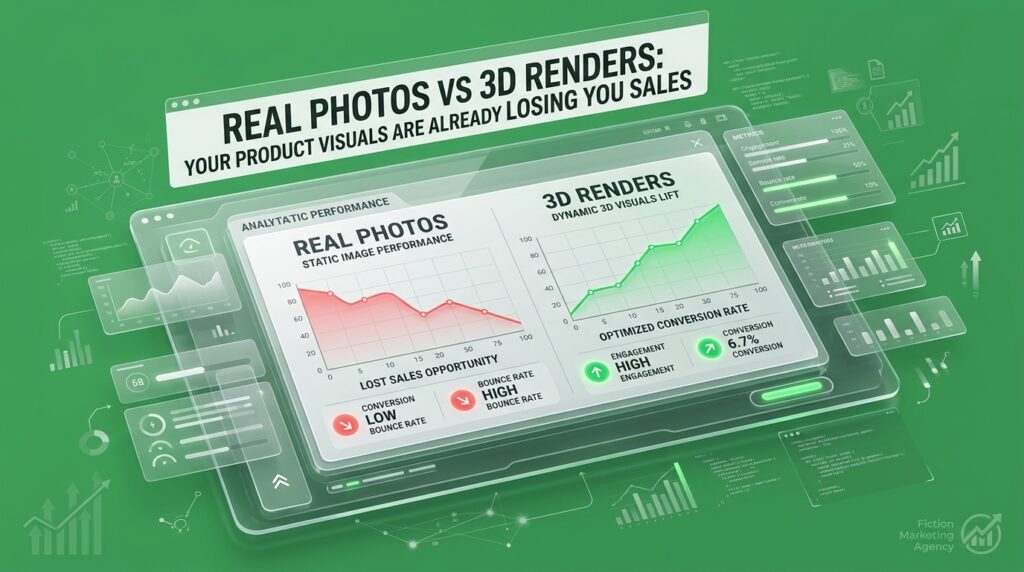
Blogs > Real photos vs 3D renders: your product visuals are already losing you sales

Real photos vs 3D renders: your product visuals are already losing you sales

You just launched a product. You’ve got studio shots clean background, good light, sharp edges. The product looks fine. The listing goes live.

And it sits there.

No one’s saying the photos are bad. They’re not. The problem is that ‘not bad’ stopped being enough somewhere around 2023. And right now, while your product page loads with three static angles, a competitor is showing customers every configuration, every texture, every lifestyle context on demand, at scale, without a single reshoot.

This isn’t a debate about aesthetics. It’s a question of what actually moves product in 2026. Let’s settle it properly.

Why 3D Renders Win the Long Game for Growing Brands

While photography captures a single moment, 3D visualization builds a permanent digital asset that works across every channel. You eliminate the endless cycle of expensive reshoots, lighting setups, and location scouting. Instead, you gain the agility to update textures, swap colors, and generate infinite lifestyle imagery instantly, ensuring your brand scales efficiently while maintaining a perfectly consistent aesthetic everywhere.

The photography argument isn't wrong it's just incomplete

Nobody’s saying ditch photography. Real photos carry something 3D renders have to work hard to replicate: credibility. When someone holds a product, photographs it in real light against a real surface, there’s a tactile honesty to the result. For certain categories food, fashion, luxury goods that authenticity matters. A beautifully shot leather wallet on a raw wood desk communicates something a render can’t always touch. Traditional photography also still leads in speed-to-publish for simple, single-SKU products. If you’re selling one candle in one colour, a proper studio shoot is cheaper up front and faster to turnaround.

But here’s where the argument breaks down.

Your product probably isn’t one colour. It probably has variants. It probably needs lifestyle imagery for three different platforms. It needs seasonal refreshes. It needs to show scale, context, and detail all in a single scroll. And every one of those needs, under the traditional model, means another shoot.

According to research compiled by CGI Backgrounds, 89% of ecommerce brands cite speed and cost as the primary factors when evaluating their visual content options. Photography wins the first shoot. 3D wins every shoot after that.

3D renders didn't just get better they changed what 'good' means

Five years ago, you could spot a render. Slightly too perfect. Lighting that didn’t quite land. A material that looked more like a description of leather than actual leather.

That’s not the conversation anymore.

Modern 3D product visualisation the kind we build at “THEMAYK” produces assets that consumers can’t reliably distinguish from studio photography. Not ‘good enough to pass.’ Actually indistinguishable. But the bigger shift isn’t realism. It’s utility.

A 3D asset isn’t an image. It’s infrastructure. Once the model is built, you can:

  • Swap every colour variant without reshooting
  • Drop it into any lifestyle environment kitchen, office, outdoor with a background change
  • Spin it into video, AR, or interactive 360° for the same campaign budget
  • Scale to 50 SKUs using the same base model

This is where the cost calculation flips. The first 3D render is more expensive than the first photograph. But the second, fifth, and fiftieth are nearly free. Brands using 3D visualisation report a 40% reduction in product returns because customers understand what they’re buying before it arrives. That’s not a UX win. That’s a margin win.

The conversion data most brands never actually look at

Here’s where the debate stops being theoretical.

Product pages that include 3D content see 94% higher conversion rates compared to those using only static imagery, based on data compiled by CGI Backgrounds from ecommerce research across major platforms. 82% of shoppers who encounter a 3D asset on a product page actively interact with it they don’t just scroll past. Compare that to a static photo. The shopper looks. They don’t touch. They don’t explore. They might convert or they might open another tab and find a product that answers more of their questions.

For context on the return side: McKinsey’s 2025 retail analysis found that products featuring 3D visualisation experienced 22% lower return rates than those using static imagery. For high-AOV products furniture, electronics, footwear that number has a direct line to your bottom line.

Photography can’t match this. Not because it’s low quality, but because it’s static. A static image answers the questions you thought to anticipate. A 3D asset answers the questions your customer didn’t know they had.

So, what's actually killing your product visuals right now

It’s probably not that you chose the wrong format.

It’s that you chose one format. And you applied it uniformly across a catalog that needs different things from different assets at different stages of the buyer journey.

Here’s what we see constantly in brands that come to us:

  • Hero images shot but no lifestyle context. The product exists on a white void. It answers ‘what does it look like’ but not ‘how does it fit into my life.’
  • Multiple variants, one visual. Five colourways, three photos. Customers are guessing what the navy version actually looks like in real light.
  • No interactivity on high-consideration products. A $400 piece of furniture with four angles. The customer has twelve questions. You’ve answered four.
  • Photography budget that can’t scale. Every new product launch triggers a new shoot conversation. The team starts cutting corners. The catalog gets inconsistent.

The problem isn’t the photo. The problem is the strategy built around one type of asset.


Reclaim Your Brand’s Premium Authority

Key Takeaway

The hybrid model is what actually wins in 2026

The answer isn’t ‘3D vs photography.’ That’s the wrong question.

The brands performing best right now aren’t picking sides. They’re using both deliberately, at different stages, for different jobs.

Here’s the framework we use when building visual strategy for product-led brands:

Use real photography for hero images and trust signals.

One or two genuine studio shots anchor the listing with authenticity. These are the images that appear in thumbnails, ads, and press. Real photography earns trust quickly at the top of the funnel.

Every colour option, every size, every surface built once, rendered infinitely. Lifestyle contexts across different room settings, outdoor scenes, and seasonal environments without booking locations.

For products where scale, fit, or texture matters this is where 3D product visualisation pays back the investment immediately. Customers who can place a product in their space via AR are dramatically less likely to return it.

The same 3D model feeds your product page, your paid social, your email, your Amazon listing, and your pitch deck. One asset, infinite variations. This is the content leverage that photography physically can’t provide.

According to 360 Render’s 2025 analysis of e-commerce visual strategy, the hybrid approach photography for hero images, rendering for variant and lifestyle imagery is increasingly the standard for growing brands. It’s not the premium option anymore. It’s becoming the baseline.

Most brands are still choosing. The sharp ones are combining.

At “TheMayk”, our 3D & Motion practice exists for exactly this problem. We build product visual systems that start with real photography where it earns trust, then scale with 3D assets that make a static catalog look like a platform.

We’ve done this for DTC brands, Shopify-native operators, and product launches that needed to hit multiple markets simultaneously. The results are consistent: better conversion, fewer returns, more content at lower marginal cost.

If you’re still treating your visual strategy as ‘let’s book a shoot,’ we need to talk.


Stop guessing what your product visuals should look like. Let’s build the system. Start a conversation at www.themayk.com.

Conclusion

In 2026, relying solely on photography isn’t just traditional, it’s a bottleneck to your growth. By integrating 3D visualization, you transform your product catalog from a static gallery into an interactive sales engine. Stop guessing which format wins and start building a visual system that scales. Ready to outshine the competition? Let’s build your system at www.themayk.com.

See How Our Agency Grow Your Traffic Into Conversions

SEO – unlock sustainable growth with proven search strategies.
Content Strategy – magnetic content that earns links, shares, and brand authority.
Paid Media – precision campaigns built for measurable ROI.

Blogs

$0 to $78K in 47 days: inside our Meta + TikTok ad playbook

$0 to $78K in 47 days: inside our Meta + TikTok ad playbook. You’re launching a new DTC brand or scaling an existing one. The Shopify store is live. Product photos look decent. You’ve got some inventory. Then you flip the switch on paid ads and… crickets. Or worse clicks that go nowhere and a […]

Real photos vs 3D renders: your product visuals are already losing you sales

Real photos vs 3D renders: your product visuals are already losing you sales You just launched a product. You’ve got studio shots clean background, good light, sharp edges. The product looks fine. The listing goes live. And it sits there. No one’s saying the photos are bad. They’re not. The problem is that ‘not bad’ […]

5 AI branding mistakes DTC founders make in 2026

5 costly AI branding mistakes DTC founders keep repeating in 2026 You didn’t start your brand to look like everyone else. But scroll any ad library right now and it’s the same thing on loop same layouts, same copy patterns, same “AI-polished” look that feels… slightly off. Not broken. Not ugly. Just forgettable. That’s the […]

Contact Us