
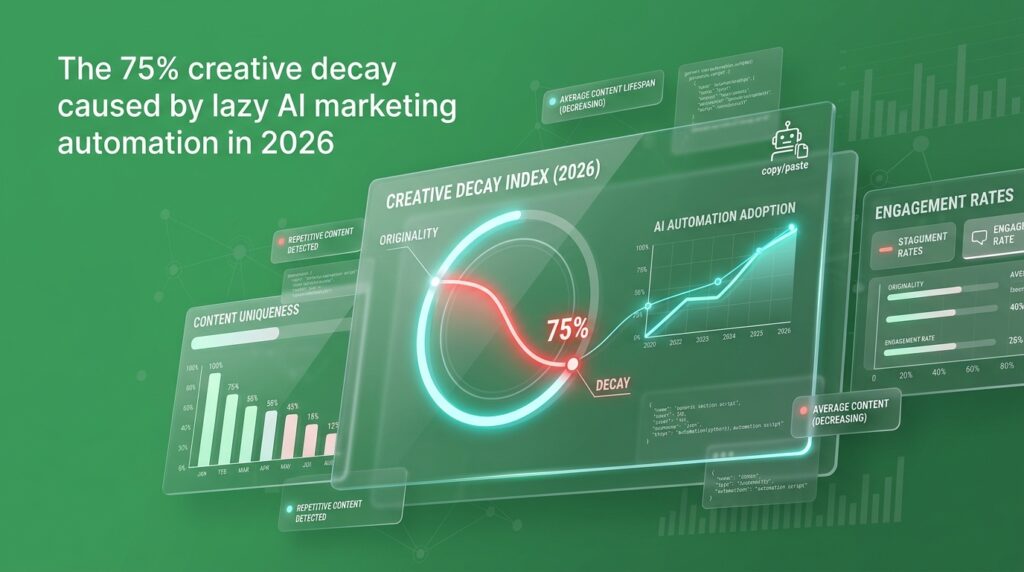
Blogs > The 75% creative decay caused by lazy AI marketing automation in 2026

Why your AI content strategy is actually training customers to ignore your brand

You’re publishing more content than ever. Your team is moving faster. Costs are down. And on the surface, the strategy looks like it’s working. But look closer at your engagement numbers over the last six months. Open rates trending flat. Social comments getting thinner. Returning visitors dropping. Your audience isn’t growing with you they’re tuning you out.

This isn’t a distribution problem. It’s not an algorithm problem. The content you’re pushing out is actively training your customers to stop paying attention to your brand.

Don’t Let Efficiency Become the Silent Killer of Your Brand’s Unique Voice and Long-Term Audience Trust

The uncomfortable truth is that your audience doesn’t actually hate technology; they just hate feeling like they’re being lectured by a robot. When you choose generic output over a distinct human perspective, you aren’t just saving time you’re actively training your customers to scroll past you. It’s time to stop blending in and start standing out.

Your content calendar is full, and your brand is disappearing

Here’s what’s actually happening.

Every piece of generic, templated, algorithmically-optimized content you publish teaches your audience something: this brand sounds like everything else. And once the brain files you in the “seen this before” category, it stops listening.

Neuroscientists call it the “pop-out effect.” For a brand, it works in reverse. Distinctive brands ones with a recognizable voice, consistent point of view, and unmistakable style get processed faster, remembered longer, and trusted more. Generic brands get scrolled past. The problem with most AI content strategies is they optimize for output, not distinctiveness. You end up with 20 blog posts that technically cover the right topics and hit the right keyword counts but read like they could have been published by any one of your competitors. Your brand becomes background noise.

Volume without distinctiveness is just noise at scale.

The trust penalty is already showing up in your data

This isn’t a theory. The research is clear and it’s getting sharper by the year.

A study by the Nuremberg Institute for Market Decisions (NIM), conducted across 1,000 respondents each in the US, UK, and Germany, found that labeling content as AI-generated led to more negative ad evaluations, decreased purchase intent, and reduced engagement even when the content quality was identical to human-made versions. Consumers saw it as less natural, less useful, less trustworthy.

And they’re getting better at spotting it. A Bynder study of 2,000 UK and US consumers found that half can correctly identify AI-generated copy. Millennials your most active buyers were the most accurate at detection. More telling even when consumers didn’t consciously know content was AI-generated, 52% reported they’d become less engaged if they suspected it. Twenty percent said AI social content made brands feel untrustworthy.

That’s not a fringe reaction. That’s most of your audience, quietly checking out.

There’s an even harder finding. A series of seven preregistered experiments published in the Journal of Business Research by Kirk and Givi (2025) demonstrated that when consumers believe emotional marketing communications were written by AI, it triggers what researchers call the “AI-authorship effect” reduced word of mouth and measurably lower customer loyalty, mediated by feelings of moral disgust. Not mild dissatisfaction. Disgust.

You’re not just losing attention. You’re training an emotional aversion to your brand.

What's actually going wrong and it's not the AI

Here’s what most people miss when they diagnose this problem: the AI isn’t the issue. The strategy is.

AI tools are neutral. They’ll write in your exact voice, reflect your brand’s point of view, generate content that’s unmistakably yours if that’s what you’ve instructed them to do. Most businesses haven’t done that work. They’ve handed the tool a topic and a keyword and called it a content strategy.

The result is content that’s technically correct and strategically vacant. It hits the right surface-level signals structure, length, keyword density while completely hollowing out the thing that makes your brand worth paying attention to: a distinct, human-intelligent perspective.

Research from the Ehrenberg-Bass Institute for Marketing Science has consistently shown that what drives brand recognition isn’t differentiation in the traditional sense it’s distinctiveness. The ability to be immediately identified by customers across every touchpoint. Consistent use of tone, perspective, and voice isn’t a “nice-to-have.” It’s what makes your brand mentally available when a buyer is ready to act.

Generic AI content destroys distinctiveness. Every templated post is a small erosion of the thing that makes your brand identifiable. And when your audience can’t reliably tell the difference between your content and your competitor’s? They stop caring enough to try.

You're training your customers the question is what you're teaching them

This is the insight most brands need to sit with: every piece of content you publish is a training event.

Behavioral conditioning works both ways. If your emails arrive and consistently deliver something sharp, opinionated, and distinctly yours your audience opens the next one faster. They start to associate your brand with “worth my time.” If your content arrives and consistently reads like a competent but characterless summary of a topic your audience trains themselves to skim. Then to skip. Then to unsubscribe, without really knowing why.

You don’t notice it happen. Open rates don’t collapse overnight. Engagement degrades slowly, over months, until one day you’re looking at a list that won’t move no matter what you do to the subject line. This is the compounding damage of an AI content strategy that optimizes for output over identity. It’s not just missed opportunity it’s active brand erosion. Every post that sounds like everyone else is buying down the trust equity you’ve worked to build.

What you’re publishing right now is either building your brand or eroding it. There’s no neutral.

Here's what a brand-protective AI content strategy actually looks like

This is fixable. But it requires a different frame AI as a production tool inside a human strategy, not as the strategy itself.

Define what you actually sound like specifically enough to replicate it

Most businesses can’t answer this question precisely. “We’re bold and professional” isn’t a voice. It’s a vague intention. Go back through your best-performing content the pieces that got real engagement, real replies, real shares and pull out the structural and tonal patterns. What’s the sentence rhythm? What opinions does the brand take? What does it refuse to say? What topics does it approach in a way no one else does?

That’s your voice document. Not a paragraph of adjectives a concrete, replicable pattern.

AI is exceptional at research, structure, first drafts, SEO optimization, and production efficiency. It should handle all of that. But it should be operating inside a defined strategic brief one that includes the brand’s specific point of view on the topic, the insight it wants to deliver, and the emotional register the piece should hit.

The brief should be harder to write than the article. That’s the point.

Most content audits look at traffic and ranking. They don’t look at the harder question: could this have been published by a competitor? Pull your last 20 pieces. If the honest answer to that question is “yes” for more than half of them, your brand is losing ground even if the traffic looks fine.

Work with your content strategy team to map the delta between “what we publish” and “what only we could publish.”

Generic AI content defaults to balanced, neutral, comprehensive. Those are the wrong defaults for a brand that wants to be remembered. Your brand should have positions. On your industry. On bad advice circulating in your space. On what clients are getting wrong and why. Opinion isn’t unprofessional it’s what separates a brand from a directory.

Use your AI-powered content creation tools to produce opinionated content at scale not neutral content at scale. That’s a different brief with a dramatically different output.

Watch for the signal that your audience is tuning out

Track engagement quality, not just engagement volume. Comments that are substantive. Replies that reference specific points. Shares with personal commentary attached. These are signals that your content is landing as yours, not as generic category content. If those signals are dropping while vanity metrics hold steady, you’re already in the erosion phase.

Use your behavioral tracking data to catch this early before the damage compounds.

Your content is either building a brand or training people to ignore one

At “TheMayk”, we see this pattern constantly when we audit new clients’ content systems. The volume is there. The calendar is full. The keywords are covered. And the brand has quietly become invisible not to the algorithm, but to the actual humans they’re trying to convert.

The fix isn’t less AI. It’s more strategy around the AI. It means knowing what your brand uniquely thinks, uniquely says, and uniquely delivers and making sure every piece of content, however it’s produced, reflects exactly that. Efficiency without identity isn’t a content strategy. It’s an expensive way to disappear.

If you’re not sure whether your content is building your brand or eroding it, that uncertainty is already an answer.

Stop guessing. Let’s build a system that actually works. Book a free audit call at www.themayk.com.

Key Takeaway

Conclusion

Efficiency is useless if it makes you invisible. When your content mirrors everyone else, you aren’t building a brand you’re creating background noise. To win, you must stop using AI to replace your voice and start using it to amplify your unique, human perspective. Give your audience something worth opening, or they’ll eventually stop looking for you altogether. Choose identity over output.

See How Our Agency Grow Your Traffic Into Conversions

SEO – unlock sustainable growth with proven search strategies.
Content Strategy – magnetic content that earns links, shares, and brand authority.
Paid Media – precision campaigns built for measurable ROI.

Blogs

Why 80% of startups fail by replacing creative strategy with automation

Why 80% of Startups Fail by Replacing Creative Strategy With Automation You bought the tools. You set up the workflows. Your team is running AI across content, emails, ads, and social. Output is up. Costs are down. Velocity is through the roof and your brand is disappearing in plain sight. This isn’t a story about […]

Why your AI-powered marketing is currently yielding a 0% conversion rate

Why Your AI-Powered Marketing Is Currently Yielding a 0% Conversion Rate You’re using AI to write your emails, generate your ad copy, and push out content three times a week. Your team is faster than ever. Your content calendar has never looked fuller. And your conversion rate is sitting somewhere between embarrassing and invisible. You’ve […]

The 75% creative decay caused by lazy AI marketing automation in 2026

Why your AI content strategy is actually training customers to ignore your brand You’re publishing more content than ever. Your team is moving faster. Costs are down. And on the surface, the strategy looks like it’s working. But look closer at your engagement numbers over the last six months. Open rates trending flat. Social comments […]

Contact Us