
Blogs > Why 90% of your 2026 ad spend is actually fueling your competitors

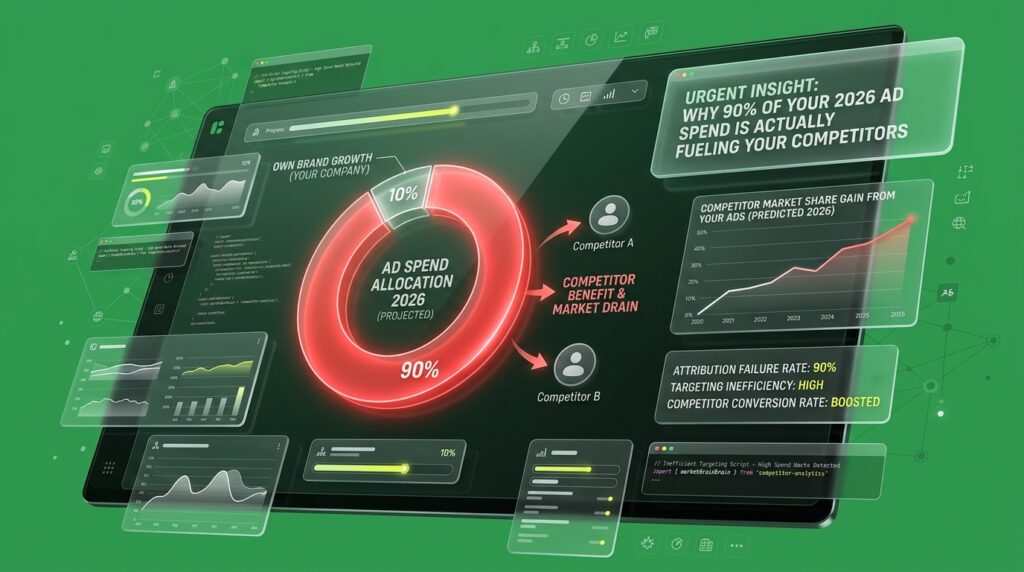
Why 90% of your 2026 ad spend is actually fueling your competitors

You raised your media budget this year. The results looked roughly the same.

Your agency sent a report with impressions and reach numbers. Your dashboard showed spend going out. Your ROAS stayed flat. And somewhere in another browser tab, a competitor running tighter campaigns, probably on a fraction of your budget quietly picked up the customers you just paid to reach.

This isn’t a media buying problem. It isn’t even an agency problem.

It’s a structural one. And the money is already gone before your ad ever touches a real person.

You’re Paying for the Click Your Competitor Is Closing the Sale

Every dollar you spend sparks intent but without speed and precision, that intent slips away. Platforms recycle your data, competitors move faster, and your funnel quietly leaks conversions. The brands winning right now aren’t louder they’re tighter, faster, and ruthlessly focused on turning attention into revenue before anyone else can.

Your ad budget isn't reaching customers it's feeding the machine

Here’s a number the ad industry doesn’t put in the headline slides it sends you.

According to the Association of National Advertisers’ Programmatic Transparency Benchmark Report, only 36 cents of every dollar that enters a demand side platform actually reaches a consumer as a viewable impression on quality inventory. The rest gets swallowed by intermediaries.

Twenty-nine percent goes to DSP and SSP fees. Another thirty-five percent disappears into non-viewable placements, made for advertising sites, invalid traffic, and inventory that is technically “served” but never seen by a real person.

That report tracked $123 million in real ad spend. It wasn’t theoretical. It was actual brand budgets.  Kimberly Clark, Mondelēz, Dell, Nissan going through the same pipes you’re using right now.

And it’s getting worse, not better. The ANA’s 2025 benchmark found that programmatic waste has risen 34% in just two years, now sitting at $26.8 billion annually. The industry fixed one problem and quietly created three more.

So, before you ask “why aren’t my ads performing,” the real question is: how much of that spend actually had a chance to perform?

The part where your budget literally trains your competitor's algorithm

This is the piece most business owners don’t know and it’s the one that costs the most once you see it.

When you run broad targeting on Meta or Google, you’re bidding on the same audiences as every other brand in your category. Every impression you buy, every click you generate, every behavioral signal you create gets fed back into the platform’s algorithm. It learns what your high-intent customer looks like.

And then it sells that same audience to your competitors.

Research from Stanford Graduate School of Business found that when a user visits your site and you don’t immediately retarget them, a competitor running aggressive retargeting on the same platforms will intercept them within hours. The study put it plainly: consumers who leave your website are likely to be a target of a competitor’s ad campaign the same day.

You spent money to pull someone into your funnel. They considered buying. They left. And then your ad spend the signals you generated, the cookies you set, the audience data you created got used to serve them your competitor’s offer.

That’s not a glitch. It’s how the system is designed.

You’re not just failing to convert. You’re actively building your competitor’s retargeting list.

Spending more on a broken foundation just breaks it faster

Most businesses respond to flat results the same way: increase the budget. It feels like the logical move. More reach, more shots at conversion.

But if the foundation your landing page, your funnel, your follow-up sequence isn’t converting what you already have, more spend is just more speed into the same wall.

Here’s the math. If your current landing page converts at 1.2% and you double your ad spend, you now have double the traffic failing to convert at 1.2%. Your cost per acquisition just doubled. Your competitor, who spent three months fixing their landing page and brought conversion to 2.8%, now acquires customers at less than half your cost  with the same ad platform, the same audience, and a smaller budget.

This isn’t a theory. Gartner’s 2025 CMO Spend Survey found that CMOs are already spending 31% of their total marketing budgets on paid media the highest share in years while simultaneously reporting that “CMOs are getting less for each media dollar they spent.” The spend is going up. The return per dollar is going down.

Ad costs aren’t helping either. Google’s cost per click rose 13% year over year in 2024, and Meta’s average ad price increased 10% in the same period. You’re paying more to reach the same person who’s increasingly likely to leave your funnel intact.

More budget into a broken system isn’t growth. It’s accelerated waste.

You're measuring reach when your competitor is measuring outcomes

Open the report your agency sent you last month. Count how many times you see the word “impressions.” Count how many times you see “cost per acquisition.”

That ratio tells you everything.

Vanity metrics impressions, reach, click through rate , are easy to produce and hard to argue with. They look like evidence of effort. But they don’t answer the only question that actually matters is how much did you sell for every dollar you spent?

Research from Rakuten Marketing cited by eMarketer found that marketers waste an average of 26% of their budgets on ineffective channels and strategies, with roughly half admitting to wasting at least 20%. The 2026 Demand Science report puts the average closer to 25% on activities that produce no measurable results.

Your competitor isn’t looking at impressions. They’re looking at which channel produced a customer at what cost with what lifetime value. They’re cutting the channels that can’t answer that question and doubling the ones that can.

The difference between those two businesses run on the same platforms in the same categories is often just measurement discipline.

You can’t optimise what you’re not tracking. And right now, most of your spend is invisible to you.

Your audience is being sold back to you at a markup

Here’s one more mechanism most business owners never think about.

When you run programmatic display campaigns, the kind that follow users around the web, your ads run on an average of 44,000 websites per campaign, according to the ANA’s own data. Not 44 carefully chosen, brand-safe, high-converting domains. Forty-four thousand.

Most of those placements are junk. Made for advertising sites. Content farms. Inventory that exists solely to collect ad dollars. Your ad runs. A bot “views” it. The impression is counted. The pixel fires. And you pay for an engagement that never happened.

The ANA’s data on this is unambiguous: the average campaign can reach 95% of its target audience using a few hundred websites. Instead, most brands are spreading spend across tens of thousands, paying a premium for the privilege of advertising to nobody.

Meanwhile, over 25% of every programmatic dollar is consumed by intermediary fees before your ad is ever served. DSPs, SSPs, ad exchanges, data management platforms, each one taking a cut before a single real person has seen anything.

You’re not running ads. You’re subsidising an industry that profits from your inability to see where your money goes.

So, here's what actually fixes it

None of this is fixed by switching platforms. It’s not fixed by hiring a new agency or launching a new creative. The problem is structural, and the fix is structural too.

Stop the bleed before you scale

Audit your current conversion rate before touching ad spend. If less than 2% of your traffic becomes a lead or a sale, the funnel is broken. Every additional dollar you put into traffic is a dollar accelerating that failure. Fix the foundation, the landing page, the messaging, the trust signals, before you run another campaign.

Our conversion rate optimisation work at ‘TheMayk” starts exactly here. We find where your existing traffic is already dying before we talk about driving more of it.

If you’re running programmatic display, ask your agency or DSP for a site-level breakdown of where your impressions are running. If the answer includes more than 500 domains, you’re paying for an audience that doesn’t exist. Consolidate to trusted, high-intent placements. Your CPM might increase slightly. Your effective cost per real impression will drop dramatically.

Stanford’s research on retargeting timing is clear: if you’re not advertising to a site visitor within the first week, you’ve likely already lost them to a competitor’s retargeting campaign. Your follow-up sequence needs to activate within 24–48 hours, not the following month when your campaign finally “optimises.”

If you don’t have an automated follow-up sequence in place, our sales funnel breakdown process maps exactly where those exits are happening and what needs to change.

Your agency should be able to tell you, with specificity, what each channel produced in revenue last month. Not estimated reach. Not click-through rates. Actual trackable outcomes tied to actual money. If that conversation hasn’t happened, the data doesn’t exist, and you’re flying blind.

Our marketing dashboards and analytics reporting are built for exactly this. If you can’t see it, you can’t fix it, and right now, most of your spend is invisible.

Get specific and stay there

The businesses that win on less budget aren’t doing more. They’re doing fewer things, on fewer platforms, aimed at fewer people, but with far more precision. One channel, understood completely. One audience, researched obsessively. One message, tested and tightened until it converts.

That’s the machine your competitor built. It doesn’t require a bigger budget. It requires a decision to stop spreading spend thin and start concentrating it.

The Audit that changes everything

This is the exact analysis we run for every new client at “TheMayk” before we touch a single campaign. We map where the budget is actually going, what percentage is reaching real people, where the funnel is leaking, and which channels are producing traceable revenue versus which ones are producing reports.

It takes about 48 hours. It almost always finds $X,000s in spend that’s either funding ad tech intermediaries, training competitor algorithms, or converting at a rate so low it would be cheaper to simply stop.

If your ad spend is going up and your results aren’t following, let’s find out exactly why. Book a strategy call at www.themayk.com. Stop guessing.

Conclusion

Your ad budget isn’t underperforming it’s being quietly diluted, redirected, and repurposed against you. Until you control where money flows, how audiences are captured, and what truly converts, growth will stay elusive. The advantage doesn’t go to bigger spenders it goes to sharper systems that turn every dollar into measurable, defensible outcomes.

See How Our Agency Grow Your Traffic Into Conversions

SEO – unlock sustainable growth with proven search strategies.
Content Strategy – magnetic content that earns links, shares, and brand authority.
Paid Media – precision campaigns built for measurable ROI.

Blogs

Why 90% of your 2026 ad spend is actually fueling your competitors

Why 90% of your 2026 ad spend is actually fueling your competitors You raised your media budget this year. The results looked roughly the same. Your agency sent a report with impressions and reach numbers. Your dashboard showed spend going out. Your ROAS stayed flat. And somewhere in another browser tab, a competitor running tighter […]

Why 8 out of 10 brands will disappear this year.

Why 8 out of 10 brands will disappear this year Havas’ 2025 data says 78% of brands could vanish tomorrow and nobody would notice. Here’s exactly why, and what separates the ones that survive. | themayk.com Most brands aren’t dying because the market is tough. They’re dying because they were never truly alive in the […]

Why Your Competitors Are Winning Even With a Smaller Budget.

Why your competitors are winning even with a smaller budget You raised your budget this quarter. Your results didn’t follow. Somewhere out there, a competitor you know has less money than you is showing up everywhere. Better ads. Sharper brand. More traction. More clients.  And you’re sitting here wondering what they figured out that you […]

Contact Us