
Blogs > Why 8 out of 10 brands will disappear this year.

Why 8 out of 10 brands will disappear this year

Havas’ 2025 data says 78% of brands could vanish tomorrow and nobody would notice. Here’s exactly why, and what separates the ones that survive. | themayk.com

Most brands aren’t dying because the market is tough.

They’re dying because they were never truly alive in the minds of their customers to begin with. They launched. They posted. They ran ads. They attended the right conversations. And when they disappeared, not a single person noticed the silence.

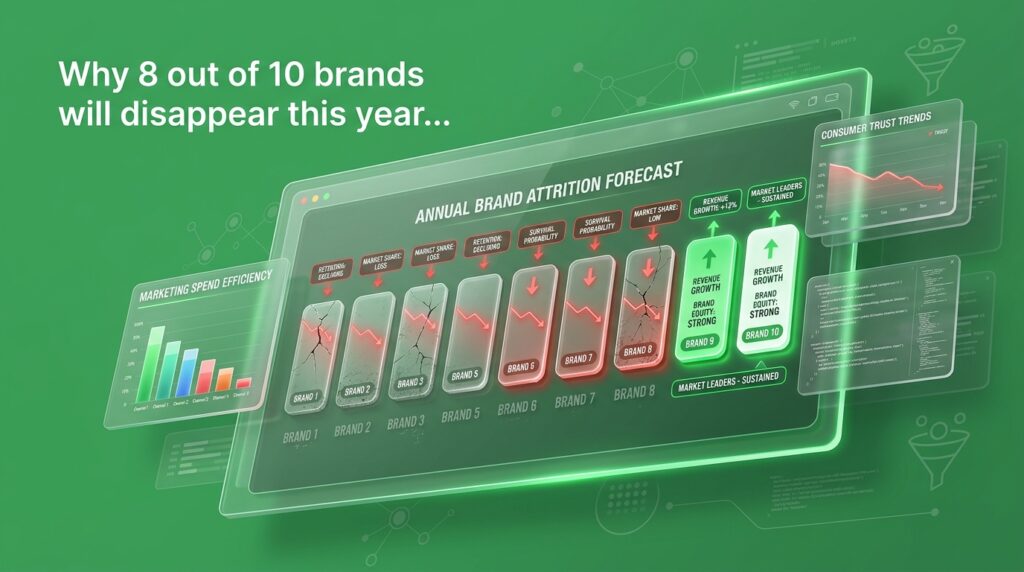
Havas’ 2025 Meaningful Brands study put a number on it: 78% of brands could vanish tomorrow and consumers simply wouldn’t care. That figure is up 5% year on year. Not a blip, a trend and it’s accelerating.

If you’re running a brand right now, that statistic is either irrelevant to you or it’s about you. There isn’t much in between.

Seen Everywhere, Remembered Nowhere: The Silent Death of Modern Brands

Most brands think they’re competing on creativity or budget, but the real battle is memory. If customers can’t recall you without seeing your logo, you’ve already lost ground. The surprising part? Small, focused brands often win this game not by shouting louder, but by standing sharper, clearer, and unmistakably different in a crowded feed.

Most brands are spending to be seen, not remembered

Here’s what’s actually happening in the market right now.

Business owners are putting real money into ads, content, SEO, and social media. The metrics look fine. Impressions are up. Reach is decent. The agency reports are full of charts that go in the right direction. But the customers aren’t buying. Or they’re buying once and not coming back. Or they’re buying from a competitor who spends half as much.

The reason is almost always the same thing “visibility without identity is just noise”.

When your customer sees your ad, then sees your competitor’s ad, and feels nothing distinguishable between the two, you haven’t lost to a better product. You’ve lost to a brand that made a stronger impression. And if your brand can’t make an impression, your media spend is essentially renting attention that doesn’t convert to memory.

According to Lippincott’s Brand Aperture research, after studying over 800 brands and surveying more than 100,000 consumers across nine countries, only 5% of brands are actually seen as unique by the people who use them. Not by people who’ve never heard of them. By their own customers.

5% That’s the fraction of brands that have done the hard work of becoming genuinely distinct. Everyone else is paying to be forgotten faster.

Your customers can't tell you apart, and you've been pretending that isn't true

Gartner’s research found that 46% of customers, nearly half, can’t tell the difference between most brands’ digital experiences. Same aesthetics. Same tone. Same offer structure. Same checkout flow. Same kind of Instagram grid.

What you’ve built starts to look a lot like everyone else’s. Not because you copied them. Because you optimized for the same benchmarks, followed the same trend reports, and hired agencies working from the same playbook. This is the trap most growing brands walk straight into. You focus on execution, post frequency, ad creative, landing page layout, without ever stepping back to ask: would someone remember this brand if the logo was removed?

Most wouldn’t.

A brand isn’t your logo. It isn’t your color palette. It isn’t your tagline. It’s the specific feeling a person gets when they encounter you, before they buy, during the purchase, and after. If you can’t define that feeling in two sentences, your customers definitely can’t feel it.

This is exactly why we see founders who’ve invested heavily in paid social advertising still hitting a ceiling ,not because their ads are wrong, but because the brand the ads are pointing to doesn’t give customers a reason to stay.

The brands that survive don't chase attention, they build gravity

 There’s a real difference between brands that attract customers and brands that hold them.

Attention is bought. Gravity is earned. And gravity is what turns a transaction into a relationship, a follower into a buyer, a buyer into someone who tells five other people.

The brands that are still here a decade from now have something in common. They didn’t try to win every channel. They didn’t react to every trend. They built a system, a clear position in the market, a consistent voice, and a product or service experience that matched both.

Consistent brand presentation increases revenue by 33%, according to research collated at the Ehrenberg-Bass Institute. Not brand awareness. Not brand recognition. Consistency. The unglamorous, unsexy discipline of showing up the same way every time, until customers can predict you, and predict themselves choosing you.

That consistency also compounds. The more recognizable your brand becomes, the less you pay to be noticed. The lower your cost per acquisition drops. The higher your customer lifetime value climbs.

The brands that disappear are the ones that never built that system. They treated every month as a fresh start, chasing whatever was performing right now, never building anything that held weight from one quarter to the next.

The three actual reasons a brand goes invisible

We’ve reviewed enough client accounts at THEMAYK to stop being surprised by the patterns. The businesses that are fading aren’t unlucky. They’re stuck in one of three specific failure modes.

  1. They have a presence, not a position.

There’s a difference between showing up and standing for something. A presence means you have accounts, campaigns, and content. A position means someone can finish this sentence about you: “They’re the brand that…” without hesitating.

Most brands have the first. Almost none have the second. And without a position, every campaign you run is trying to do too many jobs at once, awareness, consideration, trust, conversion, none of which it can do well.

  1. They’re optimizing the wrong thing.

Traffic without conversion rate optimization is expensive decoration. If your landing pages aren’t built to convert attention into action, more spend just means faster leakage. We’ve seen brands triple their ad budget and watch their return stay flat, not because the market didn’t respond, but because the experience customers arrived at wasn’t ready for them.

  1. They don’t know what their data is actually saying.

According to LendingTree’s analysis of U.S. Bureau of Labor Statistics data, 48.6% of businesses fail within five years. In most cases, the warning signs were there months before the collapse, in the data. Drop-off rates. Session behavior. Repeat purchase frequency. Customer acquisition cost trending the wrong direction. The businesses that catch these signals early survive. The ones that wait until revenue dips are almost always too late.

This is what our business and website analytics work is designed to surface, not vanity metrics that look good in presentations, but the specific data points that show you where customers are deciding against you, and what it would take to change that.

The ones that don't disappear did this differently

The surviving 22%, the brands consumers would actually miss, aren’t necessarily bigger or better funded. They’re more intentional.

They made a specific choice about who they exist for and built everything around that decision. Their content marketing strategy is anchored to that positioning, not chasing algorithms. Their SEO is built to attract the exact customer who would benefit most, not to rank for every possible keyword. Their product, their visual identity, their customer communications, they all say the same thing.

They also think longer. Most failing brands are optimizing for this quarter. Surviving brands are building assets, brand equity, customer loyalty, predictive analytics systems that help them spot opportunities before competitors do, that compound over time.

The uncomfortable truth is that most of what kills a brand isn’t one bad campaign. It’s years of diffuse effort that never added up to anything a customer could hold onto.

You can't out-spend that problem. You can only out-think it.

What to actually do with this

If you’re reading this and recognizing your brand in any of the above, the work isn’t complicated. But it does require honesty.

Run the logo test

Take your last three pieces of content, ads, posts, emails, and remove your logo. If a competitor’s logo could replace yours without anything feeling wrong, you don’t have a brand yet. You have content.

Not your tagline. Not your mission. One sentence that explains exactly who you’re for and what you do that no one else does in quite the same way.

Walk through your website, your checkout, your onboarding as if you’ve never heard of you. Every point of friction is a customer you’re losing. Every moment of confusion is trust you haven’t earned

If you’re acquiring customers but they’re not coming back, the problem isn’t your ads. It’s your brand experience. Fix what happens after the click before you spend another dollar driving traffic toward it.

Stop averaging your identity across channels

 A brand that behaves differently on every platform isn’t a brand, it’s a collection of disconnected campaigns. Decide who you are and hold to it everywhere.

Stop Leaking Revenue to "Optimized" Mediocrity

The ones that disappear had every chance not to

This isn’t a story about bad luck or tough markets.

The 78% of brands that could vanish without anyone noticing had the same opportunities as the ones that stayed. They had budgets. They had teams. They had channels. What they didn’t have was a reason for customers to care that was specific enough, consistent enough, and real enough to matter.The market doesn’t owe you a customer’s attention. But you can earn it, not by being louder, not by being everywhere, but by being the brand that someone can actually feel the difference of.

We work with founders and marketing teams at ‘TheMayk” who’ve reached that ceiling, spending is up, results aren’t moving, and something is clearly wrong but the dashboards won’t tell you what. We find it. And then we build the system that fixes it.

If your brand is showing up but not sticking, let’s figure out exactly why. Book a strategy call at www.themayk.com. Stop guessing.

Conclusion

Most brands fade because they lack clarity, consistency, and a distinct position in customers minds. Visibility alone isn’t enough. The brands that survive build lasting emotional connection, deliver consistent experiences, and turn attention into loyalty, making themselves impossible to ignore or replace.

See How Our Agency Grow Your Traffic Into Conversions

SEO – unlock sustainable growth with proven search strategies.
Content Strategy – magnetic content that earns links, shares, and brand authority.
Paid Media – precision campaigns built for measurable ROI.

Blogs

Why 90% of your 2026 ad spend is actually fueling your competitors

Why 90% of your 2026 ad spend is actually fueling your competitors You raised your media budget this year. The results looked roughly the same. Your agency sent a report with impressions and reach numbers. Your dashboard showed spend going out. Your ROAS stayed flat. And somewhere in another browser tab, a competitor running tighter […]

Why 8 out of 10 brands will disappear this year.

Why 8 out of 10 brands will disappear this year Havas’ 2025 data says 78% of brands could vanish tomorrow and nobody would notice. Here’s exactly why, and what separates the ones that survive. | themayk.com Most brands aren’t dying because the market is tough. They’re dying because they were never truly alive in the […]

Why Your Competitors Are Winning Even With a Smaller Budget.

Why your competitors are winning even with a smaller budget You raised your budget this quarter. Your results didn’t follow. Somewhere out there, a competitor you know has less money than you is showing up everywhere. Better ads. Sharper brand. More traction. More clients.  And you’re sitting here wondering what they figured out that you […]

Contact Us